
UCCE grape advisor studies effects of minimally maintaining vineyard blocks
Oversupply of grapes, plummeting consumer demand and skyrocketing production costs have led the wine industry to a crisis point.
“We have an economic downturn in the wine-grape market, and it is considerably worse or more intense compared to the historical ones within the memory of professionals active in viticulture right now,” said Christopher Chen, University of California Cooperative Extension viticulture advisor for Mendocino, Sonoma and Lake counties.
The severity of the situation has forced growers to consider a new way to weather the storm – vineyard “mothballing.” Also called idling or resting, it entails maintaining the vines with minimal labor and inputs (and not harvesting the fruit), with an eye toward rapidly ramping up production in the future.
During hard times, growers typically have two choices, either pull out their vines entirely and replant when the market improves or continue farming as usual, but at a loss. Mothballing might be attractive to some growers – such as those who want to preserve heritage vines – as a “middle road” approach.
The challenge at present, though, is the lack of a roadmap.
“I have not seen any good information on mothballing as a practice,” said Chase Thornhill, owner and general manager of Mendocino Wine Company in Ukiah. “I don’t know that there’s any information in the viticulture books on what to do if you’re tight on cash and the industry has collapsed. It doesn’t exist, and the industry really needs that playbook.”
While Chen observes that mothballing is still relatively rare, he said interest has grown dramatically. Virtually unheard of in his area three years ago, mothballing-type practices can now be seen in about 1 out of 20 vineyards.
According to Chen, mothballing was first done at scale in Australia, where growers rode out a severe downturn in the early 2000s. Very little academic research on the approach was conducted at that time, however, and now Chen is trying to fill in the gaps.
In 2025, he launched a study to systematically research the effects of mothballing. At four locations growing cabernet sauvignon and chardonnay in Sonoma and Mendocino counties, Chen is looking at the impacts of different “intensities” of mothballing with varying levels of irrigation and maintenance.
After collecting preliminary data last year, Chen and the collaborating managers plan to continue mothballing in 2026 and 2027 before attempting to return the vineyards to full production by 2029.
Growers must weigh costs, benefits of mothballing and restoring vineyards
Before choosing to mothball, of course, growers need the math to pencil out. At a basic level, that means estimating how much money they would save in vineyard management costs – and then how much it’s going to cost to “correct” the planned reduction in vineyard management as they return to production.
“That ‘cost now’ versus ‘expenses later’ calculation really determines whether it’s worth it or not to do mothballing,” Chen said. “That’s my primary concern.”
In his study, Chen is looking at costs and consequences of varying levels of mothballing intensity: 1) doing nothing except pest and disease management; 2) managing pests/disease and also pruning to keep the vines in shape; and 3) continuing to farm but without the “extraneous” practices intended to make the fruit appealing to buyers.
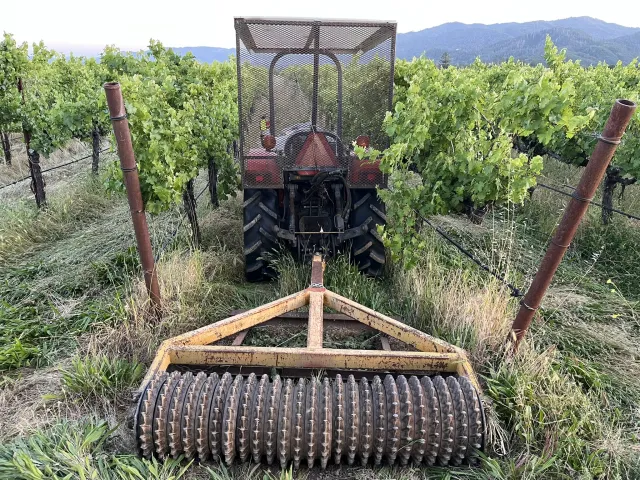
Last year, Chen studied a site at Mendocino Wine Company, where Thornhill chose a mothballing strategy with very little intervention – just irrigating, spraying for powdery mildew and rolling down cover crops into thatched “mats” on the ground (to reduce fire risks and protect the soil).
For Thornhill, it was a matter of simple economics. At the beginning of 2025, he knew that he was going to be unable to sell his fruit.
“If you’re not covering the farming costs with what you’re going to produce and then sell, you’re losing money,” said Thornhill, who has worked in the wine industry for 20 years. “And who can afford to lose money, especially now? That would risk jobs and risk the total enterprise.”
Estimating that it would cost $30K to $60K per acre to replant, Thornhill did not want to sacrifice his vines’ many future years of productive life just to save some money in the short term.
“We’ve got to strike a balance between preserving the asset – and not losing our shirt on that preservation,” said Thornhill, adding that he has returned those blocks to production and is waiting to evaluate the harvest later this year.
Chen: Pests surge, berries shrink in first year of mothballing
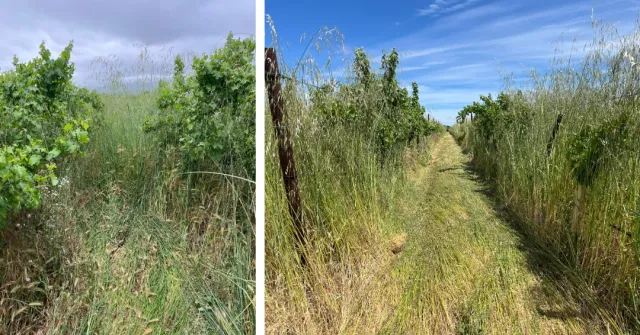
In the first year of his research, Chen already has made several significant observations. First, he wanted to see if pests would immediately return to the vineyard if a grower stopped managing the canopy and applying pesticides as they would under normal production – or whether there would still be some degree of control due to previous treatments.
“There isn’t,” Chen said. “We did see – immediately in the first year – a 44% increase in leaf hoppers, which is an easy way to count how many flying insect pests there are in the vineyard more generally.”
Secondly, on a more positive note, Chen observed that there didn’t appear to be any additional water stress on the vine as a result of not pruning or managing the canopy.
And third, he saw that berry development slowed under mothballing conditions. By eschewing pruning, there were more shoots and clusters and thus more berries, but they were smaller and with less sugar accumulation.
“If you plan to do this, you have to plan to not harvest,” Chen advised. “You can’t try to harvest because the quality of the fruit is not going to be typically acceptable to most wineries.”
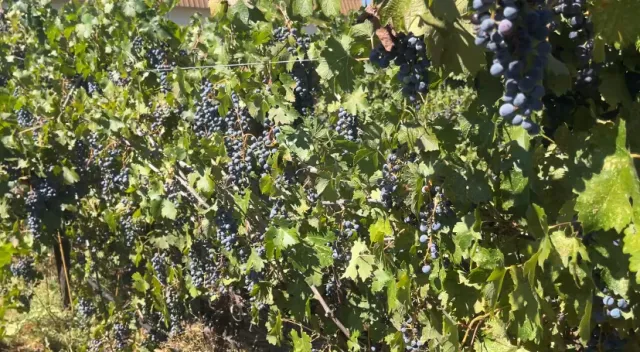
Disease and pest management must continue while mothballing, advisors warn
Another point of emphasis for viticulture experts is that growers must not consider mothballing a passive practice. George Zhuang, UCCE viticulture advisor for Fresno County, said his biggest worry with mothballing is potential neglect of pest and disease management due to a grower’s “laser-focus” on cutting costs.
“My concern is that the pest and disease issue becomes so enormous that when you decide to bring the vineyard back, it might not be possible,” said Zhuang, highlighting vine mealybug as one prominent threat.
Chen echoed that sentiment, emphasizing that mothballing is an active management process – and not a “set it and forget it” approach.
“You do have to go out and make sure that the pests and diseases are under control because that is a regulatory issue with the state and the county governments, and you will get fined and penalized for becoming a pest nuisance if you’re not careful,” said Chen. He added that growers should inform their neighbors that they are mothballing and not abandoning their vineyard, as the appearance of the vines and land look virtually identical under both conditions.
Furthermore, instead of cutting water and fertilizer “cold turkey” to a vineyard’s mothballed state, Chen recommends that growers gradually taper their applications.
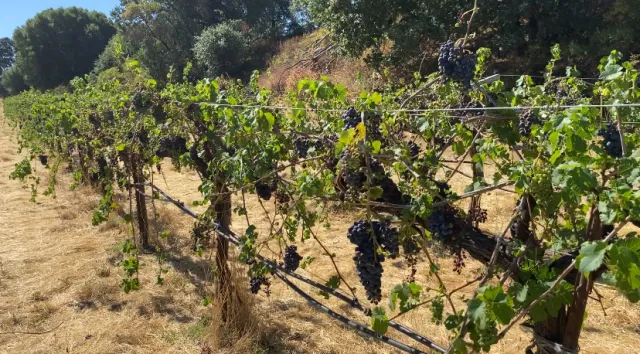
“The vines acclimate to those inputs year to year, so if they’re used to getting irrigation at high volumes every year, and if you stop water, you will cause permanent damage to those grapevines,” Chen warned.
Conversely, as a vineyard manager ramps up to normal production levels, they should not go to full irrigation right away, as that would cause unruly growth requiring intensive labor to correct, control and train.
Lastly, Chen advises growers to develop a year-by-year plan for mothballing their vineyards and returning them to full production. Based on their best prediction for future market conditions, they should devise a “reentry timeframe.”
“Plan when you are going to come back into production so that you can properly manage the resources and the vine health and the pruning and recovery period so that when you come back, it’s ready to go – rather than running into a bunch of walls,” he said.
Funding needed for research that answers growers’ crucial questions
Chen noted that mothballing might be a realistic option only for smaller operations, which are common in his region and encompass 15 to 40 acres on average. Many wine grape growers in the San Joaquin Valley, in contrast, farm hundreds of acres – making mothballing logistically more difficult and economically less viable.
Zhuang said growers also have to consider the opportunity costs of mothballing, especially in parts of the state where they could replace wine grapes with crops such as vegetables, almonds, pistachios or citrus. “If you do have a plan B, maybe vineyard mothballing is not really beneficial for you,” he said.
Chen and Zhuang said further economic analyses are needed for growers to make the best financial decisions. In addition to analyzing those tradeoffs, Chen hopes to examine the chemistry of the fruit throughout the mothballing process (Brix/sugar concentration and pH) and the practice’s effects on wine quality and taste.
While Chen is monitoring for leafhoppers, glassy-winged sharpshooters and other insects, he does not have funding to do spore counts for powdery mildew and Botrytis, two of the major fungal pathogens in vineyards. He would also like to examine impacts on soil health.
Although Chen is grateful for “in-kind” support from vineyard owners for access to study sites, he has not received external funds for this research to date. And to Thornhill and his peers in the wine industry, Chen’s “playbook” is a vital piece of information for growers, who are most concerned about the time to recovery after mothballing.
“I think that the general reaction is: ‘Wait a minute, what's going to happen?’ If we don't farm this year, does that mean that it’s going take us three years to get back to full capacity, just as if we were planting a new vineyard? Is it going to take two years? Just one?” Thornhill explained. “We just don’t know.”