
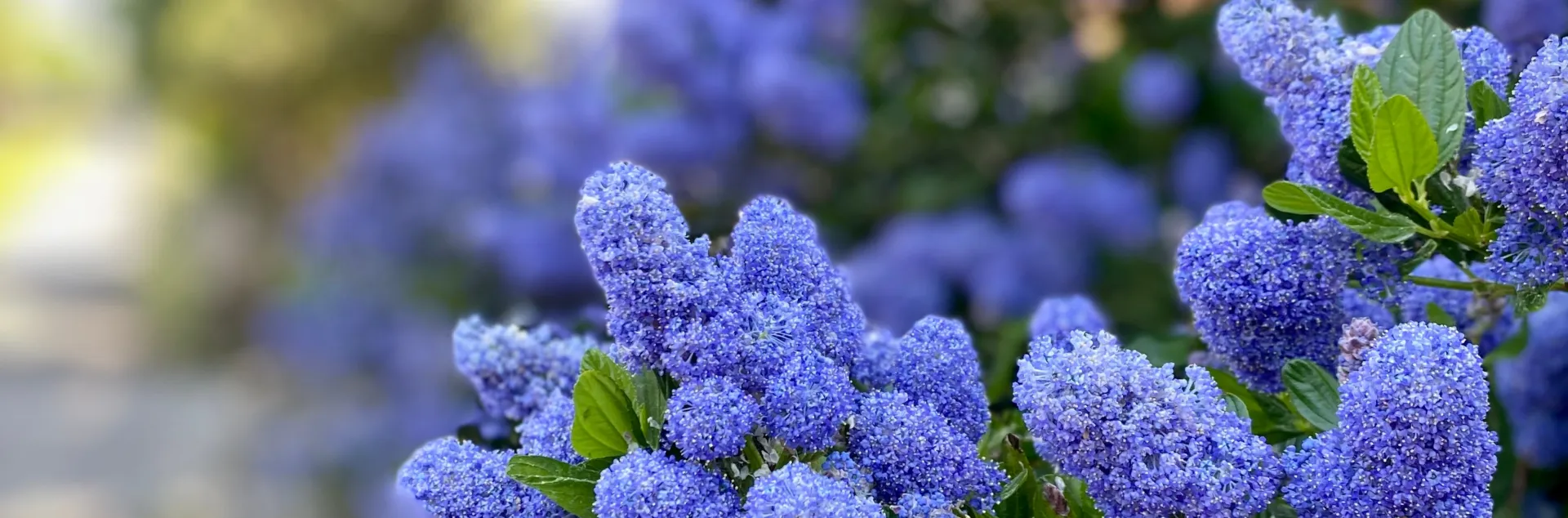
I’ve always loved that time in early spring when our hillsides are painted with great drifts of blue, lavender, and white Ceanothus, otherwise known as California Lilac. After many years of admiring them from afar, I plan to add some to my garden. In the meantime, here’s a bit of what I’ve learned so far about Ceanothus, which might convince you, too, to grow this hardy native.
Born to Thrive: Native Roots & Varieties
Ceanothus is primarily native to North America, with its undeniable heartland right here in California, home to over 50 unique species. In the rugged environment of the Sierra foothills, with our scorching, dry summers and chilly, wet winters, local varieties like Ceanothus cuneatus (Buckbrush) and Ceanothus integerrimus (Deer Brush) thrive effortlessly. Ceanothus is a drought-tolerant plant that ranges in form from groundcovers to tall bushes. Two showy, common hybrids are “Concha” and “Julia Phelps.”
Many ecologists consider Ceanothus a keystone species in California ecosystems, meaning it acts as a crucial hub for a massive network of local wildlife. Bees, butterflies and moths love the flowers, and small birds find the dense branches a great place to hide and build nests.
The plant is also a classic “fire follower.” Many species produce seeds with a tough outer coat that can lie dormant in the soil for decades, waiting for the intense heat of a wildfire to crack the shell and trigger germination.
Historical Roots
For the Central California Native Americans, Ceanothus was a multi-use resource. The flexible yet incredibly strong branches were highly prized for weaving intricate baskets. The flowers and fresh seed pods contain rich amounts of saponins, natural chemical compounds that foam when agitated. By rubbing the fresh blossoms with a little water, they created a gentle cleanser with a fresh, sweet scent.
In some western folklore, gold miners believed that where Ceanothus roots grew deepest into quartz veins, there were surely veins of gold to follow. And during the American Revolution, an eastern relative of our local shrub became famous as “New Jersey Tea.” When the colonists boycotted taxed British tea, they dried the leaves of Ceanothus as an herbal substitute.
Cultivation Tips
Growing Ceanothus is remarkably easy, provided you follow one golden rule: step away with the garden hose.
- Exposure: Plant in full sun. They crave the heat.
- Soil: Excellent drainage is non-negotiable. If you have heavy clay, plant them on a slope or a raised mound.
- Water: Once established (usually after their first summer), Ceanothus requires virtually no summer water. In fact, overwatering in hot weather might introduce a deadly root fungus.
- Bonus: As a nitrogen-fixing plant, Ceanothus actually improves the quality of the soil it's planted in.
To recreate a lovely, ecologically balanced Sierra landscape, pair Ceanothus with climate-matched companions like California Fuchsia (Epilobium canum), Foothill Penstemon (Penstemon heterophyllus), and Deer Grass (Muhlenbergia rigens).
By welcoming Ceanothus into my yard, I won’t be just planting a shrub; I’ll be inviting a piece of California’s living history—and a magnet for local pollinators and wildlife—right to my doorstep.
Oh, and then there’s that show-stopping blue …
Rachel Oppedahl is a UC Master Gardener of Tuolumne County. UCCE Central Sierra Master Gardeners can answer home gardening questions, from rainwater tanks to drought-resistant plants. Call 209-533-5912 in Tuolumne County, 209-754-2880 in Calaveras County or fill out our questionnaire at (Ask a Master Gardener). Check out our webpage at https://ucanr.edu/site/uc-master-gardeners-central-sierra You can also find us on Facebookand on the radio at kaad-lp.org or 103.5 FM on Motherlode Community Radio.