
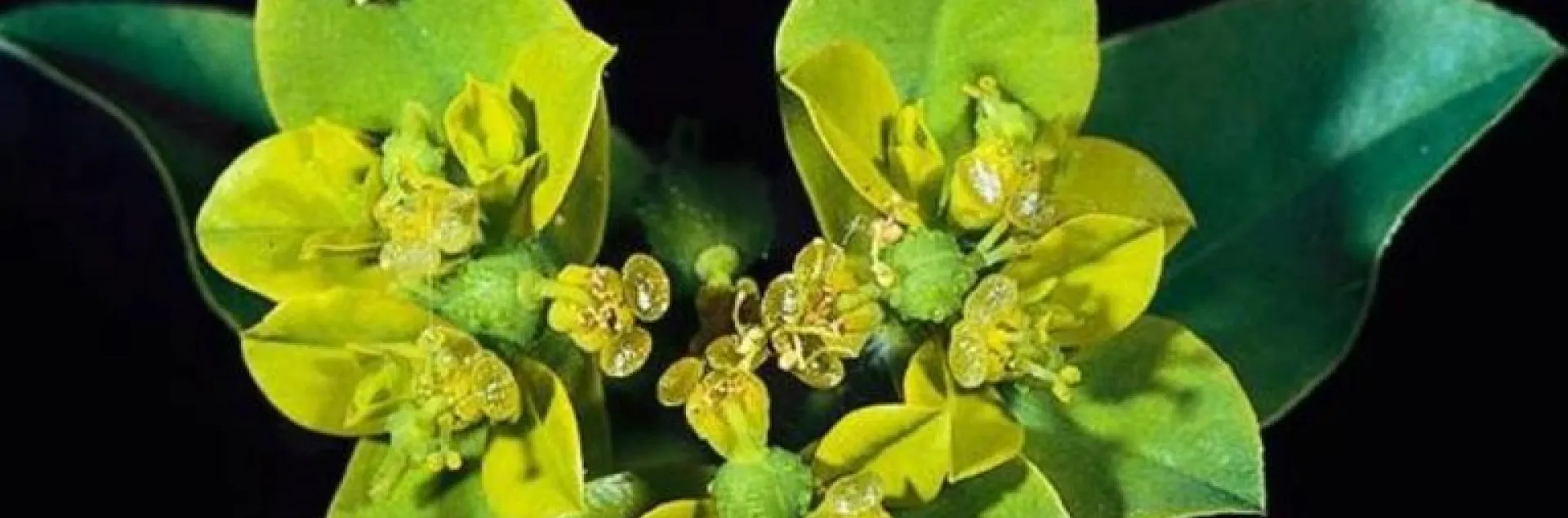
Noxious weed! This “cute” perennial plant grows about 3 feet tall, displaces desirable vegetation, and reduces the biodiversity of our native ecosystems. It was introduced from southern Europe as an attractive ornamental. But it has no natural deterrents, takes over natural habitats, and is quite invasive.
It is an attractive and interesting plant. The “flowers” are unusual, with yellow-green bracts surrounding smaller, interior flowers. If I had seen this plant in the wild, I would have been very tempted to pick it for examination.
However, the milky sap of this plant is toxic. Because of the toxic sap, gloves must be used and care exercised during attempts to remove or identify this plant. It can irritate skin, eyes and digestive tracts of humans and animals. There have been reports of livestock poisonings in cattle and horses, and—for us humans—excruciating pain if gotten in the eyes. Wildlife avoids grazing on it, as well. In California, its listed as a type B noxious weed with significant economic or environmental impact.
Originally, oblong spurge was found along meadows and waterways, but more recently has moved into the Sierra foothills, invading dry hillsides, oak woodlands, mixed conifer forests and areas recovering from wildfires. It is also found in Oregon and Washington. In 2020, Amador County partnered with University of California Cooperative Extension in a project to control oblong spurge along the Mokelumne River watershed, a multi-year project that has been promisingly successful.
Some identifying characteristics to look for in the fall and winter are semi-woody shoots that turn reddish. Leaves often turn reddish to yellowish just before dropping.
Oblong spurge develops vertical taproots that can bud off new plants near the soil surface. It has a deep spreading root structure and produces numerous buds, making control difficult. It is insect pollinated, producing seeds in summer. When mature, fruits rupture and eject seed up to 16 feet from the parent plant. Seeds can be transported great distances by human and animal activities, in water, and as hay or seed contaminants. Thus, the concern of invasiveness.
If you see an invasive weed, take photos and collect a specimen, get information regarding location (GPS or maps) and landowner, if possible. Check references to eliminate misidentification. Suspected invasive plants should be taken to the local county Agricultural Commissioner’s office for determination. Positives should be reported to the local Weed Management Area and data entered on Calflora.
Many invasive plants are attractive, provide food or medicinal benefits, and we’re tempted to tolerate them for their “beauty.” A quote I found speaks well to this: “If we really want to change people’s minds about invasive plants, I think we need to re-name them...i.e. Himalayan blackberry could probably be called ‘ravening monsterthorn’ without anybody who is familiar with it complaining.” Ursula Vernon
A good visual identification handout for oblong spurge can be found here.
Nancy Bliss is a University of California Cooperative Extension Master Gardener of Tuolumne County. UCCE Central Sierra Master Gardeners can answer home gardening questions, from rainwater tanks to drought-resistant plants. Call 209-533-5912 in Tuolumne County, 209-754-2880 in Calaveras County or fill out our questionnaire at (Ask a Master Gardener). Check out our webpage at https://ucanr.edu/site/uc-master-gardeners-central-sierra You can also find us on Facebookand on the radio at kaad-lp.org or 103.5 FM on Motherlode Community Radio.