

Using Science for Community Change
Youth participatory action research (YPAR) is an approach in which young people investigate issues that matter to them and use what they learn to improve their communities. Rather than starting with a predetermined science topic, YPAR can begin with a question or problem youth identify from their own lives. Young people then use research practices to better understand the issue, gather and analyze evidence, develop conclusions, and decide what action to take.
How Can You Use YPAR?
YPAR can be used in 4-H, afterschool programs, schools, community organizations, environmental education, and other youth development settings. Adults play an important role as facilitators and research mentors, while allowing young people meaningful ownership over the questions they investigate and the actions they pursue.
A YPAR project typically supports young people to:
- Identify an issue that matters to them. Begin with young people's experiences, questions, concerns, and observations about their community.
- Learn more about the issue. Explore existing research, public data, community knowledge, and other credible sources.
- Develop a research question and investigation. Youth might use surveys, interviews, focus groups, observations, mapping, or other research methods.
- Collect and interpret evidence. Analyze what the data show, consider different explanations, and connect findings with what is already known.
- Use the findings. Youth decide how to communicate what they learned and take informed action, such as presenting findings to decision makers, educating others, designing a program, or proposing a community change.
Get Started with YPAR
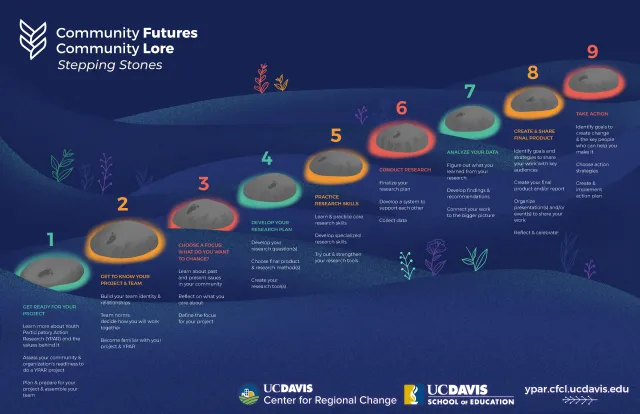
Community Futures, Community Lore is a free UC Davis resource for educators and young people interested in conducting YPAR. The resource includes nine “Stepping Stones” that guide groups through identifying community issues, designing a YPAR project, developing relationships, generating knowledge, and taking action. It also includes activities, examples, and guidance that can be adapted for different youth and community settings. UC ANR educators used Community Futures, Community Lore in the YPAR projects described in the research below.
Research from UC ANR
Financially supported by the University of California, Agriculture and Natural Resources Competitive Grant 2017-2021 (No. 17-4976).
UC ANR research with middle and high school youth found that personally meaningful community issues can provide an entry point into science learning. Youth used research to explore topics such as learning English, school food, ethnic studies, racism and bias, and how local businesses engage with teenagers. In the process, they practiced finding reliable information, developing research questions, choosing methods, collecting and analyzing data, interpreting evidence, and communicating findings.
Neas, S., Worker, S. M., Kok, C. M., & Espinoza, D. (2026). YPAR as process: Supporting youth development through youth participatory action research. Afterschool Matters, 40.
This study examines how YPAR supports youth development and critical consciousness. A key implication for practitioners is to clarify whether the primary goal is producing a particular research product or supporting youth development. When youth development is the priority, giving young people time and support to identify issues that are personally and collectively meaningful can be especially important. Read the article
Worker, S. M., Neas, S., Espinoza, D., Kok, C. M., & Smith, M. H. (2023). Youth science learning as/for community participation: Examples from youth participatory action research. Journal of Youth Development, 18(1).
This study shows how young people entered scientific investigation through personally meaningful community issues and used science practices as tools for understanding and affecting conditions in their communities. We make two arguments about science education in out-of-school time, using our experience implementing youth participatory action research. First, we discuss redefining scientific literacy as a collective property rather than that of an individual; and second, for focusing science education programs on helping youth achieve positive community change/impact, rather than only advancing individual scientific literacy. We maintain that positioning science as a tool for social transformation (that is, integrating science learning and civic engagement) will tap into young people’s motivation, assets, and better prepare them to become central participants in communities. Read the article
Worker, S. M., Espinoza, D., Kok, C. M., Neas, S., & Smith, M. H. (2023). Youth participatory action research: Integrating science learning and civic engagement. California Agriculture, 77(2), 74–82.
This article describes YPAR as an approach for integrating science education with civic and community engagement. Read the article
