Why have plastics become one of the most utilized materials in the world?
What is it about plastic that makes it so versatile?
What impacts does plastics have on the environment?
How can we develop materials that have the advantages of plastic but fewer of the negative impacts?
What are the advantages and disadvantages to transitioning to renewable plastics?
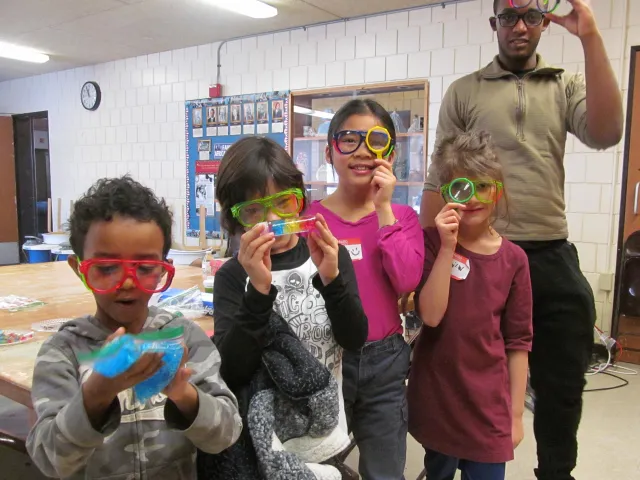
Plastic pollution is one of the most pressing environmental issues of our time. Despite global efforts to reduce, reuse, and recycle, the vast majority of plastic waste ends up in landfills or the natural environment, contributing to climate change, ecosystem damage, and public health concerns. In response to this urgent challenge, the 4-H Sustainable Polymer curricula series empowers young people to become informed environmental stewards by exploring the science behind plastics and sustainable alternatives.
Developed through a partnership between the NSF Center for Sustainable Polymers and Cooperative Extension professionals in California, Minnesota, and New York, this curriculum series includes four grade-specific guides for youth in grades K–2, 3–5, 6–8, and 9-12. Each curriculum features hands-on, inquiry-based activities that help youth understand the impacts of petroleum-based plastics and investigate the potential of sustainable polymers made from renewable resources. Designed for use in 4-H clubs, afterschool programs, camps, and classrooms, the lessons foster curiosity, critical thinking, and community engagement.
Youth participants explore how plastics are made, used, and discarded—and how innovative materials like bioplastics might shape a greener future. Older youth engage in service learning and community action projects, applying what they’ve learned to real-world sustainability efforts. Evaluations show that youth gain knowledge, shift attitudes, and feel empowered to make environmentally responsible choices. Through the 4-H Sustainable Polymer curricula, young people aren’t just learning about science—they’re learning how to be changemakers in their communities.
Visit the project webpage at https://www.4hpolymers.org/
Curriculum
The curriculum is available for free in PDF or in print from Shop 4-H.
K-2 | 3-5 | 6-8 | 9-12 Content | 9-12 Action |
|---|---|---|---|---|
 |  |  |  |  |
Publications
- Worker, S. M., Nayak, R., & Smith, M. H. (2026). 4-H Sustainable Polymers curriculum strengthens youth scientific literacy. California Agriculture: The Journal of UC Agriculture and Natural Resources, 80 (June). https://doi.org/10.3733/001c.162704.
- Worker, S., McCambridge, J., Stevenson, A., Fields, J., Maille, A., Meehan, C. L., Mondl, A., Malone, C., & Smith, M. H. (2022). Sustainable Polymers: New 4-H STEM Curricula. The Journal of Extension, 60(1). https://doi.org/10.34068/joe.60.01.01
- Smith, M., Worker, S., Meehan, C., McCambridge, J., Maille, A., Malone, C., Mondl, A., Stevenson, A. (2023). Comparisons of professional development approaches for out-of-school time educators. University of California, Agriculture and Natural Resources. https://anrcatalog.ucanr.edu/Details.aspx?itemNo=8725
California Team
- Dr. Martin Smith
- Dr. Steven Worker
- Dr. Cheryl Meehan
- Emily K. Manroe
- Joy Ng
- Emma Simpson
- Allison Keaney
- Jessica Bautista
- Taylor Gullikson
- Melanie Ng
- Jacki Zediker
- Emily Schoenfelder
- Kelley Brian
- Alyssa Sankey
- Christa Costello
- Allie Panero
- Abigail Cappa
About 4-H Polymers
This project was supported by the NSF Center for Sustainable Polymers, a National Science Foundation Center for Chemical Innovation. This project was a collaboration between the NSF Center for Sustainable Polymers and 4-H Extension Educators at the University of Minnesota, University of California-Davis and ANR, and Cornell University. Curriculum activities follow gender-equitable best practices established by PBS/TPT's SciGirls.