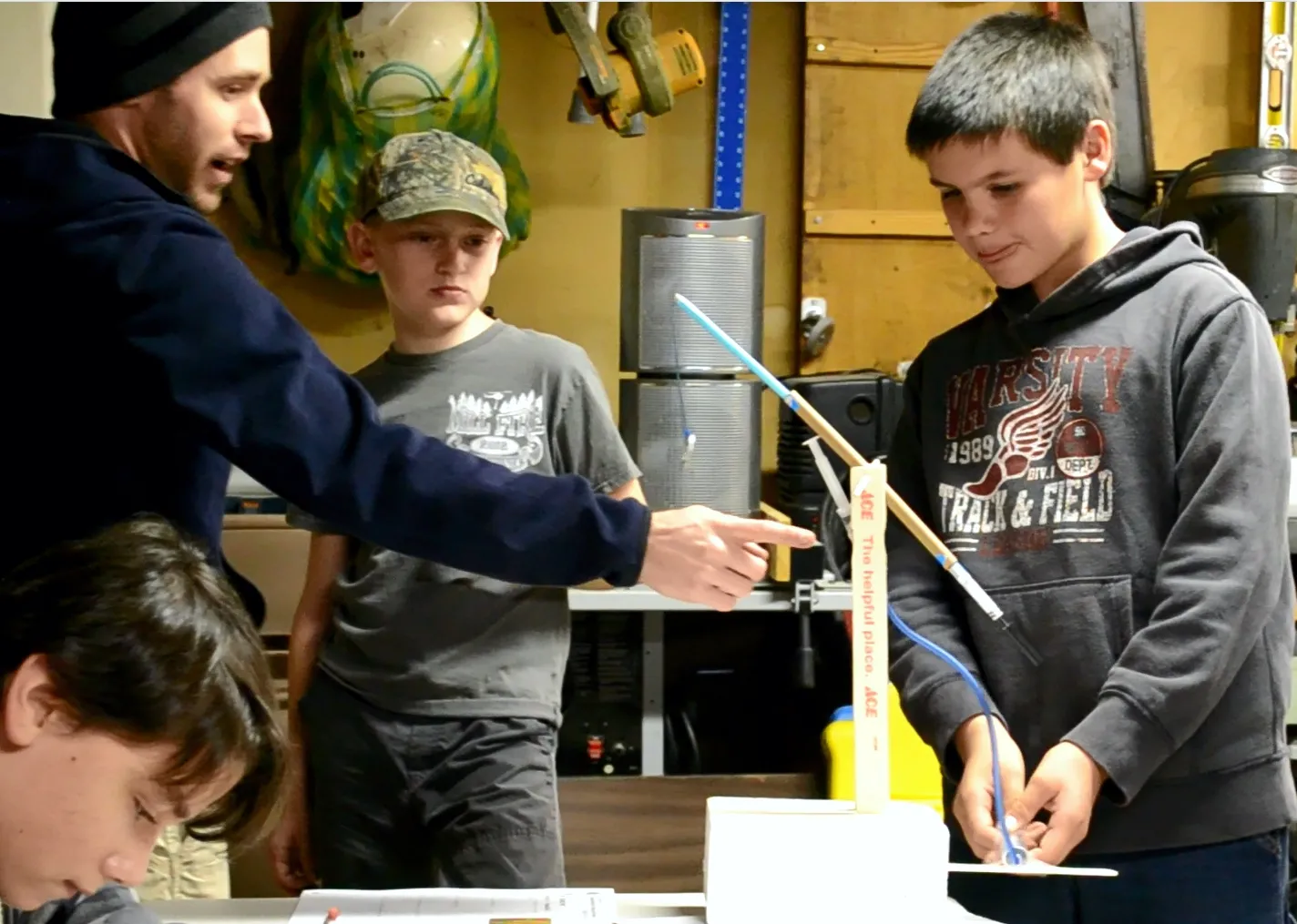
The 4-H Junk Drawer Robotics (JDR) curriculum is a hands-on, design-based educational program that engages youth in learning science, engineering, and technology using everyday household materials. Targeted at upper elementary and middle school students, JDR emphasizes scientific inquiry and the engineering design process, helping youth develop critical thinking, problem-solving, and creative skills.
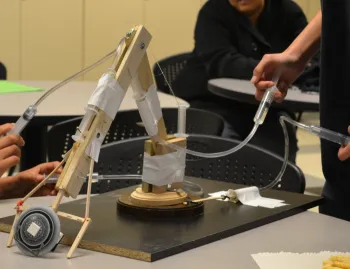
The curriculum is divided into three levels: Give Robots a Hand (form and function, scientific habits of mind, and leverage), Robots on the Move (friction, basic electrical power and motors, gears systems, and buoyancy; role of constraints and engineering iteration), and Mechatronics (Synergy when mechanical, electronic, and feedback systems are merged; electronic circuits, sensing, and mathematical number systems).
Each level supports small-group collaboration and is structured around the experiential learning cycle—To Learn, To Do, and To Make—guiding youth from exploration to design to creation.
- To Learn (Science) activities emphasize exploration and form the foundation upon which youth build conceptual understanding.
- To Do (Engineering) activities build upon the knowledge gained in the exploration phase related to the concepts in the module. Youth are presented with a design problem and work together in small groups to design and plan a solution.
- To Make (Technology) activities allow youth to build and test their design while solidifying their understanding of the concepts.
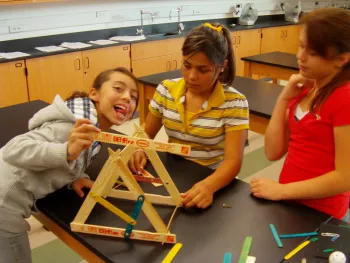
JDR stands out by avoiding expensive, pre-made robotics kits and instead encourages innovation through repurposing materials, promoting accessibility and creativity. It fosters cross-age learning, where teen mentors facilitate activities with younger children, and aligns with the Next Generation Science Standards through practices such as modeling, data analysis, and systems thinking.
The curriculum has been shown to improve content knowledge and youth motivation while preparing young people to be future-ready problem solvers. Its unique blend of science inquiry, engineering design, and technology creation positions JDR as a powerful tool in expanding youth access to high-quality STEM education.
Curriculum
Junk Drawer Robotics | Junk Drawer Robotics | Junk Drawer Robotics | Youth Notebook |
|---|---|---|---|
 | 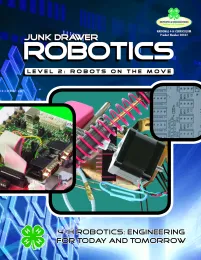 | 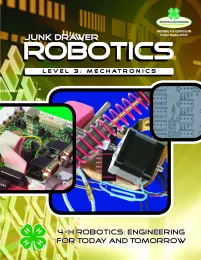 | 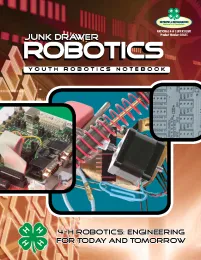 |
JDR Level 1Archived | JDR Level 2Archived | JDR Level 3Archived | JDR Youth NotebookArchived |
Toolbox | Facilitating | Activity Supplies | |
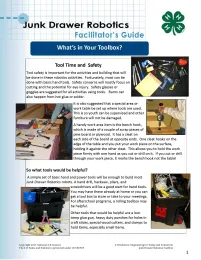 | 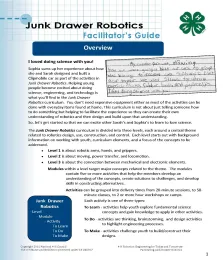 | 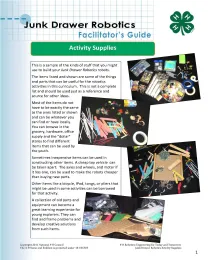 | |
JDR ToolboxArchived | JDR Facilitator GuideArchived | JDR Activity SuppliesArchived |
Evaluation
Evaluation of the 4-H Junk Drawer Robotics curriculum shows strong, positive outcomes for both youth participants and adult facilitators.
Youth who engaged in the program demonstrated increased understanding of core science and engineering concepts, including the engineering design process, and showed improved confidence in applying these concepts to real-world problems. Additionally, youth expressed a greater interest in pursuing STEM careers. Youth valued the hands-on building activities and found the experience fun and engaging.
Facilitators reported that the open-ended nature of the activities fostered creativity and problem solving, with many noting that youth were most excited by the opportunity to invent, construct, and test their own designs. Adult facilitators, including those new to robotics education, gained confidence in leading inquiry-based, experiential learning activities.
Publications
Worker, S. M. (2019). Development of an artifact-based evaluation framework for assessing 4-H learner outcomes. Journal of Extension, 57(1). https://tigerprints.clemson.edu/joe/vol57/iss1/14
Worker, S. (2016). Volunteer educators’ influence on youth participation and learning in 4-H STEM learning by design programs [Doctoral dissertation, University of California, Davis). PQDT Open (10165795) https://www.proquest.com/openview/4cd4bccb6eb2ac40804877c814bb135c/
Worker, S., Mahacek, R., Wheeler, T., Frerichs, S. (2015). Engineering for everyone: 4-H’s Junk Drawer Robotics curriculum. In Cary Sneider (Ed.), The Go-To Guide for Engineering Curricula PreK-5: Choosing and Using the Best Instructional Materials for Your Students (Ch. 13, pp. 191-202). Corwin.
Worker, S.M., & Mahacek, R.L. (2013). 4-H out-of-school time STEM education. Children’s Technology and Engineering, 18, 16-20.
Mahacek, R. & Worker, S. (2011). Extending science education with engineering and technology: Junk drawer robotics curriculum. In A. Subramaniam, K. Heck, R. Carlos, & S. Junge (Eds.), Advances in youth development: Research and evaluation from the University of California Cooperative Extension 2001-2010 (Ch. 7, pp. 46-57). University of California Agriculture and Natural Resources.
Barker, B. & Mahacek, R. (2011). No robotics in school? 4-H can help. Learning & Leading with Technology, International Society for Technology in Education.
Team
- Richard Mahacek
- Steven M. Worker
- Anne Mahacek
Acknowledgements
We recognize financial support from JCPenney, Lockheed Martin, and National 4-H Council.