Food Access & Food Insecurity

Nutrition Policy Institute: Page

CalFresh Healthy Living Evaluation

The University of California’s Nutrition Policy Institute (NPI) works in partnership with the California Department of Public Health and local health departments to evaluate CDPH’s portion of the CalFresh Healthy Living program.
View Page
Primary Image
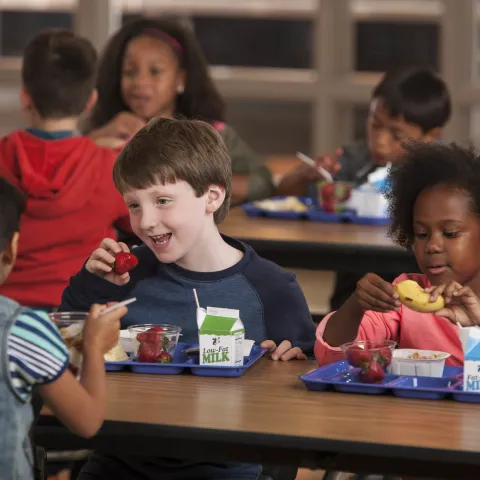
Children in cafeteria eating school meals. Photo credit: USDA.
Nutrition Policy Institute: Page

School Meals for All

California is among the first in the nation to adopt a universal school meals program, or school meals for all, offering breakfast and lunch to all TK-12 students at public and charter schools every instructional day, at no charge, regardless of household income. The University of California's Nutrition…
View Page
Nutrition Policy Institute: Page

Best of Science Letters

The Nutrition Policy Institute's mission is to conduct and translate policy-relevant research to transform environments for healthy children, families and communities. While federal agencies must solicit input via public comment periods, Best of Science Letters may be used to translate the evidence base to…
View Page
Nutrition Policy Institute: Page

Our Impact

NPI's research provides influential evidence that shapes federal, state and local nutrition programs. Since 2014, NPI has contributed to several program and policy wins! Read about our impact!
View Page
Nutrition Policy Institute: Page

Recursos

Este sitio contiene entrenamientos en línea, páginas de web, vídeos y hojas informativas del Instituto de Políticas de Nutrición y publicaciones de noticias en Español.
View Page
Nutrition Policy Institute: Page

Nuestro Impacto

La investigación del Instituto de Políticas de Nutrición (NPI) ofrece evidencia importante que tiene influencia en los programas de nutrición federales, estatales y locales. Desde 2014, NPI ha contribuido a varios logros de programas y políticas.
View Page
Nutrition Policy Institute: Article

The State of School Meals for All in California

February 25, 2025
By Christina E Hecht, Kenneth Hecht, Wendi Gosliner, Caitlin D French, Monica D Zuercher, Dania Orta-Aleman, Lorrene D Ritchie
Research Brief • February 2025 • Download PDF (222 KB)BackgroundHistorically, students whose household income was at or below 130% of the federal poverty level (FPL) were eligible for school meals at no charge and those between 130-185% FPL were offered a reduced-price meal. Students from families…
View Article
Nutrition Policy Institute: Article

The California Fruit and Vegetable EBT Pilot Project at Farmers’ Markets

February 1, 2025
By Sridharshi C Hewawitharana, Ron Strochlic, Samantha Sam-Chen, Wendi Gosliner
Evaluation Findings Research Brief • February 2025 • Download PDF (270 KB)BackgroundIn 2023, the California Department of Social Services initiated the California EBT Fruit and Vegetable Pilot Project (CF&V), testing a new approach for increasing access to fruits and vegetables (FV) among…
View Article
Primary Image
A family child care home provider sits at a table with three children and talks to them about the food they are eating while they share a lunch meal together.
Nutrition Policy Institute: Article

Evidence to Support an Additional CACFP Meal Reimbursement for Family Childcare Home Providers

December 3, 2024
By Danielle Lee, Kassandra A Bacon, Celeste Felix, KC Fiedler, Susana Matias, Lorrene D Ritchie
Policy Brief • December 2024 • Download PDF (284 KB) “Ideally, we would like a reimbursement for all the meals that we serve, which is five. But if I have a secondary choice, I would want to be reimbursed four meals, breakfast, lunch, and dinner, plus either AM snack or PM snack.” – Family childcare…
View Article
Nutrition Policy Institute: Article

Challenges Experienced by Child and Adult Care Food Program Sponsors

November 24, 2024
By Danielle Lee, KC Fiedler, Kassandra A Bacon, Reka Vasicsek, Lorrene D Ritchie
Research Brief • November 2024 • Download PDF (171 KB)BackgroundThe federal Child and Adult Care Food Program, or CACFP, provides nutritious meals and snacks to over 4.7 million US children, predominantly from families with lower incomes, through reimbursements to their childcare providers.1 Family childcare…
View Article