

Evaluation Findings Research Brief • February 2025 • Download PDF (270 KB)
Background
In 2023, the California Department of Social Services initiated the California EBT Fruit and Vegetable Pilot Project (CF&V), testing a new approach for increasing access to fruits and vegetables (FV) among Supplemental Nutrition Assistance Program (SNAP) shoppers. California nutrition incentive programs typically provide SNAP shoppers purchasing SNAP-eligible items with dollar-for-dollar matching funds that must be used to purchase FV at farmers’ markets. In contrast, the CF&V pilot provided SNAP shoppers using their EBT card to purchase FV at participating pilot sites with a dollar-for-dollar match as a supplemental benefit. The benefit could be spent at the site or placed back on SNAP shoppers’ EBT cards to be used just like regular EBT funds at any SNAP authorized retailer. CF&V also offered shoppers the option of earning the entire monthly benefit in one visit, rather than weekly installments. CF&V was implemented from February 2023-January 2024, at 7 farmers’ markets (FMs) throughout California and 87 other retail outlets (OROs) such as grocery stores, 78 of which began implementation after October 1, 2023.
What We Did
We conducted a mixed-methods evaluation of CF&V. Quantitatively, we analyzed data from 61,692 SNAP households representing 436,879 transactions earning and/or spending supplemental benefits for the period February 23, 2023-January 31, 2024 at FMs and/or OROs. This analysis aimed to identify patterns in supplemental benefit earning and redemption at FMs and OROs. Qualitatively, we conducted 7 focus groups with 40 SNAP shoppers and 7 focus groups with 17 staff at participating FMs to elicit stakeholder perceptions of the pilot’s novel approach to providing incentives for FV purchases.
What We Found
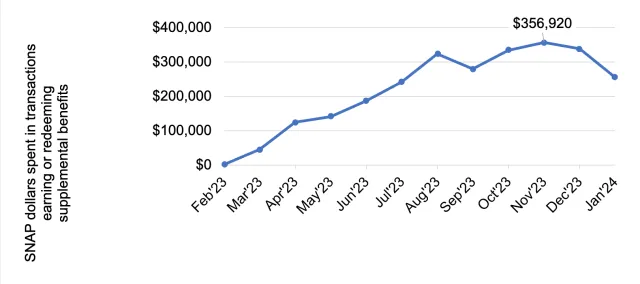
CF&V drew increasing numbers of SNAP shoppers to FMs. The number of households using the program at pilot FMs increased from 415 in March 2023 to a peak of 2,938 in November 2023. SNAP spending at participating FMs also increased over time, peaking at $356,920 in November 2023 (Figure 1).
Figure 1. Supplemental Nutrition Assistance Program (SNAP) dollars spent at pilot farmers’ markets over time (Feb 2023-Jan 2024; n=7,819 households, 22,702 transactions spending SNAP dollars).
However, the total amount of supplemental benefit dollars earned at OROs ($3,014,000) was much greater than the amount earned at FMs ($1,193,000) (Figure 2), despite most OROs starting implementation many months after FMs. Of the supplemental benefits earned at the pilot FMs, 23% was spent at pilot FMs and 73% was spent at OROs.
Figure 2. Total supplemental benefits earned or redeemed at farmers' markets and other retail outlets during the California EBT Fruit and Vegetable pilot over time (Feb 2023-Jan 2024; n=61,692 households, 436,879 transactions).

FM shoppers appreciated the ability to spend the supplemental benefit on any SNAP-eligible item at any SNAP-authorized retailer.1 Many reported using those funds to purchase items such as meat, milk and eggs at local grocery stores.
“So I use [the benefit] in the grocery stores for my normal groceries. It just gives me more buying power on my [EBT] card when I go to the grocery store.” – English-speaking shopper, Northern California FM
That dynamic created frustration among some FM staff, who felt their efforts largely benefited OROs.
“I like the fact that people do have more funds that they can use anywhere that they need it. What I don't like is that it means in a way that the FMs are subsidizing [grocery stores] and all the other places where people go to get food, and it should be the other way around.” – Staff member, Southern California FM
FM shoppers also appreciated the ability to earn the maximum monthly supplemental benefit in a single transaction,1 which participating households did 88% of the time.
“I’m disabled. . .I try to get [to the farmers’ market weekly] but if I can’t, then on the plus side, at least I know that I can still use [all] my Market Match. And so that’s the positive, as opposed to the way that it was designed before, where I would lose out.” – English-speaking shopper, Northern California FM
“I like this program because they give us the money in one lump sum and that allows me to buy the most I can in just one purchase.” – Spanish-speaking shopper, Southern California FM
Increased attendance at pilot FMs, coupled with shopper difficulties understanding the program and the need for lengthy explanations, often resulted in long lines, frustrating staff and shoppers.1
“I’ve seen like 10 people in line sometimes and it goes really, really slow, because [the staff are] spending so much time talking and explaining the details.” – English-speaking shopper, Northern California FM
Long lines and shopper confusion may have reduced utilization, particularly among new FM shoppers: 42% of the total sample of SNAP shoppers at pilot FMs used the program for only one month. However, among early CF&V users (those using the program within the first 3 months of implementation) 58% used it for 3 or more months during the pilot period.
FM staff appreciated the benefits of CF&V for shoppers but reported dissatisfaction with increased paperwork and reduced opportunities for positive engagement with shoppers.1 Many felt they did not have adequate resources to support the program and 4 of 7 FMs dropped out before the end of the pilot.
“It costs us in personnel almost three times as much to administer this program as the original Market Match. . . We’ve got five people just on the EBT portion.” – Staff member, Southern California FM
“I think if they expand [the pilot] to all of our sites, we’d have staff who definitely would not be up for the challenge. They would probably not be willing to be managing it on their own at a site. Because it does take someone who’s pretty skilled, who has a lot of patience.” – Staff member, Northern California FM
Conclusions
- SNAP FM shoppers appreciated the California Fruit and Vegetable EBT Pilot Project, despite reporting some dissatisfaction.
- FM staff reported more dissatisfaction with the program, with 4 of 7 FMs choosing to discontinue participation prior to the end of the pilot.
- The qualitative and quantitative findings indicate that the supplemental benefit earned at FMs was largely spent at OROs, validating FM staff concerns that the pilot was associated with FMs processing SNAP dollars for OROs.
- Quantitative findings indicated that after the initial visit, many (42%) SNAP shoppers did not return to participating FMs during the pilot, raising questions about shopper satisfaction and pilot utilization.
- Future efforts to replicate this program should consider FM staffing needs, challenges associated with FMs processing benefits that may be spent at OROs, and reduced advantages for SNAP participants to shop at FMs if the program is available at nearby OROs.
References:
- Chelius C, Strochlic R, Hewawitharana SC, Gosliner W. Opportunities and Challenges of California's Fruit and Vegetable Electronic Benefit Transfer Pilot Project at Farmers' Markets: A Qualitative Study with Supplemental Nutrition Assistance Program Shoppers and Farmers' Market Staff. Nutrients. 2024;16(19):3388. DOI: https://doi.org/10.3390/nu16193388
Acknowledgements: This research was made possible through a contract with the Ecology Center, Agreement Y20-5354, and funding provided by the California Department of Social Services, Agreement SG-EBT-21-0002 Any opinions, findings, conclusions, or recommendations expressed in this publication are those of the authors and do not necessarily reflect the views of funding agencies. Thank you to the pilot farmers’ market staff and shoppers for their participation in this study.
Suggested citation: Hewawitharana SC, Strochlic R, Sam-Chen S, Gosliner W. The California Fruit and Vegetable EBT Pilot Project at Farmers’ Markets. Evaluation Findings Research Brief. University of California, Agriculture and Natural Resources, Nutrition Policy Institute. February 2025.
University of California Agriculture and Natural Resources is an equal opportunity employer.
© 2025 UC Regents, Creative Commons 4.0 International License.
