


Policy Brief • December 2024 • Download PDF (284 KB)

“Ideally, we would like a reimbursement for all the meals that we serve, which is five. But if I have a secondary choice, I would want to be reimbursed four meals, breakfast, lunch, and dinner, plus either AM snack or PM snack.” – Family childcare home (FCCH) provider
Background
Low diet quality is common among young U.S. children, particularly in families with low-income.1,2 The Child and Adult Care Food Program (CACFP), serving over 4.2 million children predominantly with low incomes, reimburses childcare providers for up to 2 meals and 1 snack daily, provided they meet nutrition standards. CACFP meals and snacks are more nutritious than those offered by non-CACFP providers and improve children’s diet quality and food security.3
However, only about half of qualifying providers participate in CACFP due to numerous barriers including insufficient reimbursements.4 CACFP participation is also declining, especially for family childcare homes (FCCH).5 Policymakers are proposing initiatives, such as an additional meal reimbursement, to reverse these trends.
What Was Studied
This brief summarizes a study conducted by the University of California’s Nutrition Policy Institute, UC Berkeley and CACFP Roundtable. We surveyed 277 CACFP-participating licensed FCCH in in 2024, and interviewed 10 FCCH providers, 5 sponsors and 5 family-recipients in 2024, to understand perspectives about CACFP and reimbursements.6 Sponsors are public or nonprofit private organizations that administer CACFP for licensed family childcare homes and childcare centers that do not choose to operate the program directly through the state.
Key Findings
CACFP Meals are Important for Improving Child Food Security
31% of providers said they worry children would be hungry if they didn’t get meals and snacks in childcare.
“I have children tell me that the meals that I give them here is what they get all day.” – FCCH provider
Providers Offer More than the Current Reimbursable 2 Meals and 1 Snack Each Day
On average, providers offered at least 4 meals/snacks to children each day (Figure 1).
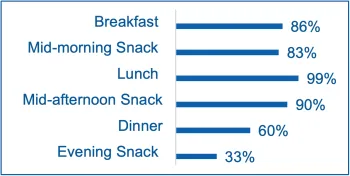
“I appreciate that they will follow his needs… if he's still a little hungry, he gets an extra snack.” – Family recipient
Providers Want More Meals and Snacks Reimbursed by CACFP
67% of providers say they want more than 3 meals/snacks reimbursed by CACFP; on average they want 4 meals/snacks reimbursed.
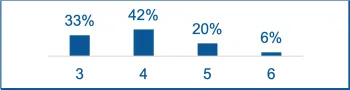
“All of our providers are serving all meals all day because their parents are working. If we were able to assist with giving those providers reimbursement for [all] those meals, it would be so helpful for them, their business, and the families and the children in their care.” – FCCH sponsor
Recommendation
Policymakers should support efforts to increase the number of reimbursable meals and snacks for childcare providers that participate in the Child and Adult Care Food Program to 4 per child per day to support improved child nutrition and food security.
References
- US Department of Agriculture and US Department of Health and Human Services. Dietary Guidelines for Americans. 9th Edition. 2020–2025, December 2020.
- Kay MC et al., Measuring Dietary Quality Among Toddlers in the Feeding Infants and Toddlers Study, 2016, Using the New Healthy Eating Index-Toddlers-2020. J Acad Nutr Diet. 2024:S2212-2672(24)00809-8.
- Kenney EL, et al. The Child and Adult Care Food Program and young children's health: a systematic review. Nutr Rev. 2023;81(11):1402-1413.
- Andreyeva T, et al. Federal Nutrition Assistance for Young Children: Underutilized and Unequally Accessed. Am J Prev Med. 2024;66(1):18-26.
- US Department of Agriculture. CACFP Family Day Care Home Participation Study. July 2023.
- Bacon KA, Lee DL, Vasicsek R, et al. Provider, sponsor and family perceptions of Child and Adult Care Food Program (CACFP) participation and COVID-19 reimbursement increases. Public Health Nutr. 2025;28(1):e195.
Suggested citation: Lee DL, Bacon K, Felix C, Fiedler K, Matias SL, Marshall SK, Homel Vitale E, Ritchie LD. Policy Brief: Evidence to Support an Additional CACFP Meal Reimbursement for Family Childcare Home Providers. Nutrition Policy Institute, University of California, Agriculture and Natural Resources. CACFP Roundtable. University of California, Berkeley. December 2024.
Acknowledgements: Thank you to the family childcare home providers, families and sponsors who participated in this study and the California Department of Social Services (CDSS) for their collaboration. This work was supported by grant #283-5102 from Healthy Eating Research, a national program of the Robert Wood Johnson Foundation and the California Collaborative for Pandemic Recovery and Readiness Research (CPR3) Program which was funded by the California Department of Public Health (CDPH). The CDSS and CDPH were not involved in data collection, data analysis and interpretation, manuscript development, or the decision to publish.
University of California Agriculture and Natural Resources is an equal opportunity employer. © 2024 UC Regents, Creative Commons 4.0 International License.
