
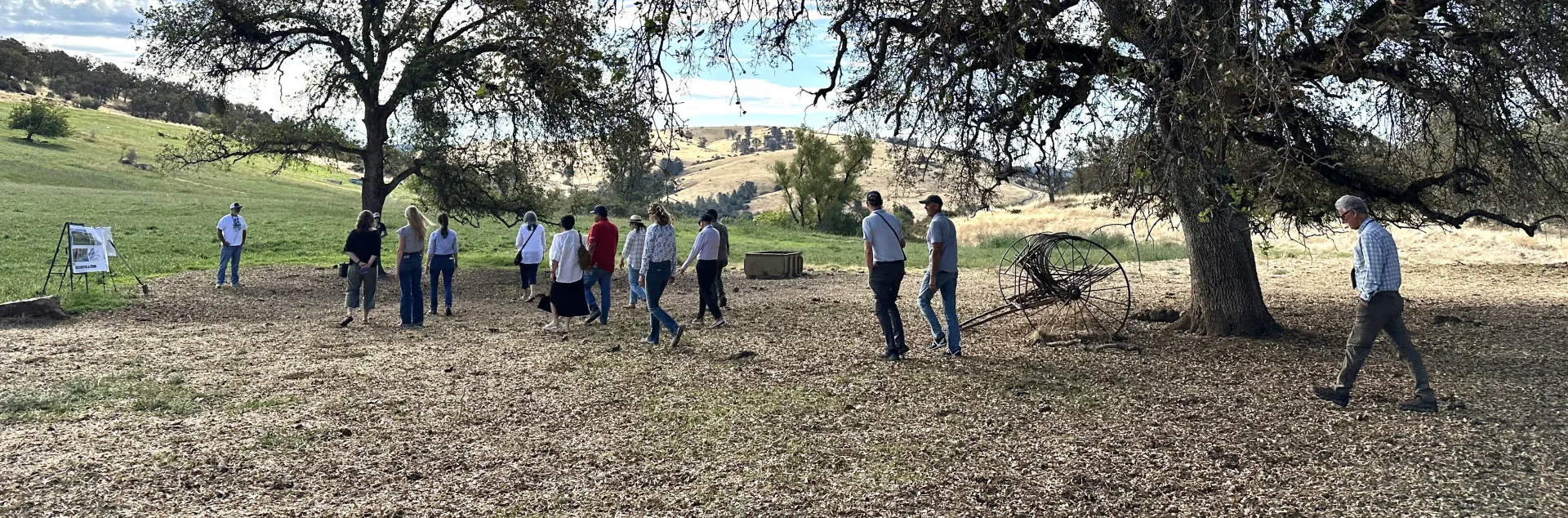
Cow burps, burn scars, food hubs, demo gardens and rock dust were all part of the smorgasbord of UC ANR research projects and initiatives featured on Sept. 9-10. Members of the UC President’s Advisory Commission on Agriculture and Natural Resources (PAC) and UC ANR Governing Council spent two days in El Dorado, Placer and Yuba counties learning about a host of ANR programs and UC Cooperative Extension activities.
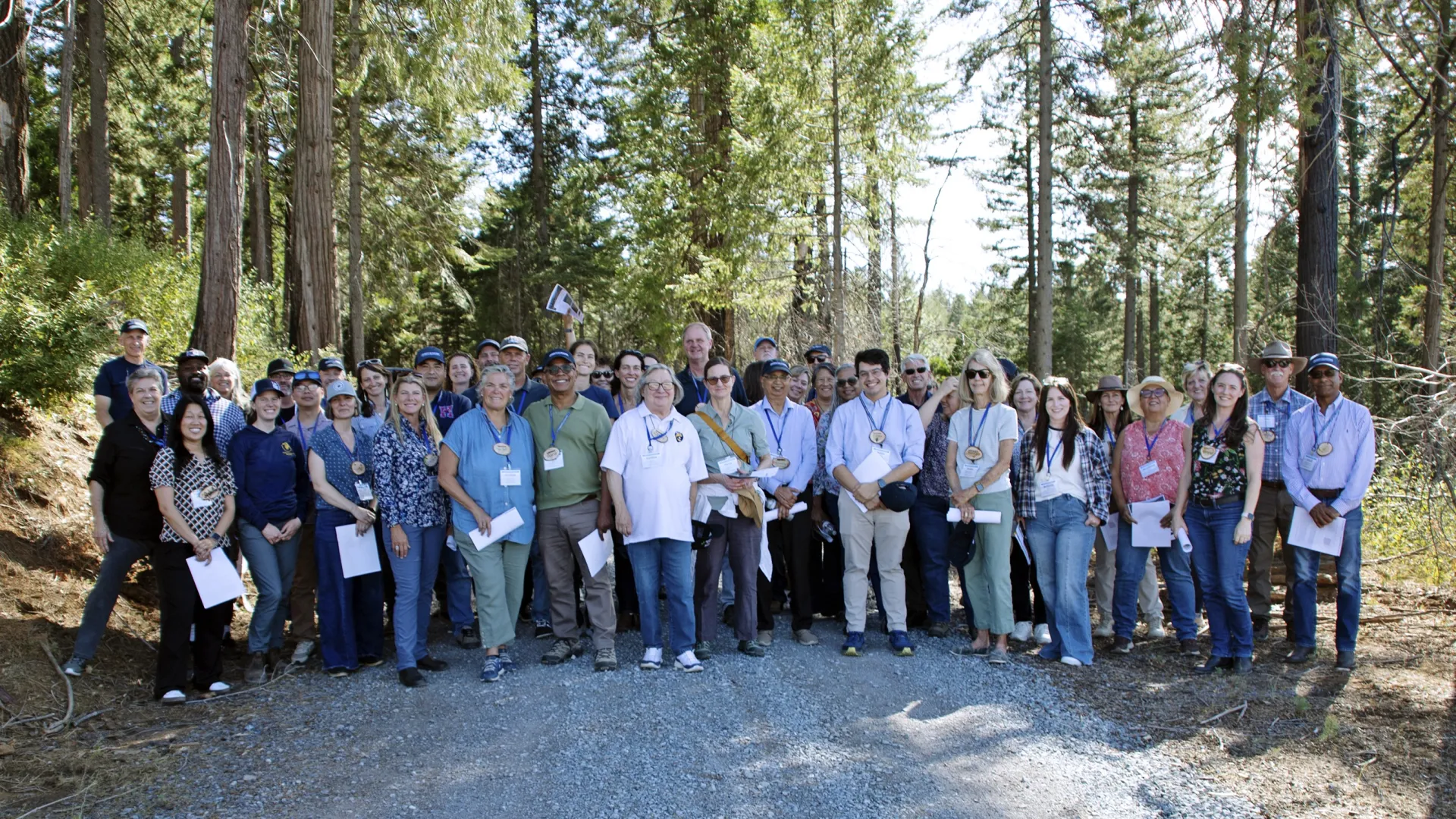
At Berkeley Forests’ Blodgett Forest Research Station and UC ANR’s Sierra Foothill Research and Extension Center, tour attendees heard from UCCE researchers, ANR and UC leadership, and local volunteers and partners about how leading-edge science is contributing to solutions that make a difference in the region.
Day 1: Blodgett Forest Research Station
Upon arriving at Henry Vaux Forestry Education Center at Blodgett, Vice President Glenda Humiston thanked the group for traveling to El Dorado County to learn more about UC ANR’s work. David Ackerly, dean of the UC Berkeley Rausser College of Natural Resources, offered a warm welcome and introduced UC Berkeley Chancellor Rich Lyons.
Lyons called Blodgett the epitome of UC’s land-grant mission, bringing together research, education and public service to address pressing challenges.
“For more than 90 years, Blodgett Forest has served as a living laboratory where we can test how science and active management create healthier, more resilient forests in the face of wildfire and climate change,” Lyons said.
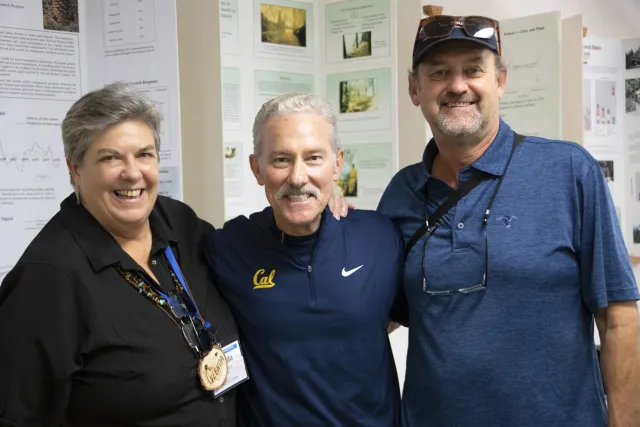
He also highlighted two themes that resonated throughout the two-day tour: 1) the impact of close collaborations throughout the UC system, such as those between all the UC campuses and the UC ANR/UCCE network; and 2) the importance of places like Blodgett and Sierra Foothill REC, which can host crucial research projects that simply would not be possible on private property or other public lands (due to limitations from regulations or time constraints, for example).
Rob York, UCCE specialist at UC Berkeley and co-director of Berkeley Forests, elaborated on the uniqueness of Blodgett as a “working forest” that serves a variety of clientele while also being tremendously productive from an academic research standpoint.
Ariel Rivers, who hails from El Dorado County and serves as the UCCE area director for the Central Sierra, highlighted studies on virtual fencing as it applies to grazing animals for fuels management at Blodgett. She also mentioned ongoing research and extension efforts on Christmas trees, glassy-winged sharpshooter and wine grapes, and woody biomass in the local bioeconomy.
On the bus ride through the mixed conifer forest at Blodgett, York expounded on its history, the 25 years’ worth of research supporting the benefits of prescribed fire, and the intentional co-directorship of Berkeley Forests – split between an Extension specialist and a UC Berkeley faculty member (most recently Scott Stephens).
When asked about current priorities in using fire to boost the resilience of California forests, York said a primary concern is workforce development and training enough skilled personnel to perform prescribed burns and put the science-backed solutions into practice.
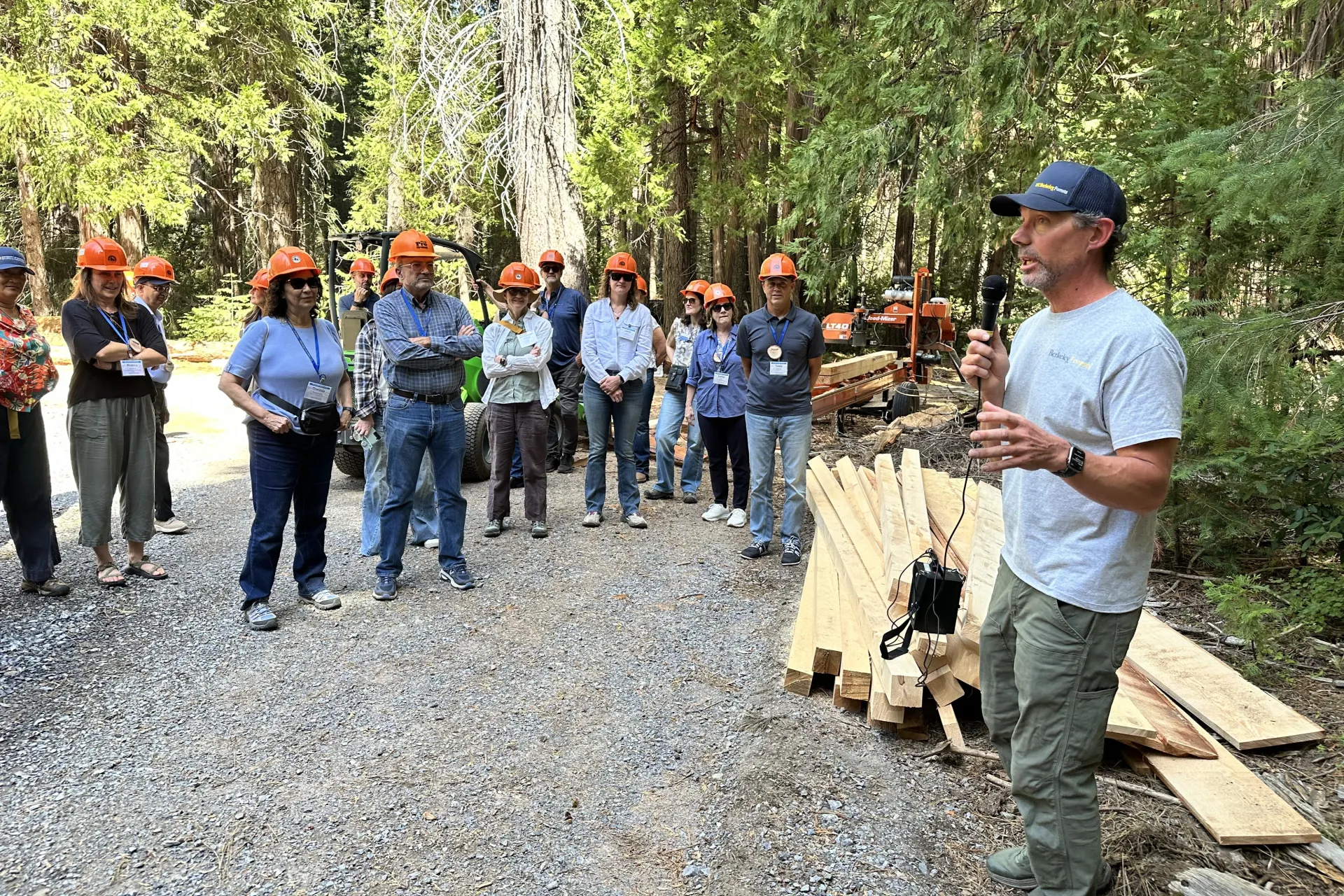
At the first field site, Ariel Roughton, research stations manager of Berkeley Forests, described sustainable thinning and timber harvest operations at Blodgett. She narrated as the group watched a crew fell a Ponderosa pine and use a heavy-duty tree processor to trim the limbs and cut the trunk to specified lengths. Then, a couple crew members demonstrated how a portable sawmill cuts raw logs into usable boards.
Ricky Satomi, UCCE forestry and natural resources advisor for Sutter and Yuba counties, talked about innovations in mass timber products (engineered material made from layers of lumber that are glued or fastened together with dowels or nails) and mentioned the efforts of the UC Berkeley Wood Lab, led by the Berkeley team of UCCE specialists Paul Mayencourt and Daniel Sanchez.
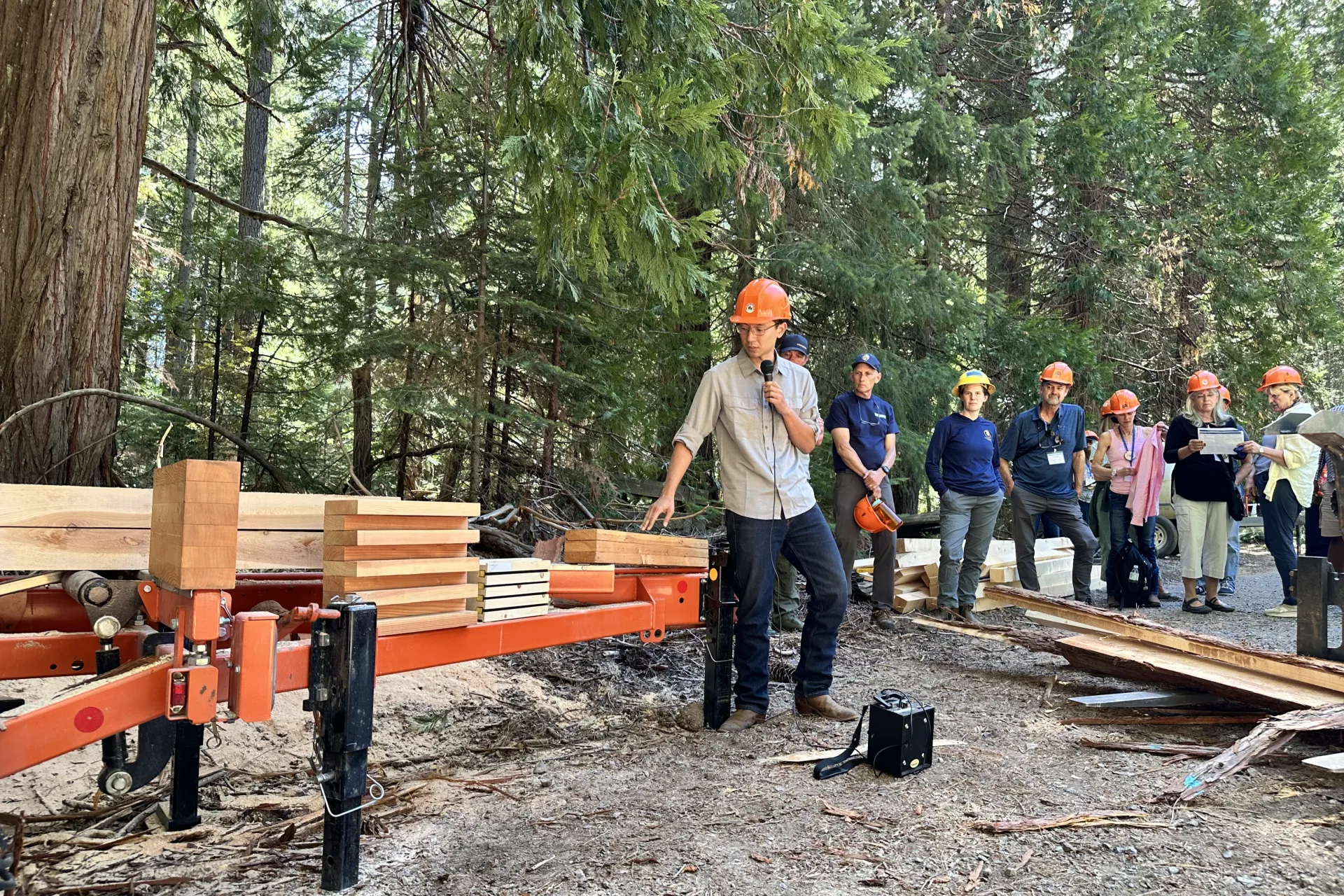
“Mass timber is the new frontier where we’re trying to identify new ways to use wood and build larger, more robust buildings with it, as opposed to relying so heavily on concrete or steel,” Satomi said.
Next, the group traveled to a site overlooking an expansive vista of charred trees, the burn scar of California’s largest wildfire of 2022, the Mosquito Fire. Prescribed fire effectively functioned as “fuel breaks” as that devastating fire spread.
John Battles, a professor in UC Berkeley’s Rausser College and former faculty co-director of Berkeley Forests, gave an overview of fuel treatments at Blodgett (prescribed fire only, mechanical only, and fire with mechanical) and their effects on forest resilience and carbon sequestration and carbon cycling.
“That’s one of the great parts about a place like Blodgett – because you can be here long-term, you can see how multiple different factors come into play,” said Battles, noting that researchers have seen accrued benefits from multiple burns over an extended period of time.
Susie Kocher, UCCE forestry advisor for the Central Sierra, discussed the impact of forest stewardship workshops aimed at helping private landowners enhance forest health and resilience.
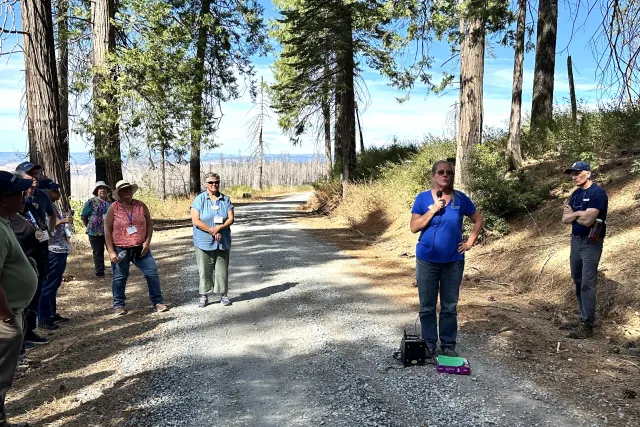
“A third of California is forested – that’s 32 million acres, and that includes oak woodlands – and of that, 40% is privately owned,” Kocher pointed out. “Private nonindustrial landowners – out of all the land ownerships of working forests – have the greatest need for expertise, outreach and education about what to do with their landscape.”
While many landowners now understand the need to manage their forests through mechanical thinning, prescribed burns or other treatments, there is an urgent need for more people to perform those tasks. Kocher has been organizing “minicamps” for community college students so they get hands-on experiences and an up-close look at forestry careers.
She was followed by Miranda Redmond, assistant professor in forest science and climate change at UC Berkeley’s Rausser College. Redmond provided an overview of her research into the factors that contribute to the success (or failure) of conifer seedlings that are planted after severe wildfires.
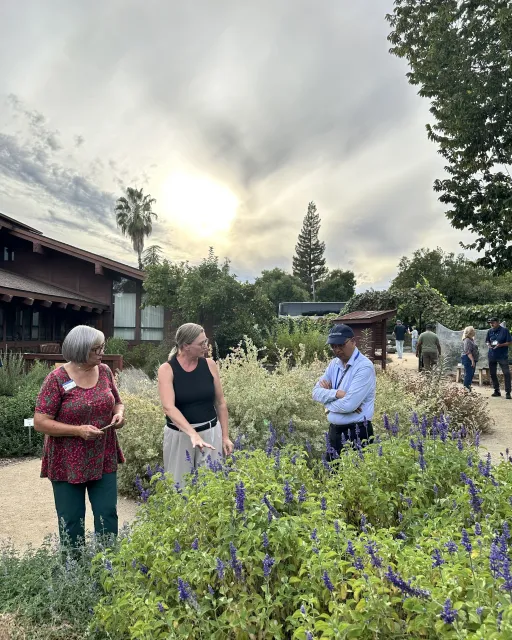
Leaving Blodgett, the tour group next stopped at the UC Master Gardeners Demonstration Garden at the Loomis Library. UC Master Gardener Karen Lopez greeted the visitors and invited them to tour the garden and visit a display on how the local fire station is demonstrating fire-wise landscaping.
Before dinner at High-Hand Café in Loomis, Humiston acknowledged Michele Fisch, UCCE area director for Placer, Nevada, Plumas and Sierra counties; and introduced Placer County Agricultural Commissioner Josh Huntsinger. He provided a thumbnail sketch of the area’s fruit packing and shipping history (the café itself was originally a fruit packing shed).
Then, Tracy Celio, regional director of F3 Local, enumerated the far-reaching impact of the Southwest Regional Food Business Center (SRFBC), operated by UC ANR before withdrawal of federal funding. Celio emphasized the importance of local partnerships in that work and introduced Tammi Reidl, founder of Gold Country Food Hub in Auburn.
Reidl talked about developing a one-stop food resource hub for farmers with the support of the SRFBC, using AI to gather information on grants, networking opportunities and educational events from a variety of sources in a centralized location.
“It’s programs like this, and funding like this, that allows food hubs to provide infrastructure that helps build capacity and resiliency in our local farms, food businesses and regional food system,” Reidl said.
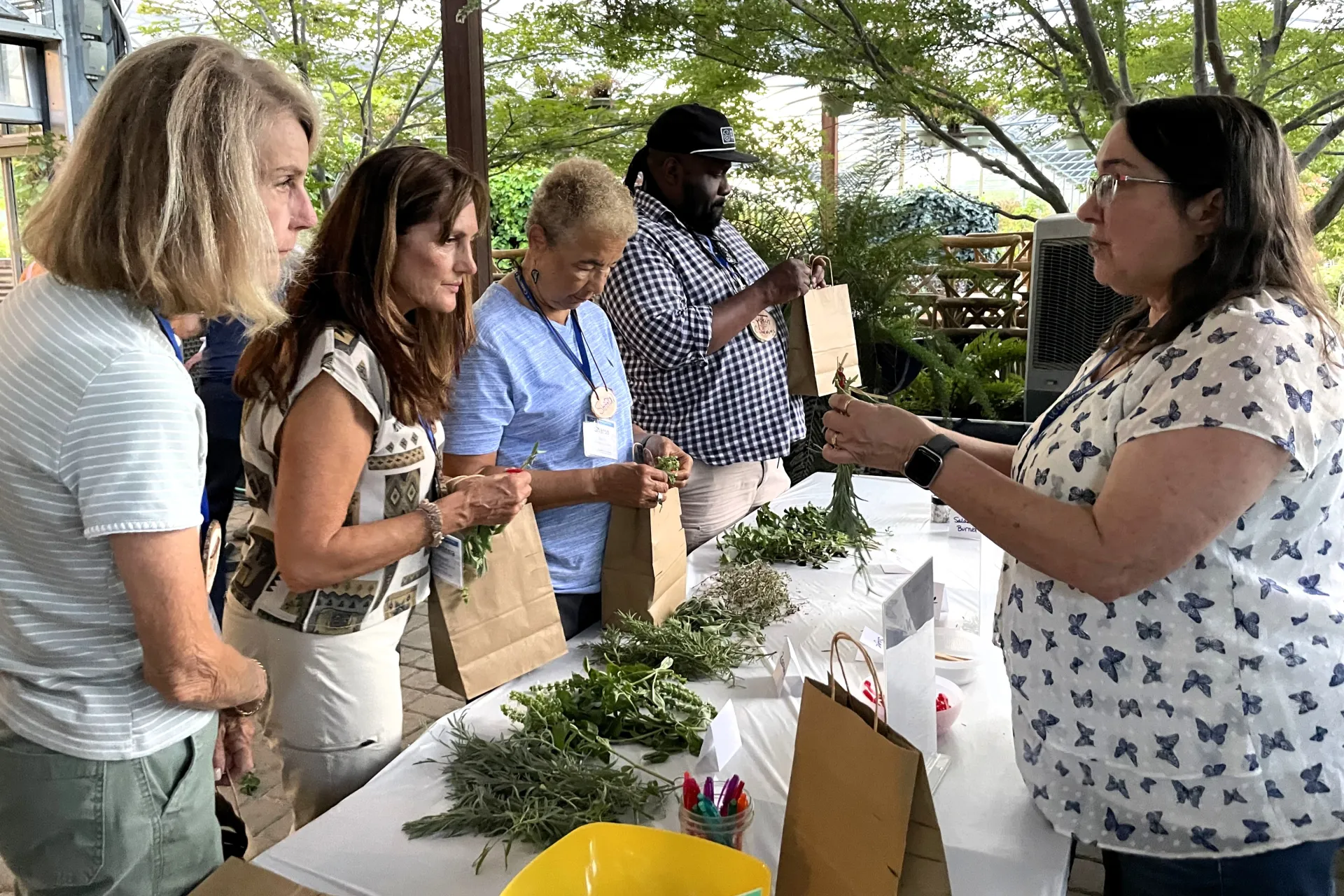
The evening concluded with a hands-on activity led by Sue Mosbacher, UC Master Food Preserver program manager, who showed attendees how to dry freshly cut herbs using just a paper bag.
Day 2: Sierra Foothill Research and Extension Center
The following morning, tour participants traveled to Sierra Foothill Research and Extension Center in Browns Valley in Yuba County. Gathered in the main meeting room, the group heard Darren Haver, UC ANR interim associate vice president for research and extension, give an overview of UC ANR’s 10 Research and Extension Centers (“living laboratories” in a similar vein to Blodgett).
Dustin Flavell, Sierra Foothill REC director, introduced the history and ecology of the REC and spotlighted its extraordinary people and their “can-do” spirit that make possible the broad range of research projects on livestock and natural resources. He also emphasized the scale of the REC, as its 5,700 acres make it the biggest in the UC ANR system.
“The nice thing about a place this large is we have the ability to scale up,” Flavell said. “We can take research on a small plot, whether it’s on campus or in a greenhouse, and scale them up to a much larger scale to see if the results are still applicable.”
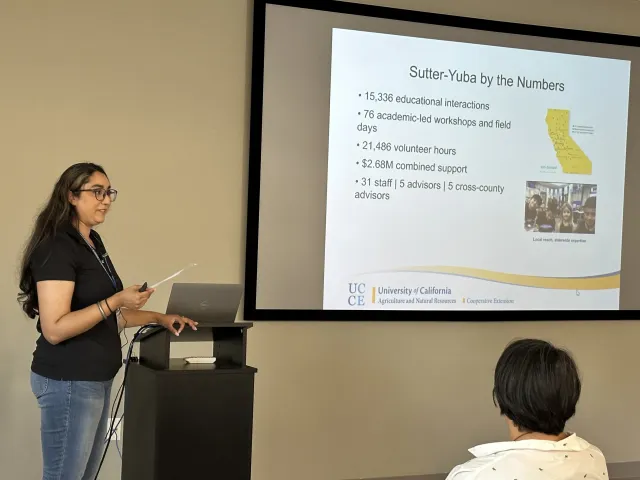
Next, Preet Ahluwalia, UCCE area director for Colusa, Glenn, Butte, Sutter and Yuba counties, cited examples of how UC ANR academics, staff, volunteers and partners help turn research into practical value for clientele. In particular, she highlighted UCCE agronomy advisor Sarah Light’s nitrogen calculator for fertilizer planning, volunteer-powered efforts to map priority invasive weeds, and connections in the community through the 4-H and UC Master Gardener teams.
The group then took the bus to the first stop of the Sierra Foothill REC tour, where attendees were greeted by Toby O’Geen, UCCE specialist and soil science professor at UC Davis. O’Geen pointed into the distance at shed-like structures dug into a hillside.
In each dug-out “trench,” metal trays collect water that is being analyzed for the concentration of carbon. O’Geen and his collaborators are looking at the effects of “enhanced rock weathering” – a process by which silicate rock breaks down in soil, draws carbon from the air and thus helps mitigate climate impacts caused by carbon emissions.
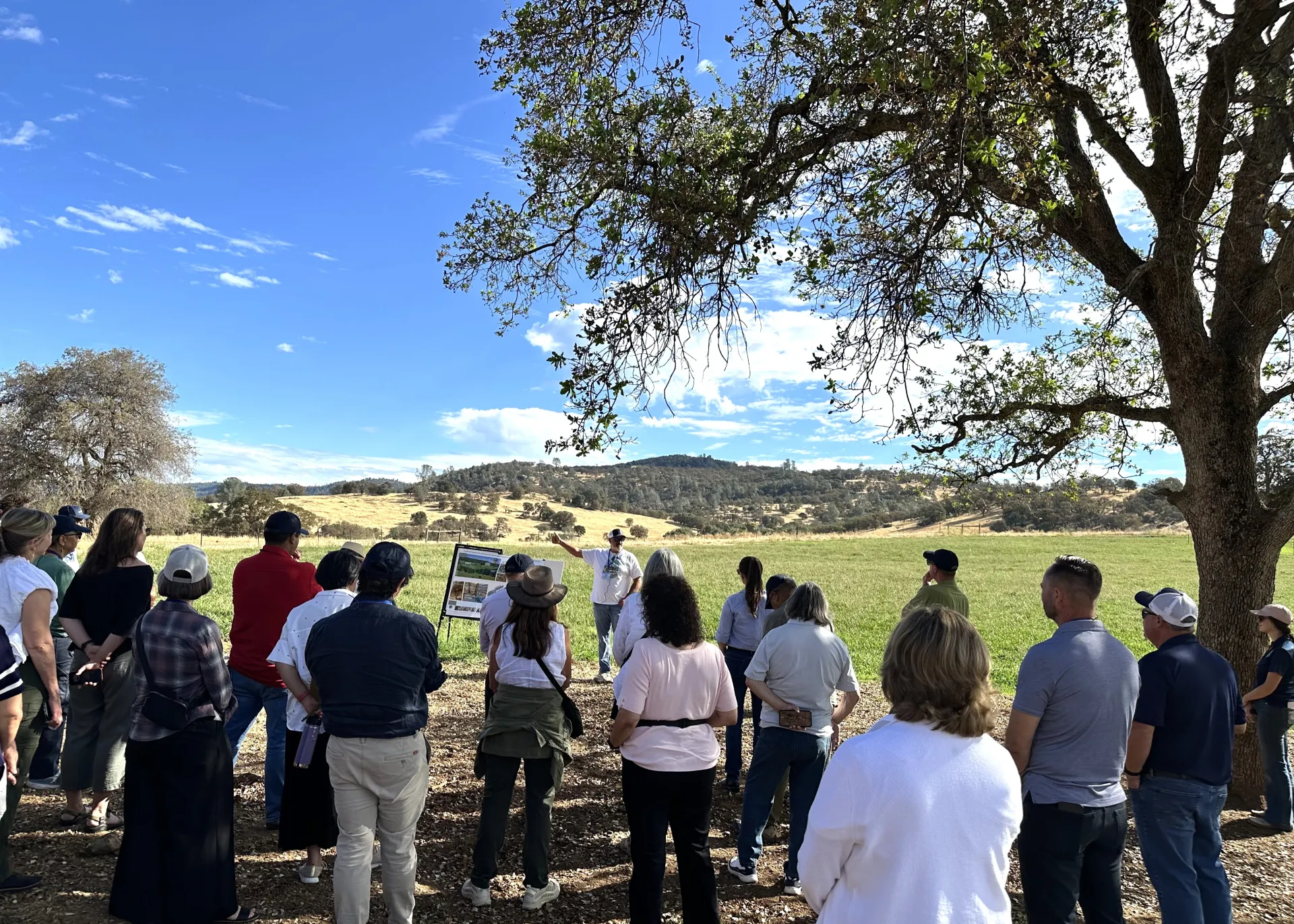
In the first study of its kind in the world, O’Geen noted that the application of finely crushed rock and mineral in a working agricultural landscape (as a way to super-charge the weathering process and consumption of atmospheric CO2) is indeed contributing to carbon sequestration. O’Geen is also looking at potential co-benefits of the practice, such as enhancing soil fertility and boosting forage yield and quality, as a way to incentivize adoption by producers.
O’Geen stressed that collaboration with UC Davis faculty and students and Lawrence Livermore National Laboratory – as well as support from SFREC – have been crucial in conducting this study.
“Here we have the research infrastructure to do this work and, more importantly, the human capital,” he explained. “That has been instrumental in the setup of our experiment. SFREC staff helped us build these plots, build the exclusions of cattle, apply the rock dust, and then build these very exciting ‘trenches.’”
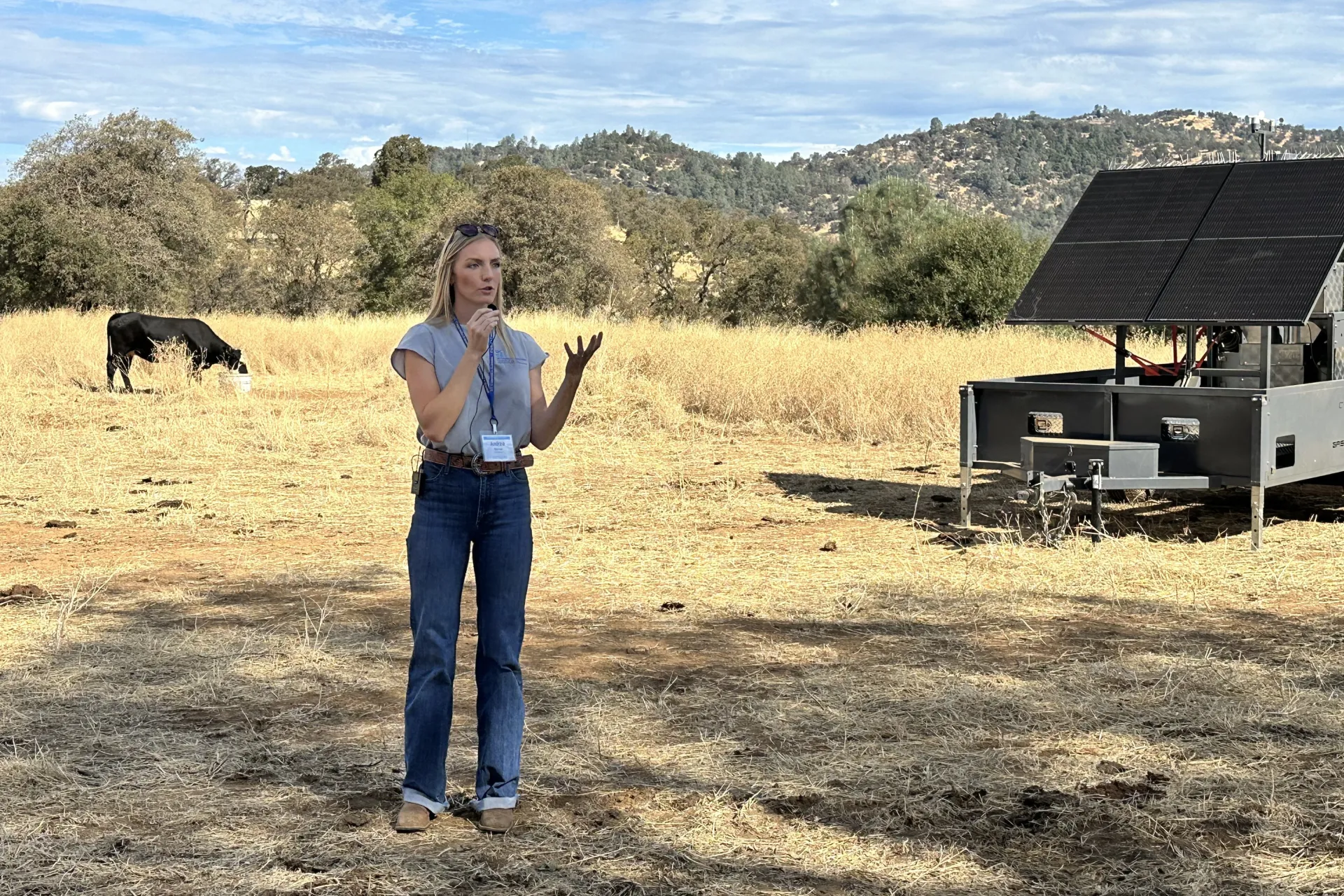
The group then walked down the dirt road to meet Andrea Warner, UCCE livestock and natural resources advisor for Sutter, Yuba, Placer and Nevada counties, and staff research associate Chloe LeMaire. With cattle grazing behind her, Warner provided an update on her team’s research on adding red seaweed to beef cattle rations in rangeland settings as a way to reduce methane emissions.
In the first part of this multi-phase study, the scientists have found that consumption of the seaweed additive in the mineral supplement varies widely with each individual’s feeding habits – but there remains a strong correlation between the amount of red seaweed consumed and reductions in methane.
“We’ve observed reductions in the 40% range, whereas some of the feedlot and dairy studies have shown an 80% reduction, but then those cattle are consuming the additive a lot more consistently than the rangeland cows do,” Warner said.
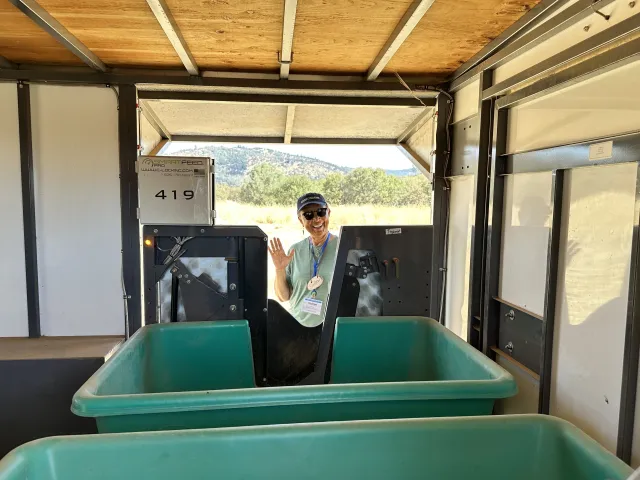
Tour participants also had an opportunity to get a closer look at the Smart Feeder, a trailer-like apparatus that controls the cows’ access to the mineral/red seaweed mixture. Also on view was the Green Feeder, a device with alfalfa treats that entices cattle to stand under a hood, where sensors measure the methane from the cow’s burps.
Then the bus took the group up a hill, where participants marveled at a sweeping view of the western horizon and the imposing Sutter Buttes in the distance.
They were greeted by Theresa Becchetti, UCCE livestock and natural resources advisor for Stanislaus and San Joaquin counties. Standing between greenhouse-like structures that move up and down the hillside on tracks, Becchetti explained that the overhead structures (designed by an engineering student at UC Merced) limit the amount of precipitation that reaches the test plots.
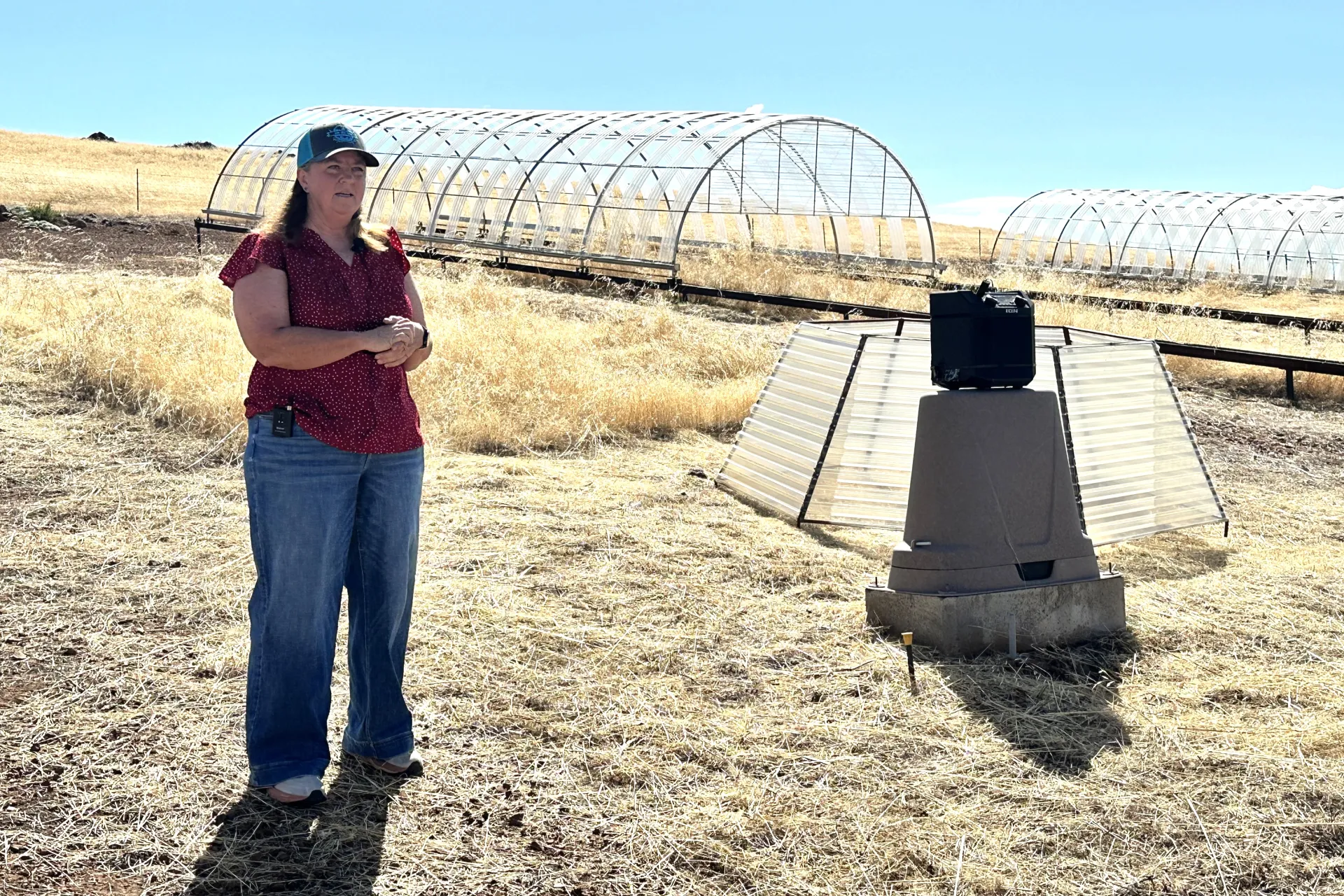
In a study initiated by former SFREC director Jeremy James, researchers are studying how annual grasses and forbs – the primary forage base on California rangelands – are affected by climate change. The experimental setup allows them to manipulate the microclimate (temperature and precipitation) across the plots and track the resulting changes in forage production and species composition. As expected, the scientists saw less forage production on the hotter and drier plots.
“With a hotter, drier climate, we’re going to have a shorter grazing window, and how are we, as Cooperative Extension, going to help the ranching industry solve that problem?” Becchetti said.
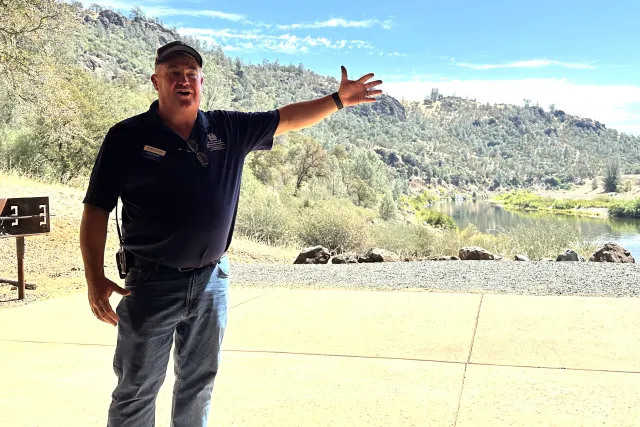
The bus then wound its way down the hill to the pavilion at the Yuba River Education Center, where Dustin Flavell highlighted UC research on the Chinook salmon spawning run in the stretch of river below. While enjoying the commanding view of the Yuba, the visitors concluded their two-day tour with a scrumptious barbecue lunch prepared by Sierra Foothill REC staff.
“I want to thank all the staff and academics who welcomed us and shared their knowledge and insights throughout the tour, with a special thank-you to Sherry Cooper and Kathy Eftekhari for handling the logistics,” said Humiston. “And, again, many thanks to our PAC volunteers and UC leaders for making the time to join us; their partnership and voices are vital to our mission at UC ANR and experiences like this give them an even deeper understanding of how our work makes a positive difference for California communities.”