
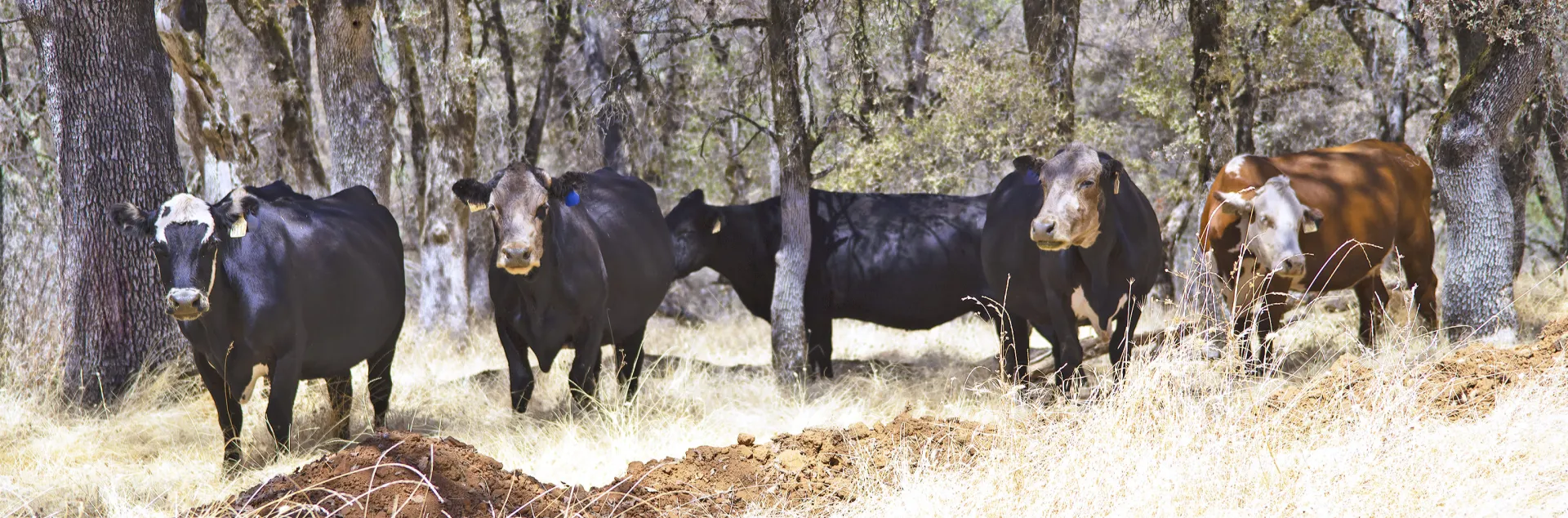
Project at UC ANR center in Yuba County probes additive effectiveness on rangelands
Previous studies have shown that adding red seaweed (Asparagopsis taxiformis) to beef cattle rations could reduce methane – a potent greenhouse gas – produced by the animals by up to 90%.
But those results were in controlled settings – not wide-open rangelands.
“The challenge now is finding a reliable method of delivering the seaweed product to cattle grazing on pasture,” said Andrea Warner, a University of California Cooperative Extension livestock and natural resources advisor for Sutter, Yuba, Placer and Nevada counties.
“Cattle in feedlots or dairies are being fed a total mixed ration every day and they’re in a more controlled environment,” Warner explained, “whereas out here [on rangelands] we could have cattle grazing on several hundred acres of pasture.”

Scientists added red seaweed to a salt-based mineral supplement mix, which they put in “free choice” feeders – covered metal troughs – in the pasture. When they tried to measure results, they discovered two things. One, actual consumption of the supplement was inconsistent, with seemingly less efficacy in decreasing methane output. And two, their conclusions were limited by significant shortcomings in their data.
“Our results really said that we needed better capabilities to make measurements,” said Sheila Barry, UCCE livestock and natural resources advisor for the San Francisco Bay Area.
Barry is the first author of a study published last year, funded by the Russell L. Rustici Rangeland and Cattle Research Endowment, UC Davis. The authors concluded that additional research – with improved equipment and methods – was needed to better understand how seaweed additives could realistically be incorporated into grazing systems.
That’s why Barry, Warner and their collaborators are back with a new project at UC ANR’s Sierra Foothill Research and Extension Center in Browns Valley, Yuba County. This study is funded by the California Department of Food and Agriculture’s Livestock Enteric Methane Emission Reduction Research Program.
The first phase of the project is running “palatability trials,” to gauge whether the addition of seaweed affects the cows’ consumption of the mineral. That will help the scientists determine optimal mineral mixtures. Subsequent phases will assess consistency of the cows’ consumption, verify any reductions in methane and measure impacts on livestock performance (i.e., weight change and body condition).
Research probes practicality of seaweed additives in grazing system
While methane produced by ruminants (cattle, sheep, goats, etc.) comprises only 6% of global human-related greenhouse gas emissions, curbing that methane is regarded as the “single most effective target for near-term climate change mitigation strategies.”
“Given that it’s a short-lived greenhouse gas, there’s an opportunity – if we can reduce the amount of methane that’s coming from ruminants – to contribute more quickly to reducing greenhouse gases in the atmosphere,” Barry said.

Livestock grazing, primarily by beef cattle, occurs across 34 million acres in California – about 33% of the state’s total land area. But those rangelands, which provide 70% to 80% of forage for the state’s grazing beef cattle, lack essential nutrients such as selenium, copper and zinc.
Thus, those minerals – usually in the form of a salty, sand-like product – are regularly provided to grazing cattle by ranchers. And that mineral supplement is a promising way to incorporate red seaweed (as well as bromoform, the active ingredient that reduces methane production) into the cattle diet.
But the first study of this approach conducted at Sierra Foothill REC ran into several problems. The amount of seaweed and bromoform consumed by the animals appeared to be highly variable.
Furthermore, the “laser methane detector” – a device that emits a laser beam and measures how much light is absorbed by methane – had its drawbacks. It required each animal to be confined to a chute for at least four minutes so their breath and burps could be measured, and this limited the number of cattle that actually produced usable readings.
Importantly, the study also didn’t track or account for individual consumption patterns – instead producing only averages. The “supplement consumed by each animal” was calculated by dividing the total amount of supplement consumed by the number of days in the feeding period and the number of heads in the test group.
“We didn’t have any way to measure individual intake or control individual intake,” Barry said.
The solution? Give the cattle electronic IDs.
New study deploys two innovative technologies
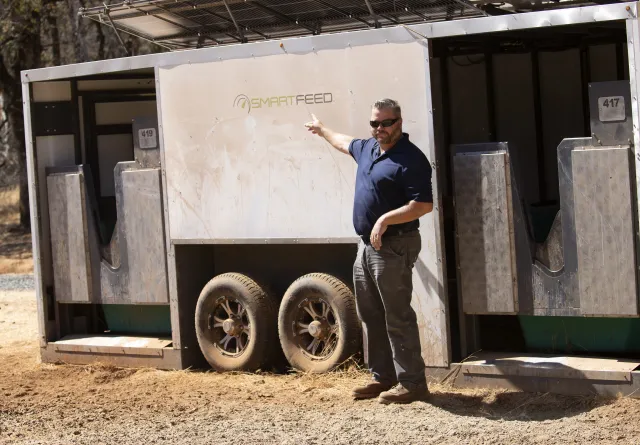
The researchers’ new study of the cow-calf system at Sierra Foothill REC uses a “Smart Feeder,” which features a shed-like structure that controls cattle’s access to the mineral supplement housed inside. It can provide four different treatments – two with plain mineral (no seaweed), and two with different formulations of the seaweed additive-mineral supplement mix.
When a cow puts its head into a feed bin to consume the mineral, a scanner reads the RFID (radiofrequency identification) tag on the animal’s ear, lowers a gate for access and weighs the feed bin before and after the cow’s snack time.
“The Smart Feeder records exactly how much mineral each individual animal is consuming, which will also allow us to calculate how much red seaweed they are ingesting,” Warner explained.
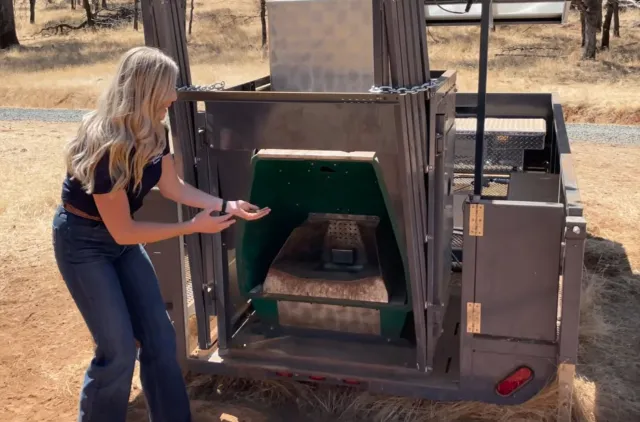
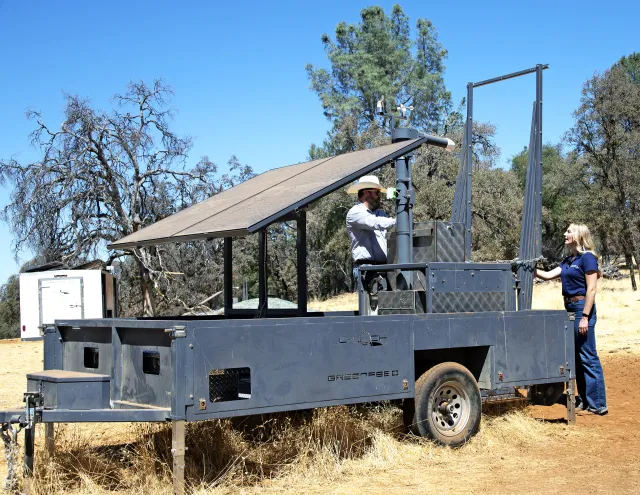
Secondly, to replace the laser methane detector, the team is deploying a “Green Feeder”, which acts like a bovine vending machine. The scientists are training the cows to approach and stay next to the machine for treats in the form of alfalfa pellets.
With the cow’s head comfortably in the “chamber” (which looks like a range hood), the device reads its RFID tag and dispenses the pellets, one small serving at a time, to keep the animal close to the feeder. Sensors continuously measure concentrations of carbon dioxide and methane and the system calculates overall gas emissions from the cattle.
“The Green Feeders measure methane but, in order to do that, the animals have to use these feeders for about three to five minutes,” Barry said.
New machines present new challenges
Getting the cows to stay put for accurate methane readings – and getting them accustomed to two different machines – are just some of the struggles that the researchers are working through.
“Using this technology on rangeland is proving to be very challenging, so we have had to go through a lot of troubleshooting,” Warner said.
Located in a remote area of the vast 5,700-acre Sierra Foothill REC, the Smart Feeders and Green Feeders rely on solar panels. The string of rainy, overcast days in early winter forced the team to use a generator.
Because the systems must be controlled and monitored remotely, an Internet connection also was required, which necessitated the installation of a “mini Starlink” – also solar-powered.
Various delays then pushed the timeline into calving season – a less-than-ideal time to start a study of the cows, most of which had calves.
“Cows, rugged terrain, weather events, research and technology are all tough to get on the same page, but we are getting there,” Warner said.
The researchers highlighted the team effort on the project, especially the contributions of UC Davis’ Jordan Munson, who manages the cow herd.
Sierra Foothill REC essential for conducting livestock studies
The team also praised the Sierra Foothill REC staff for keeping the project on track.
Barry singled out Chloe LeMaire, the staff research associate who has been doing the day-to-day tasks (like mixing the seaweed additive into the mineral), as well as the maintenance team and Scott Beasley – who built awnings to keep the feeders dry, made retrofits for solar panels and fixed faulty door latches.
“We have the machinery, we have the brain power, we have the passion, and we have the employees with the stick-to-it-iveness – so we’re able to have a full-service research center here in Browns Valley,” said Nikolai Schweitzer, Sierra Foothill REC agricultural operations manager.
Indeed, Barry acknowledges that their project would not even be possible without the resources available at the REC.
“The fact that we have livestock there – and people who can manage the livestock – that’s just instrumental,” she said. “You couldn’t do this elsewhere; we wouldn’t have been successful in getting funding to do a project like this without the research center.”
The study is slated to run through the end of 2027. Barry is the project lead, and UC ANR collaborators include Warner; Josh Davy, UCCE livestock and natural resources advisor for Tehama, Glenn and Colusa counties; and Gaby Maier, UCCE specialist for beef cattle herd health and production at the UC Davis School of Veterinary Medicine.