What is a Cover Crop?
Cover crops are grasses, legumes, forbs, or mixtures grown primarily to provide seasonal soil cover and conservation benefits- including increasing soil health (e.g. surface soil carbon, soil aggregation, water infiltration, and biological activity), controlling weeds, helping water. They are commonly planted between cash crops, when the field might otherwise be left bare, but they can also be established within a growing crop. The key characteristic of a cover crop is that it is grown to benefit the system – as described above – rather than for harvest. Instead of being harvested, cover crop biomass is either incorporated into the soil as green manure or retained on the soil surface as residue after termination. Cover crops can be grazed, provided sufficient plant biomass is retained as soil cover.
There is no single cover crop or mixture that is best for every field. Species selection and management should be based on the goals for the field, available water, planting and termination windows, and the crop that will follow. The Cover Crop Selector can be used to explore cover crop species and mixtures suited to specific management goals and growing conditions. For example:
- Legumes such as vetch and clover can fix atmospheric nitrogen
- Deep-rooted species such as radish can improve soil water infiltration
- Fast-growing grasses such as cereal rye can provide soil cover, reduce erosion/runoff, and capture residual nutrients.
Cover crops can increase crop diversity and may help disrupt certain weed, insect, and disease cycles - similar to rotating a cereal grain after several years of alfalfa. Flowering species such as mustards, vetches, and clovers can provide resources for pollinators and other beneficial insects.
Our Research
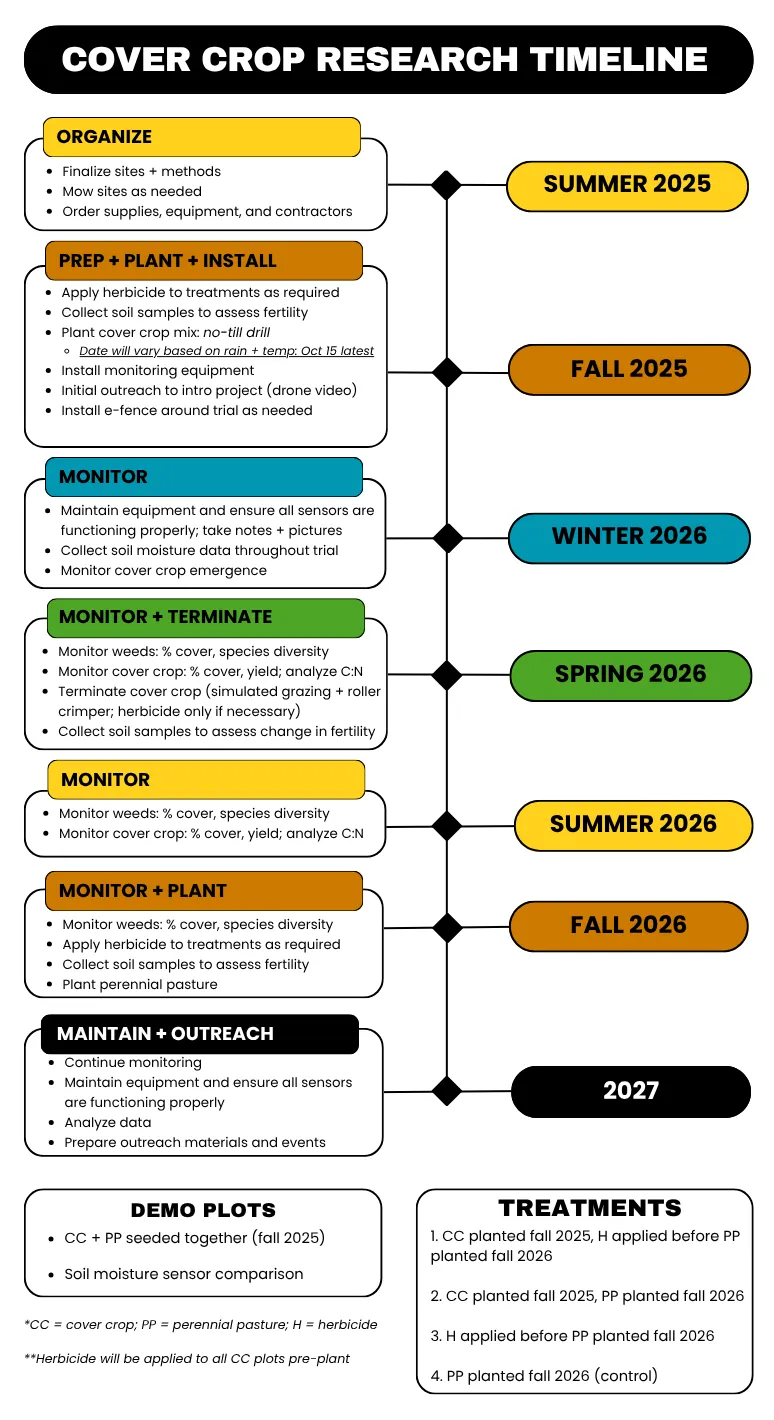
Our research project is examining whether a cover crop mix planted in fall can increase dryland perennial pasture establishment success (i.e, emergence and persistence) by controlling weeds and conserving soil moisture, two primary barriers. We selected a standard cover crop mix of 3 distinct species that, in theory, would have complementary soil health benefits: daikon radish (large taproot to reduce compaction and improve infiltration), wooly vetch (nitrogen fixing), and cereal rye (fast growing to increase cover and reduce runoff).
Goals and Objectives
The goal of this project is to develop more successful dryland perennial pasture establishment strategies, thereby creating a resilient, and economically profitable forage base for beef cattle operations in Siskiyou County. Precedent-setting irrigation water curtailments coupled with drought and precipitation uncertainty make perennial pasture establishment particularly challenging. To adapt, many ranchers seek dryland perennial grass varieties and novel dryland management strategies. The utility of cover crops has been extensively researched in other production systems and regions of California. However, ranchers in the intermountain region have little to no information about the utility of cover crops within their production system.
Objectives
- Evaluate the effect of a cover crop mix on the subsequent establishment of perennial grasses, including cover crop impacts on weed suppression and soil moisture.
- Calculate the economic impact of management strategies and associated grass establishment.
- Initiate the development of best management practices for cover crops in perennial grass pasture systems of the intermountain region of California.
Further reading:
California Department of Food and Agriculture. (2026). Healthy Soils Program 2026 practice guidelines. https://www.cdfa.ca.gov/oars/healthysoils/docs/HSP_2026_Practice_Guidelines.pdf
Clark, A. (Ed.). (2007). Managing cover crops profitably (3rd ed.). Sustainable Agriculture Research and Education (SARE) Outreach.
Mitchell, J. P., Singh, P. N., Wallender, W. W., Munk, D. S., Wroble, J. F., Horwath, W. R., Hogan, P., Roy, R., & Hanson, B. R. (2012). No-tillage and high-residue practices reduce soil water evaporation. California Agriculture, 66(2), 55–61. https://doi.org/10.3733/ca.v066n02p55
Mitchell, J. P., Cappellazzi, S. B., Schmidt, R., Chiartas, J., Shrestha, A., Reicosky, D., Ferris, H., Zhang, X., Ghezzehei, T. A., Araya, S., Kelly, C., Fonte, S. J., Light, S. E., Liles, G., Willey, T., Roy, R., Bottens, M., Crum, C., Horwath, W. R., . . . Scow, K. M. (2024). No-tillage, surface residue retention, and cover crops improved San Joaquin Valley soil health in the long term. California Agriculture, 78(2), 52–63. https://doi.org/10.3733/001c.94714
U.S. Department of Agriculture, Natural Resources Conservation Service. (2024). Conservation practice standard: Cover crop (Code 340). https://www.nrcs.usda.gov/sites/default/files/2024-06/340-nhcp-cps-cover-crop-2024.pdf
Wilson, R., Culp, D. A., Peterson, S., Nicholson, K., & Geisseler, D. (2019). Cover crops prove effective at increasing soil nitrogen for organic potato production. California Agriculture, 73(2), 79–89. https://doi.org/10.3733/ca.2019a0005
Image