
Background information

The Mediterranean oak borer (MOB) is an ambrosia beetle native to the Mediterranean region, including Europe, the Middle East, and North Africa, where it primarily attacks oak species. The first North American infestations of MOB were confirmed in valley oaks in Napa County, California in late 2019, followed by Lake and Sonoma Counties in early 2020, and Sacramento County in September 2020. MOB has since been found in Amador, El Dorado, Marin, Mendocino and Yolo Counties.
Almost around same time, a separate introduction of MOB was detected in Multnomah County Oregon in 2018. By 2025, detections of MOB occured in 6 Oregon counties: Clackamas, Marion, Multnomah, Polk, Washington and Yamhill. In Oregon, it is predominantly a problem in Oregon white oaks.
According to climatic suitability models by Dr. Gengpin Zhu at Washington State University, MOB will be able to establish widespread in California and along the western regions of Oregon and Washington.
Female beetles
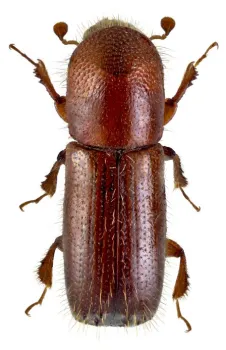
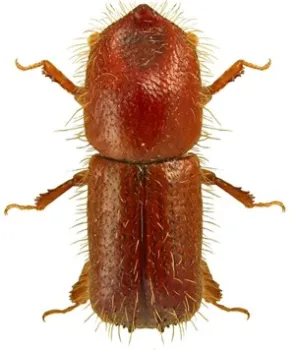
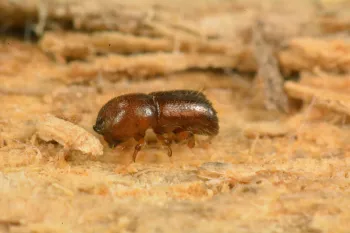
Female beetles are light brown and 3 mm (1/8 inches) long. MOB females can be separated from all other bark and ambrosia beetles in California by the squared off shape and pattern of bumps on the tip of the abdomen.
Male beetles
Life cycle
Beetles require 5-8 weeks to develop from egg to adult and can have three or more generations per year. In California mated females overwinter in the gallery system and emerge when the internal temperature of the tree reaches approximately 65° F. This internal temperature is typically reached between early March and late April when the nights are at least in the 50s and the daytime temperatures are in the mid sixties for 3 or more days, the seventies for two or more days, or the 80s for one or more days.
Mediterranean oak borers have sibling mating. Females can mate with their brothers prior to leaving the gallery and flying to a new tree to initiate construction of a new gallery where the cycle repeats. In addition, an unmated female can lay unfertilized eggs that develop into males that the female can then mate with to produce fertilized eggs that develop into additional females.