
What Is Hydroponics?
- Hydroponics is a method of growing plants without soil, using a nutrient-rich water solution instead.
- Water carries nutrients directly to the plant roots, so soil is not required.
- With roots immersed in a nutrient solution, plants receive consistent access to water and nutrients.
- Many systems also use an inert substrate, or growing medium, such as coconut coir, perlite, or vermiculite, to support the roots.
- Hydroponics is especially useful where space or soil quality is limited, such as in urban settings, balconies, patios, and school gardens.
Advantages
- Plants can be cultivated indoors or outdoors and, with appropriate lighting, grown year-round.
- Gardeners have greater control over nutrient levels, water, and environmental conditions.
- Plants typically grow faster and may produce higher yields than in comparable soil systems.
- Hydroponic systems reduce the risk of many soil-borne diseases, and no weeding is required.
- Systems can be designed for close plant spacing and vertical stacking, making efficient use of space.
- Many components, such as containers and plumbing, can be cleaned and reused.
- Hydroponic systems can use less water than outdoor, soil-based gardening because the nutrient solution is recirculated rather than lost to evaporation and runoff.
- Because hydroponics can reduce water use and fit into small spaces, it is suitable for both home and school gardens.
Disadvantages
- Initial setup costs are often higher than simple soil-based container systems.
- Some system assembly is required.
- Most systems require electricity for pumps and, when grown indoors, supplemental lighting; extended power outages or equipment failures can stress or kill plants.
- Successful operation requires basic knowledge and regular monitoring of water level, nutrients, and pH.
- If a disease or root problem occurs, it can spread quickly through a shared nutrient solution.
Hydroponic Systems
While there are many different hydroponic systems, they all share the goal of keeping plant roots supplied with water, nutrients, and oxygen, but they differ in how they deliver the nutrient solution and in their maintenance needs. Hydroponic systems are often grouped into passive (static) and active (dynamic) designs. Passive systems do not use pumps or powered equipment to move the nutrient solution and generally require less frequent adjustment and monitoring. Active systems use pumps and other specialized equipment to circulate and oxygenate the nutrient solution, so they require electricity as well as regular checks of nutrient concentration, water level, pH, and equipment for signs of leaks, blockages, and failures.
EXTERNAL IMAGE
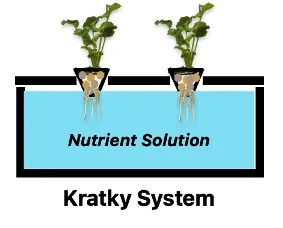
Developed by B. A. Kratky at the University of Hawaiʻi and introduced through research papers, extension articles, and patents beginning in the late 1980s, the Kratky method is a fully passive, non‑circulating hydroponic system. In this approach, plants are suspended above a reservoir of nutrient solution with no pumps, aeration equipment, or electricity; as plants grow and use the solution, the water level drops and creates an air gap that supplies oxygen to the roots. Ideal for beginners and small spaces, Kratky systems require only initial setup and simple monitoring, and are best suited to relatively fast‑growing crops such as leafy greens and herbs. Learn more about the Kratky Hydroponics method
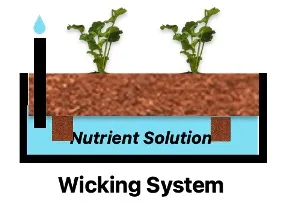
Utilizing a bed of growing medium above a reservoir, wicks passively transport nutrient solution from the reservoir into the plants’ root zone by capillary action. The growing medium supports the plants and provides an anchor point for the roots while helping distribute moisture around them. A fill tube allows the gardener to refill the reservoir without disturbing the plants, making this low-cost, passive approach a viable option not only for leafy greens and herbs, but, in larger and deeper containers, for root crops such as carrots and beets and for long-season or fruiting crops such as cucumbers, peppers, and tomatoes. Learn more about the Wicking Hydroponics method
EXTERNAL IMAGE
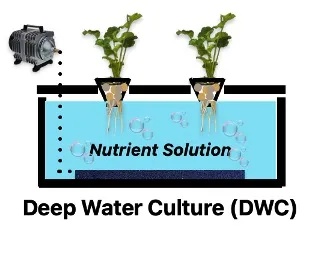
Deep Water Culture (DWC) is an active hydroponic system in which plant roots are suspended in a reservoir of nutrient-rich water, similar in layout to the Kratky method but with continuous aeration. Unlike passive Kratky systems, DWC relies on an air pump and air stone (and sometimes additional circulation) to keep the nutrient solution well oxygenated and generally requires regular monitoring and adjustment of nutrient concentration, water level, and pH. Commercial greenhouses and aquaponic operations commonly use large DWC “floating raft” beds, where plants grow on rafts that float on the nutrient solution in long raceways or ponds. DWC systems are most commonly used for fast-growing leafy greens and culinary herbs.
EXTERNAL IMAGE
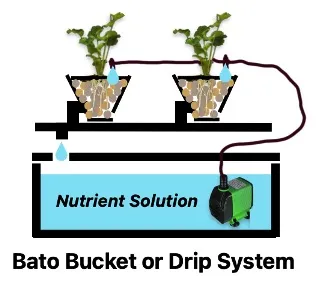
The Bato bucket (or Dutch bucket) drip system is an active hydroponic system that uses a pump to deliver nutrient solution from a central reservoir to individual media-filled buckets through drip emitters. As the solution drains through the growing medium and root zone, excess nutrient solution exits via drain fittings and typically returns by gravity through a common drain line to the reservoir (in recirculating systems) or is discharged in drain‑to‑waste designs. In commercial greenhouses, this system is commonly used for larger, high‑value crops such as tomatoes, cucumbers, peppers, and eggplant.
EXTERNAL IMAGE
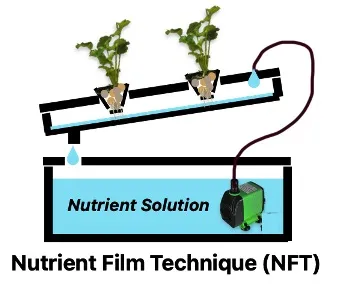
Nutrient Film Technique (NFT) is an active, recirculating hydroponic system in which a thin, continuous film of nutrient solution is pumped through slightly sloped channels, flowing over the plant roots and then draining back to a reservoir. Because the roots are exposed to a shallow stream of moving solution with plenty of air space, plants receive a steady supply of water, nutrients, and oxygen, but the system requires electricity and regular monitoring to maintain proper flow, prevent clogs, and adjust nutrient strength and pH. NFT is widely used for fast-growing, shallow-rooted crops such as lettuce and other leafy greens, culinary herbs, and, in some systems, strawberries.
EXTERNAL IMAGE
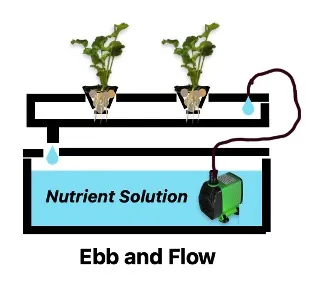
Ebb and flow, also called flood and drain, is an active hydroponic system in which plants sit in a shallow tray filled with a growing medium that is periodically flooded with nutrient solution and then allowed to drain back into a reservoir. A timer-controlled pump moves nutrient solution from the reservoir up into the tray, saturating the root zone; when the pump shuts off, gravity drains the nutrient solution away, leaving roots in moist media with ample access to oxygen between flood cycles. This versatile system can support a wide range of crops, from leafy greens and herbs to larger fruiting plants such as tomatoes, peppers, and strawberries, depending on tray depth, media choice, and flood schedule.
EXTERNAL IMAGE
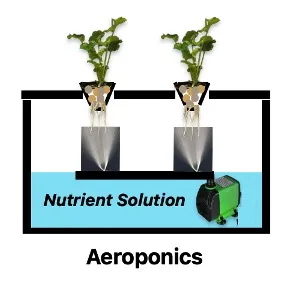
Aeroponics is an active hydroponic system in which plant roots are suspended in an enclosed air chamber and periodically misted with a fine spray of nutrient solution instead of sitting in water or growing media. Specialized pumps, nozzles, and timers deliver short, frequent mist cycles, providing very high root-zone oxygen and efficient nutrient uptake but also creating strong dependence on electricity and equipment functioning properly. Aeroponic systems are typically used for shallow-rooted, fast-growing leafy greens and herbs.
EXTERNAL IMAGE
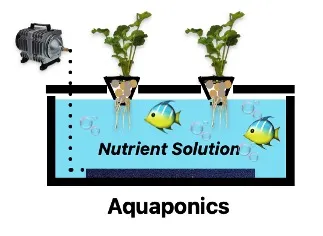
Aquaponics is an active system that integrates aquaculture (raising fish in tanks) with hydroponic plant production so that fish and plants share and continuously recirculate the same water. In many commercial greenhouse systems, fish are raised in one or more tanks and their nutrient-rich wastewater is pumped through mechanical and biological filters into hydroponic grow beds or channels, where plants take up dissolved nutrients before the cleaned water returns to the fish tanks. Aquaponic growers commonly stock fish such as tilapia, catfish, or koi and focus on fast-growing leafy greens (lettuce, kale, chard, Asian greens), herbs (basil, mint, parsley, cilantro), and, in more mature systems with higher nutrient levels, fruiting crops like tomatoes, peppers, and cucumbers. In a simple hobby setup, fish and plants may share a single tank, with plants suspended above the water so that their roots grow directly in the fish tank while the fish and beneficial bacteria provide nutrients and the plants help clean the water.
While aquaponics can function as a highly integrated ecosystem in which the fish help feed the plants and the plants help clean the water for the fish, the biggest pitfalls include the need to simultaneously maintain good water quality for fish and adequate nutrients for plants, the time required for biofilter bacteria to reach critical mass before supporting heavy plant loads, and the risk that equipment failures or disease outbreaks can quickly affect both fish and plants.
References
University of Minnesota Extension—Small-scale hydroponics
University of Nevada Extension—Hydroponics: A Brief Guide to Growing Food Without Soil
Oklahoma State Extension—Hydroponics
University of Illinois Extension—Home Hydroponics
Ryan Ronzoni, Cornell University—A Guide to Home Hydroponics for Leafy Greens
Neil Mattson, Cornell University—Fertilizer and water quality management for hydroponic crops