
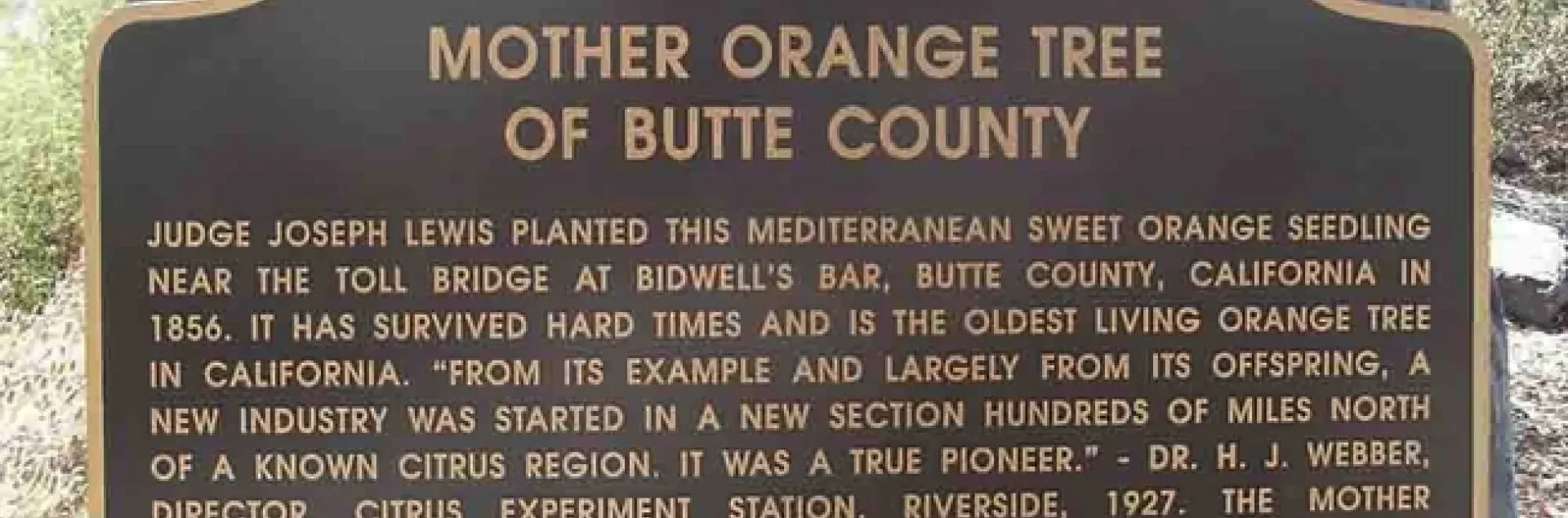
A Sweet California Success Story—and the Orchards We Lost Along the Way
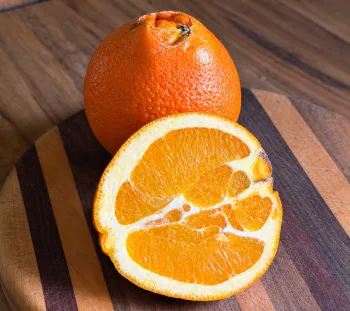
“California is a Garden of Eden,” Woody Guthrie sang in “If You Ain’t Got the Do-Re-Me.” But it was the orange tree, not the apple tree, that thrived in California. One of its most iconic citrus fruits, the Washington Navel Orange, is deeply connected to the development of the Southern California Orange Empire—a land not necessarily well-suited for the growth of citrus, with its too-cold winters and hardpan soil that doesn’t drain well.
The characteristic navel-like bulge at the end of the orange is actually an embryonic fruit—an outie—that gave the orange its name—the navel orange. It originated in Bahia, in northeastern Brazil. A spontaneous mutation occurred in an orange tree that produced juicy, flavorful fruit with very few seeds. The Brazilian growers immediately started grafting, eventually creating a whole orchard of what they called the “Bahia Orange.” In 1870, William Saunders, Chief Botanist for the USDA, had 10-12 cuttings shipped to the US and rechristened them the “Washington Navel Orange.” Saunders shipped two of these plants in 1873 to his friend, Eliza Tibbets, at the Tibbets Ranch in Riverside. Six years later, the Tibbets Orange took first place at the first annual Riverside Citrus Fair, unleashing a growers’ frenzy. Every grower wanted what was considered the “perfect” orange: a tree with a juicy, sweet-tasting fruit that separated easily into sections but had no seeds! Large orange groves with Tibbets Oranges (aka Washington Navels) exploded across Southern California, forming the Citrus Belt.
The combination of low humidity and wide temperature fluctuations in Southern California caused the navel to turn into a beautiful golden orange, unlike in the more tropical climates of Florida and Brazil, where it remained green. California’s unique climate also promoted higher sugar formation in the orange itself, producing the Washington Navel’s distinctive sweet, rich flavor. By 1900, there were 5 million cloned Washington Navel Orange trees, and the cities that sprang up next to these orange groves took on idyllic names like Arcadia, Orange, and Garden Grove.
But citrus groves are among the world’s most intensive crops, requiring huge inputs of capital and labor, water, fertilizers, and pesticides. The shallow-rooted tropical orange trees in the summer-dry climate of Southern California required regular irrigation. The problem was not a lack of water. The San Gabriel and San Bernardino Mountains had plenty of surface and subterranean water; the real problem was finding a way to bring that water to where it was needed. Water Districts constructed elaborate waterworks of dams, tunnels, flumes, canals, and ditches, some as long as 12 miles.
To fight the winter freezes of Southern California, growers turned to burning millions of gallons of crude oil in open smudge pots. Until 1950, smudge pots were regularly used to ‘heat’ entire orange groves whenever there was a threat of an overnight freeze. Finally, in 1949, responding to growing grassroots criticism, Governor Earl Warren signed the Air Pollution Control Act, placing orchard heating under the control of local counties. Within a year, growers had to apply for heating permits and use devices that conformed to stringent standards.
Even California’s natural barriers of distance and topography couldn’t keep pests out forever. In 1880, a tiny insect, the cottony cushion scale native to New Zealand, arrived and thrived on orange trees. Whole groves were destroyed before a USDA entomologist identified in 1888 an Australian ladybird, the Vedalia Beetle, as a natural predator of the scale. It was quickly imported and released, “cleansing” orchards successfully of that scale. But other diseases followed, causing leaf drop, fruit drop, fruit discoloration, and dieback. Growers resorted to two strategies: wet spraying and fumigation, tenting whole trees to apply hydrocyanic gas (HCN). Later, with the invention of the airplane, they would also use crop dusting. The unregulated application of toxic sprays and fumigation was not only very costly and frequently ineffective, but it also wreaked havoc on the environment, killing birds and beneficial insects.
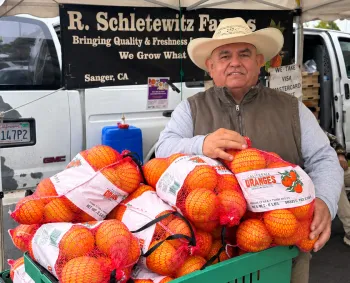
California’s citrus acreage reached its all-time high of 350,000 acres in 1945. Eleven years later, it was an historic low of 250,000 acres. First to go were the orange groves in Los Angeles County, then Orange County, replaced by tract housing developments and freeways. In 1955, Disneyland in Anaheim replaced a grove of 4000 Valencia orange trees. Today, the only remaining orange grove in San Gabriel Valley is in a back corner of the Huntington Botanical Gardens, where visitors are not permitted. Premium Washington Navel Orange production still continues today in Fresno, Tulare, and Kern Counties, but the vast citrus groves that once stretched across Southern California are largely a memory. It is hard not to feel a sense of nostalgia—and loss—for that old Citrus Belt, when fragrant orange blossoms filled the air, and seemingly endless orchards transformed the landscape into something that seemed almost like a Garden of Eden.
Source:
Farmer, Jared. Trees in Paradise: A California History. New York: W. W. Norton & Company, 2013.
Interesting read with more detailed information
Did this story leave you curious about California’s agricultural past? We’d love to hear from you! Let us know if you'd like to learn more about historic fruit trees, crops, or farming stories in future articles.
Learn more:
The Parent Washington Navel Orange Tree—Its First Years, UC ANR, Topics in Subtropics
https://ucanr.edu/blog/topics-subtropics/article/parent-washington-navel-orange-tree-its-first-years
The Parent Washington Navel Orange Tree—Its Decline and Recovery, UC ANR, Topics in Subtropics
https://ucanr.edu/blog/topics-subtropics/article/parent-washington-navel-orange-tree-its-decline-and-recovery
California Citrus and The Mother Orange Tree, UC ANR, The Real Dirt
https://ucanr.edu/blog/real-dirt/article/california-citrus-and-mother-orange-tree
Previous List of Articles Next