
by Tim Long, Stanislaus County, Online Delivery Program Volunteer
Salsa literally means "sauce" in Spanish and Italian. And of course, it is a music genre/dance style you may have seen on Dancing with the Stars…but I digress—we’re talking about food products here.
Traditional salsa is made from a base of fresh tomatoes or tomatillos, chili peppers, onions, garlic, and fresh cilantro, all seasoned with salt and fresh lime juice.
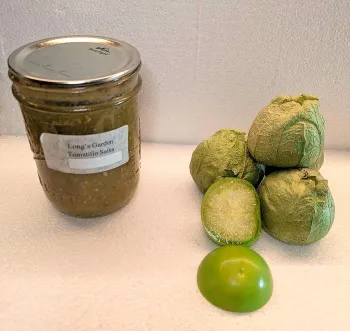
However, salsa can be made using ingredients other than tomatoes. One of the more common substitutions would be using tomatillos instead of tomatoes. This is commonly called Salsa Verde. Tomatillos are green, husk-wrapped fruits that provide the closest traditional texture and tart flavor to tomato-based salsa when boiled, roasted, or blended raw with onions and peppers.
There are also fruit-based salsas. Some examples would be mango, peach, pineapple, and/or strawberry mixed with finely diced onions, jalapeños, cilantro, and lime juice, creating a sweet and spicy topping.
Most salsa recipes feature tomatoes; however, fruit-based salsas are increasingly competing with tomato salsa. Both types of salsa are tasty and nutritious. Many people have developed their "special" salsa recipe using a unique blend of ingredients. A food safety issue is created when home food preservers use their “special" salsa for home canning. Freezing is the only safe option for preserving untested or original salsa recipes.
Because most salsa recipes contain low-acid foods, special care must be taken to can salsa safely. When making salsa for a shelf-stable canned product, always use research-based recipes that contain adequate acidity to control the growth of Clostridium botulinum spores that can cause botulism. Recipes for canning both tomato and fruit salsa can be found at the National Center for Home Food Preservation. Although it is important to follow a research-based recipe, some substitutions can safely be made, as listed below.
Safe substitutions for home-canned salsa recipes
Some changes may be made safely to canning recipes!
Before any changes are made to a tested recipe, it is important to understand the impact the change will have on either the pH or the processing time and temperature.
Salsa Substitutions
You May:
- Reduce or eliminate the sugar or salt in any tested salsa recipe.
- Substitute sweet peppers for hot peppers, and vice versa, measure for measure when preparing home-canned salsa using a tested recipe. The same is true for onions, because red, white and yellow onions are interchangeable, measure for measure.
You May NOT:
- Thicken salsa before canning.
- Add ingredients such as corn or black beans to any salsa recipe, or substitute corn or black beans for other ingredients such as peppers or onions before processing. You can add these after opening the jar, just before serving the salsa.
- Never reduce the amount of vinegar, lemon juice, or lime juice in a recipe. An equal amount of bottled lemon or lime juice can be substituted for vinegar when the recipe calls for vinegar. The reverse is not true. When lemon or lime juice is the acid called for in the recipe, vinegar cannot be substituted. This is because vinegar is less acidic than lemon or lime juice, and the substitution would result in an unsafe salsa.
- Key lime juice should not be used as lime juice because it is not as acidic as regular lime juice.
Now I’d like to touch on your choice of peppers for your salsa. Peppers range from mild to fiery hot in taste. Small peppers in the 1–3-inch (2.5–7.6 cm) range tend to be hotter than larger ones. The seeds and membranes, which contain the most heat in peppers, can be removed before adding them to the salsa mixture to moderate the heat somewhat.
The skin of long green chilies can be tough and can be removed by heating or roasting the peppers before using them. Finely chopped peppers are usually not skinned.
Wear rubber gloves when you handle hot peppers because oils in the peppers cause extreme irritation to the skin; do not touch your eyes or other sensitive tissues.
Canned chilies may be used in place of fresh.
You can substitute one type of pepper for another, but do not increase the total volume of peppers in any recipe.
Peppers are what determine the “heat” or spiciness of your salsa. Below are some common peppers with their measured Scoville heat unit (SHU), the higher the SHU, the hotter the pepper:
Common Peppers and Scoville Heat Units (SHU)
- Bell Pepper: 0 SHU (No heat)
- Poblano/Anaheim: 1,000 – 5,000 SHU (Mild)
- Jalapeño: 2,500 – 8,000 SHU (Medium)
- Serrano: 10,000 – 25,000 SHU (Hot)
- Cayenne: 30,000 – 50,000 SHU (Very hot)
- Habanero: 100,000 – 350,000 SHU (Extremely hot)
- Ghost Pepper (Bhut Jolokia): 855,000 – 1,041,427 SHU (Superhot)
- Carolina Reaper: 1,400,000 – 2,200,000+ SHU (Superhot)
This is when the Master Gardener in me comes out, so I can tell you about two peppers that are not listed above, but will give you great flavor without the heat.
A substitute for Jalapeño is a variety called Nadapeño. It is similar to a bell pepper in terms of heat (none) but tastes like a Jalapeño.
The second is a substitute for Habanero whose variety name is Habanada. It looks and tastes just like a Habanero but has NO heat.
Unfortunately, you are not likely to find these in your local produce market. I discovered their seeds online because my wife has an issue with spice and cannot tolerate even mildly spiced foods. I grow these varieties in my garden. They grow and look just like their spicy cousins, from whom their names were derived.
If you’re interested in learning more about salsa, particularly non-tomato-based versions, you should join our free online class on Saturday, September 19, 2026, from 10-11 a.m. PDT. The class is called Salsa Beyond Tomatoes. You can reserve a spot for this free event on Eventbrite. If you can’t join us live, the recording of the class will be posted a few days after the event on our recorded events webpage.