

Research Brief • June 2026 • Download PDF (262 KB)
CalFresh Healthy Living (CFHL), California’s SNAP-Ed program, promotes healthy lifestyles through nutrition and physical activity interventions delivered in low-income communities across California. This program has been administered by four state implementing agencies, the largest of which is the California Department of Public Health (CDPH). The primary focus of CDPH-CFHL is creating conditions that enable SNAP-eligible populations to make healthy choices via policy, systems, and environmental (PSE) change efforts. PSE efforts are enhanced by educational activities and supported by partnerships and multi-sector coalitions. Historically, CDPH has funded all of California’s 61 local health departments (LHDs) to plan and deliver CFHL programming in their communities.
When it was signed into law in July 2025, HR 1 (commonly known as the One Big Beautiful Bill) ended the mandatory funding for SNAP-Ed nationwide after the federal fiscal year (FFY) 2025 grant period, with funds expiring September 30, 2025. However, states received approval to utilize unspent FFY 2025 funds in FFY 2026 (October 1, 2025-September 30, 2026). With these carry-over funds, the CDPH-CFHL program continued through April 30, 2026.
PROGRAM REACH
LHDs’ FFY 2025 CFHL interventions reached 2.7 million individuals, representing 25% of eligible participants and 10% of California’s total population. LHD teams and partners reached:
1,346,195 individuals with PSE Interventions
134,302 participants of Direct Education Programs
2,022,470 individuals with Indirect Education Activities*
2,740,353 individuals overall
*Includes 1,259,856 individuals reached only by Indirect Education Activities
WIND-DOWN OF LOCAL PROGRAMS
CDPH directed LHDs to start phasing out direct services beginning October 1, 2025, and encouraged them to identify the most impactful activities and to pursue strategies, when possible, to maintain and/or sustain nutrition and physical activity work. Although two LHDs declined carry-over funds, 59 LHDs participated in the FFY 2026 program wind-down.
HOW WE EVALUATED THE PROGRAM WIND-DOWN
Evaluators at the Nutrition Policy Institute (NPI) developed a custom module in the SNAP-Ed Program Evaluation and Reporting System (PEARS) to document the program wind-down. This module asked California’s LHDs to report the ways in which they had worked during FFY 2026 towards sustaining and transitioning community nutrition and physical activity programming supported by CFHL. Of the 59 LHDs engaged in FFY 2026 wind-down programming, 57 (97%) reported their activities between February 10 and March 31, 2026. LHDs shared information about:
Delivering train-the-trainer sessions to partners to transition nutrition and physical activity programming
Providing written guidance to partners about closing out, transitioning, or sustaining CFHL efforts
Efforts to identify and apply for new sources of funding for the jurisdiction
What nutrition and physical activity programming they anticipate will continue
Findings in this brief are presented as a percent of the total sample of 57 LHDs unless otherwise noted.
ACTIVITIES TO SUSTAIN AND TRANSITION CFHL PROGRAMMING
Nearly all LHDs (96%, n=55) reported engaging in one or more activities to sustain or transition their nutrition and physical activity programming.
74% offered train-the-trainer sessions to partners
68%provided written guidance to partners
46% identified or applied for funding
44% engaged in other sustainability or transition efforts
Other efforts included identifying specific internal and external partners to take on components of an LHD’s program, distributing educational materials and supplies, and taking action to ensure that current PSEs like gardens could be maintained. LHDs described examples of these activities:
“The small portion of the CFHL work that will continue to be supported by [our] County is limited Rethink Your Drink indirect education efforts which will continue under the Oral Health Program.”
“We provided after-school Cooking Clubs with a donation of art and cooking supplies to support hands-on nutrition education. We also supplied cooking equipment (blenders, containers, and cutting boards) to help sustain food preparation lessons for students from preschool to fifth grade. We provided supplies to other partners for food tastings and family cooking nights.”
“The Public Health branch has identified that the Maternal Child and Adolescent (MCAH) scope of work focuses on nutrition education and physical activity so staff from CFHL will transition to MCAH along with another grant. We are confident that we will be able to sustain CFHL work to some degree. The focus initially will be to sustain the relationships and programming that CFHL has already established through FFY 27. The scope may not be as great as with the CFHL grant, but the hope and goal is to preserve some nutrition education and physical activity programming in some capacity.”
Train-the-trainer Sessions
Forty-two LHDs reported that train-the-trainer sessions were offered to their partners, with 23 reporting training related to both PSE and DE. Seven LHDs offered train-the-trainer sessions related to PSE only, and 10 offered sessions related to only DE.
PSE train-the-trainer sessions were offered to a range of 1-15 partner organizations (median=3).
The most common settings where PSE partners were trained to implement programming are:
K-12 schools (37% of LHDs)
Early childhood programs (26% of LHDs)
Community & rec centers (19% of LHDs)
Before & after school programs (16% of LHDs)
Food banks & pantries (11% of LHDs)
DE train-the-trainer sessions were offered to a range of 1-28 partner organizations (median=3).
The most common settings where DE partners were trained to implement programming are:
K-12 schools (44% of LHDs)
Early childhood programs (26% of LHDs)
Community & rec centers (23% of LHDs)
Before & after school programs (18% of LHDs)
Food banks & pantries (18% of LHDs)
Healthcare settings (16% of LHDs)
Providing Written Guidance
Thirty-nine LHDs (68%) provided written guidance to their partners about how to sustain, transition, or close out their CalFresh Health Living programming.
47% provided written sustainability guidance
47% provided guidance for transitioning activities
37% provided guidance for closing out activities
32% provided no written guidance for sustainability, transition, or close-out
Identifying & Applying for Funding
Twenty-six LHDs - nearly half - reported participating in efforts after July 1, 2025 to identify or apply for funding to sustain nutrition and physical activity programming within their jurisdiction. This included 3 LHDs with funds available from an existing tax or bond measure and 2 LHDs that hope to apply for funds from a future measure.
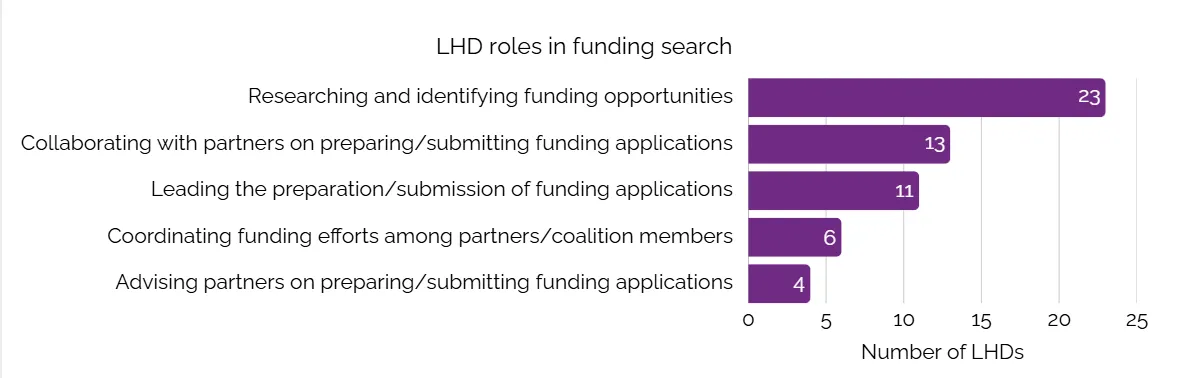
LHDs (n=25) took a variety of roles in identifying and applying for other funding sources. By far the most common role was researching and identifying potential funding opportunities, reported by 23 LHDs.
The 25 LHDs that reported engaging in funding efforts sought funding from the following sources:
81% Government (21 LHDs)
46% Private foundation (12 LHDs)
15% Donors (4 LHDs)
19% Other funders (5 LHDs)
While nearly half of LHDs were active in researching and pursuing funding opportunities, only 6 LHDs reported having secured new funding since July 1, 2025. The total dollar amount secured ranged from smaller amounts between $10,000-$50,000 to over $500,000. In addition, 12 LHDs reported having pending funding applications; 5 of those were LHDs that did not report having already secured funding.
LHDs that reported successful funding efforts varied in size and geographic region of California. Identified funding sources included:
Government
Kaiser Permanente Foundation
Managed care plan funds
The LHDs that successfully secured new funding reported applying for funds to be used for...
LHD responses demonstrate their commitment to pursuing new funding to sustain nutrition and physical programming, their priorities for how to use new funding, as well as the challenges they faced in successfully securing these funds:
“Previously submitted proposals were not funded, however, it is our main priority to continue finding funding to support this work.”
“We have applied for funding to increase nutrition security throughout the county. If secured, we will increase food distributions and serve as a food recovery organization.”
“Staff actively explored and assessed multiple funding opportunities to sustain key program components. While some opportunities were ultimately not pursued due to eligibility limitations or alignment with funding criteria, these efforts informed the division’s ongoing strategy to identify viable funding pathways. The Health Department will continue to monitor and pursue funding opportunities that support the continuation of community-based nutrition and physical activity programming, including partnerships that expand access and sustainability.”
THE FUTURE OF NUTRITION AND PHYSICAL ACTIVITY PROGRAMMING
Despite efforts to transition programming to partners and secure alternative funding, LHDs indicated that the loss of SNAP-Ed funding will have a dampening impact on their future capacity. This includes capacity to deliver nutrition and physical activity programming directly or via partners, to coordinate activities across their jurisdictions, and to carry out the data and evaluation activities necessary to support high quality, evidence-based programs.
Future Programming & Leadership Role
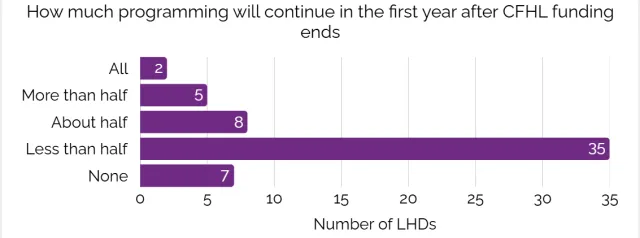
Nearly three-quarters of LHDs (73%, n=42) reported that less than half or none of the programming previously supported by CFHL would continue in the first year after the funding ends (from May 1, 2026 through April 30, 2027). When answering, LHDs were asked to consider all programming directly implemented by the LHD or by partners (funded or unfunded) under the LHD’s support and jurisdiction.
A large majority of LHDs (86%, n=49) have served in a leadership role coordinating nutrition and physical activity in their jurisdiction. Of these, less than half (43%, n=21) reported that they will continue their leadership role after CFHL funding ends.
“While efforts have been made to sustain select initiatives through partnerships and integration into other programs, maintaining the same level of reach and impact will be a challenge without dedicated funding and infrastructure.”
Capacity for Data & Evaluation Activities
Among LHDs (n=41) that expect to have some nutrition and physical activity programming in the future, a majority (61%, n=25) responded that they anticipate not having sufficient staff, time, or other resources for one or more of the data and evaluation activities involved in supporting this programming.
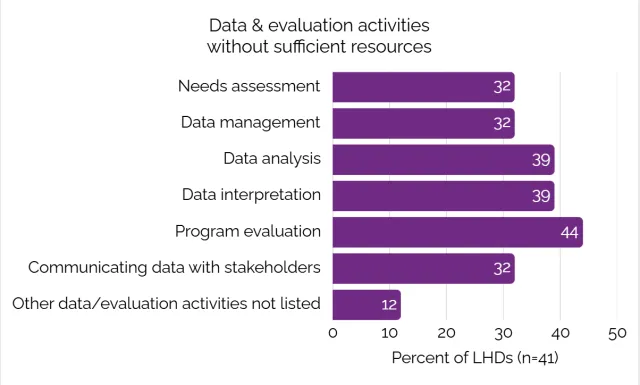
Of these activities, LHDs most commonly anticipated not having sufficient resources for program evaluation, followed by data analysis and data interpretation.

These materials were created as part of a contract with the California Department of Public Health with funding from the United States Department of Agriculture (USDA) Supplemental Nutrition Assistance Program (SNAP). These institutions are equal opportunity providers and employers.
Suggested Citation: Rider CD, Kao J, Westfall Brown M. California Department of Public Health and Local Health Department Efforts to Sustain Community Nutrition and Physical Activity Programs after the Loss of Federal SNAP-Ed Funding. Research Brief. Nutrition Policy Institute, University of California, Agriculture and Natural Resources. June 2026.
University of California Agriculture and Natural Resources is an equal opportunity employer.
© 2026 UC Regents, Creative Commons 4.0 International License.
