


Research Brief • July 2026 • Download PDF (148 MB)
Background
For over three decades, SNAP-Ed (the Supplemental Nutrition Assistance Program- Education) worked to improve nutrition and physical activity (PA) behaviors among low-resource populations through education and policy, systems, and environmental (PSE) change approaches. In California, SNAP-Ed was known as CalFresh Healthy Living (CFHL) and was implemented through multiple agencies, including the California Department of Public Health (CDPH).
CDPH disseminated SNAP-Ed funds to all 61 local health departments (LHDs), who in turn partnered with community organizations to implement programming tailored to the unique needs of their community. Sometimes community organizations received SNAP-Ed funds from LHDs to support program delivery.
In July 2025, the passage of H.R. 1 defunded the SNAP-Ed program.
What We Evaluated
The Nutrition Policy Institute administered an online survey to organizations who had partnered with LHDs to plan and deliver SNAP-Ed programming in federal fiscal year 2025. The survey assessed whether organizations would be able to continue nutrition and PA initiatives without the support of the LHD SNAP-Ed program; whether the loss of funding would impact staffing among organizations who received SNAP-Ed funding from LHDs; and how the loss of the SNAP-Ed program may impact community health.
A total of 118 community organizations responded to the survey. Most were K-12 schools (36%) or before and after school programs (9%), food assistance organizations (14%), or early care and education sites (9%). Less than half (43%) received SNAP-Ed funding.
What We Found
Few community organizations will be able to continue all SNAP-Ed-initiated nutrition and PA initiatives
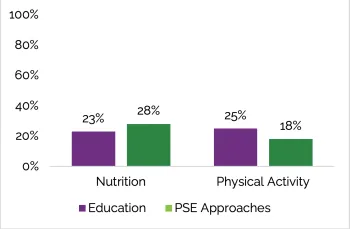
Only about a quarter of organizations reported that they would be able to continue all of their education efforts focused on nutrition (23%) and physical activity (25%) (Figure 1). Similarly, a minority of organizations indicated they would be able to continue all PSE efforts related to nutrition (28%) and PA (18%).
Partners who did not receive SNAP-Ed funding more frequently reported the ability to continue programming.
Figure 1. Proportion of Partner Organizations Able to Sustain All SNAP-Ed-Initiated Efforts after Defunding
SNAP-Ed was a key funding source for nutrition & PA initiatives
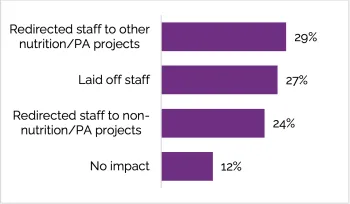
Among funded partners (n=51), more than one-third (34%) reported that all of their organization’s nutrition and PA funding was from SNAP-Ed. The majority (88%) reported that the loss of funding would have impacts on staffing, including layoffs (27%) and redirection of staff to other projects either related to nutrition/PA (29%) or not (24%) (Figure 2).
Figure 2. Proportion of Funded Partner Organizations Reporting the Following Impacts on Staffing (n=51)
Adverse effects on community health are expected
"Without [SNAP-Ed], we anticipate a decrease in awareness and knowledge around healthy eating habits, which may lead to increased rates of food insecurity, poor nutrition, and related health issues such as childhood obesity and chronic conditions."
Impacts will be felt across the lifespan, especially among vulnerable populations
The importance of SNAP-Ed for children and older adults was commonly described.
“Some of the most impactful classes were the ones where [students] learned how much sugar juice or soft drinks have and how sugar impacts their bodies… CFHL really helped us provide impactful healthy living information in a way kids were able to understand.”
Organizations expressed concern that the loss of SNAP-Ed would exacerbate existing inequities.
”Future generations lose out on the ‘upstream’ interventions that prevent illness before it starts, further widening the gap between affluent and underserved neighborhoods.”
Implications & Conclusions
Our findings suggest that the defunding of SNAP-Ed will result in decreased capacity among community organizations – such as schools, early care and education sites, and food assistance sites – to implement education and environmental change interventions that promote healthy eating and active living.
For More Information
Learn more about NPI’s CalFresh Healthy Living evaluation and access legacy resources.

These materials were created as part of a contract with the California Department of Public Health with funding from the United States Department of Agriculture (USDA) Supplemental Nutrition Assistance Program (SNAP). These institutions are equal opportunity providers and employers.
Suggested Citation: Vasicsek, R, Linares, A, Baig, R, Hewawitharana SC, Brown MW. Defunding SNAP-Ed: The Impact on Community Organizations Across California. Research Brief. University of California, Agriculture and Natural Resources, Nutrition Policy Institute. July 2026.
University of California Agriculture and Natural Resources is an equal opportunity employer.
© 2026 UC Regents, Creative Commons 4.0 International License.
