
UC ANR is pleased to release the 2026 Call for UC Cooperative Extension (UCCE) Advisor and Specialist Positions. This call builds on the almost 50 positions approved during the 2024 call and the 2022 historic release of more than 100 UCCE positions over several years.
UC ANR continues to prioritize growing its academic footprint to provide the expertise needed to improve the lives of all Californians and address emerging and future needs. We plan to release 13 to 14 new priority UCCE Advisor positions and 6 to 7 new priority UCCE Specialist positions.
Process Overview
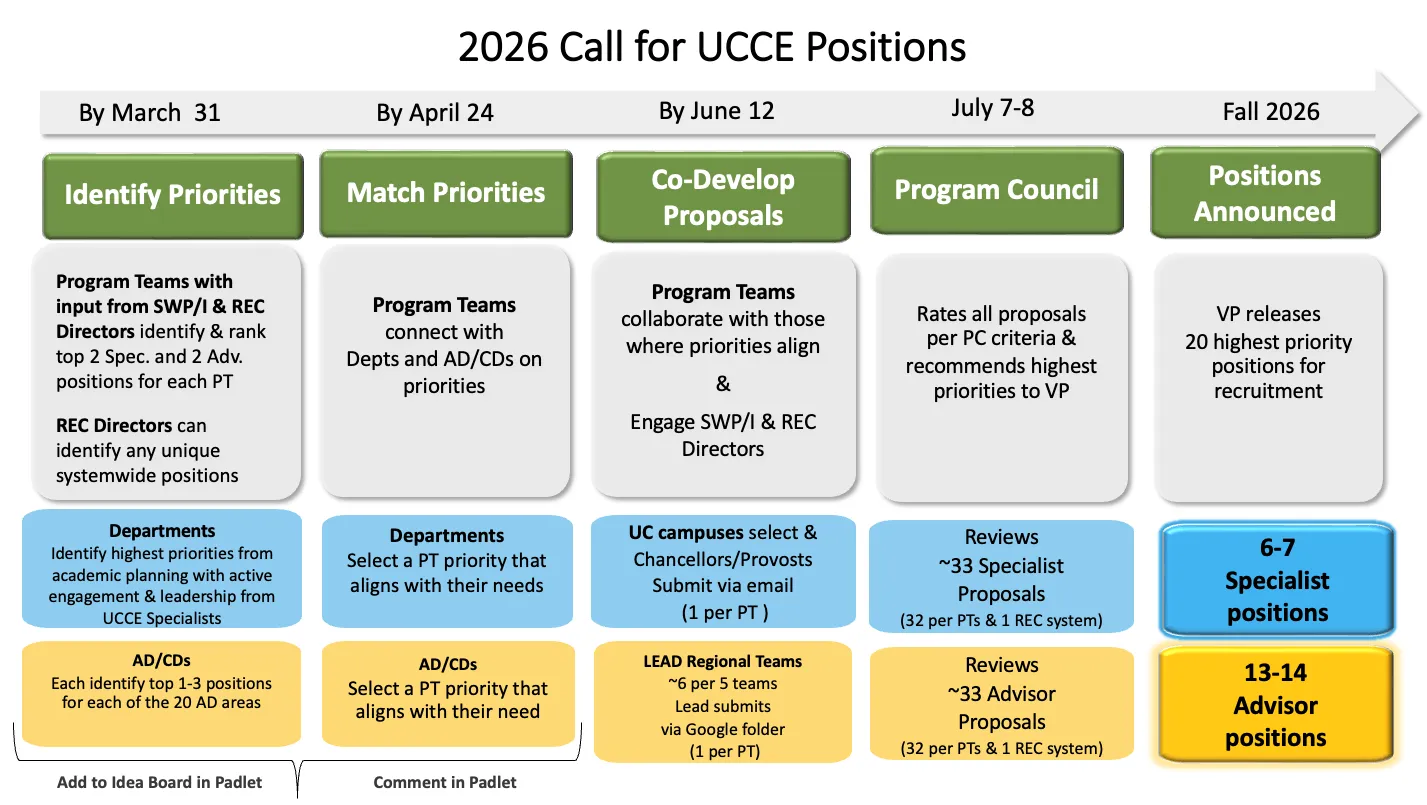
The process includes five stages: identifying priority positions, matching priorities with other groups, proposal co-creation and submission, Program Council review, and final position announcements.
View the process orientation webinar recording and presentation slides from March 4 for Program Team Leaders, Statewide Program/Institute Directors, Area/County Directors, and campus leadership.
Timeline
Stage 1: Identify priority positions by March 31
Designated groups identify and post their top priority positions and rankings to Idea Board. These groups work collaboratively across the UC ANR network and seek external stakeholder input.
Stage 2: Match priorities with other groups by April 24
Designated groups connect to identify matches and agree on positions to propose. The Idea Board/Google Sheet is updated to confirm proposals moving forward.
Stage 3: Proposal co-creation and submission by June 12
For UCCE Advisor positions:
- Each of the five Leadership & Extension Advisory Directors (LEAD) regional teams will work within their teams to submit approximately six proposals identified by each UC ANR Program Team and aligned with county academic planning priorities. Program Teams should be involved in co-development. In total, approximately 33 advisor proposals will be submitted.
For UCCE Specialist positions:
- UC Campus Provosts and/or Chancellors submit proposals identified by each UC ANR Program Team and aligned with campus academic planning priorities. Program Teams should be involved in co-development. In total, approximately 33 specialist proposals will be submitted.
Submission instructions
- LEAD regional teams: Use the Google Folder URL emailed by Janine Woods, Executive Director of County Cooperative Extension.
- UC Campus Provosts or Chancellors: Email proposals directly to Darren Haver, UC ANR Interim Associate Vice President of Research and Cooperative Extension, at dlhaver@ucanr.edu. Proposals will be added to this webpage by UC ANR.
Stage 4: Program Council reviews, July 7-8
Program Council rates proposals and recommends priorities to the Vice President.
Stage 5: Positions announced in early fall
The Vice President makes final decisions and releases positions.
Proposal Template and Resources
Proposal Template
The proposal template is required. Please note that the template has slight changes from previous years, so be sure to follow the instructions included in the current template.
Examples from Previous Years
- Agricultural Economics-Small Farms and Rural Economic Development Specialist
- Coastal Hydrology Agriculture and Water Resilience Specialist
- Commensal Rodents & Urban Wildlife Integrated Pest Management Area Advisor
- Horticulture and Small Farms Area Advisor
- Livestock and Natural Resources Advisor
- Vegetable Crop and Weed Science Advisor
Additional Resources
UCCE Programmatic Footprint Maps
The UCCE Programmatic Footprint Maps help identify where UCCE Advisors and Specialists are currently located and where there may be geographic or programmatic gaps. Secondary data layers on the maps provide information that can support proposals.
Maps are updated quarterly. They will be updated by mid-March with separations as of January 31. Please contact Katherine Webb-Martinez if someone needs to be manually removed sooner.
The March 4 orientation webinar recording linked above includes an overview and demo of the maps.
Questions
For overall process questions: Contact Katherine Webb-Martinez at katherine.webb-martinez@ucop.edu or (510) 987-0029.
For questions about using the Padlet or Google Drive: Contact Kit Alviz at kit.alviz@ucop.edu.
UCCE Position Proposals
UCCE Advisors
Select the proposals hyperlinked below for the proposed position details and list of proposal collaborators.
| # | Discipline/Specialty | Office location | Counties served | Submitted by |
| 1 | 4-H Youth Development - STEM Career Pathways | TBD | Orange, San Bernardino, and Riverside | Science Literacy and Critical Thinking PT and Region 5 |
| 2 | 4-H Youth Development - Urban Agriculture and Community Youth Development | Sacramento | Sacramento, Solano, and Yolo | Positive Youth Development and 4-H PT and Region 2 |
| 3 | Agricultural Workforce Mobility and Economic Development | Napa | Napa, Sonoma, Solano, and Lake | 2 PTs: Labor and Workforce Development and Systemic Inequities and Region 2 |
| 4 | Agronomic Cropping Systems | Tulare | Kings, Tulare, and Kern | Agronomic Crops PT and Region 3 |
| 5 | Coastal Food Systems | Sonoma | Sonoma, Marin, and Mendocino | Aquatic Food Production Systems PT and Region 2 |
| 6 | Community and Climate Resilience | TBD | San Diego and Imperial | Disaster Preparedness and Response PT and Region 5 |
| 7 | Conservation Genomics and Stewardship | El Dorado | El Dorado, Amador, Calaveras, and Tuolumne | Biodiversity Conservation and Stewardship PT and Region 3 |
| 8 | Environmental Horticulture | San Joaquin | San Joaquin, Stanislaus, and Merced | Environmental Horticulture, Floriculture, Berries, Nurseries PT and Region 4 |
| 9 | Fire - Resiliency and community adaptation | Los Angeles | Los Angeles and Orange | Fire Management, Policy, and Resiliency PT and Region 5 |
| 10 | Forestry and Natural Resources | Fresno | Mariposa, Madera, and Fresno | Forestry and Upper Watershed PT and Region 3 |
| 11 | Horticulture | Trinity | Trinity, Shasta, and Tehama | Food Systems, Food Waste, and Business Support and Region 1 |
| 12 | Human-Wildlife Interactions | San Mateo/San Francisco | San Mateo, Santa Clara, Santa Cruz, Sonoma, Marin, Alameda, and Contra Costa | Human-Wildlife Interactions PT and Region 4 |
| 13 | Irrigation and Water Resources | Yolo | Sacramento, Solano, and Yolo | 2 PTs: Water Quantity, Quality, and Security and Climate Science and Region 2 |
| 14 | Livestock and Natural Resources | Lassen | Lassen | Rangeland and Grazing Systems PT and Region 1 |
| 15 | Livestock and Natural Resources | Fresno | Fresno and Madera | Specialty Livestock and Poultry PT and Region 3 |
| 16 | Livestock and Natural Resources | San Luis Obispo | San Luis Obispo, Santa Barbara, and Ventura | Beef Production PT and Region 5 |
| 17 | Nut Crops - Almond, Pistachio, Walnut | Kings | Kings | Fruit and Nut Tree Crops PT and Region 3 |
| 18 | Small Farms and Specialty Crop | Riverside | San Bernardino and Riverside | Agroecology, Organic, and Regenerative Systems PT and Region 5 |
| 19 | Urban Agriculture and Food Systems | Santa Clara | Santa Clara, San Mateo/San Francisco, Alameda, and Contra Costa | Urban Agriculture and Community Gardens PT and Region 4 |
| 20 | Vegetable and Berry Crops | San Luis Obispo | San Luis Obispo and Santa Barbara | Vegetable Crops PT and Region 5 |
| 21 | Vertebrate Pests Management - Tree, Field and Vegetable Crops | West Side REC | Madera, Fresno, Kings, Tulare | Entomology, Arthropod, and Vertebrate Pests PT and REC System |
| 22 | Viticulture | Monterey | Monterey, San Luis Obispo, San Benito, and Santa Cruz | Viticulture PT and Region 4 |
| 23 | Woody Biomass and Forest Products | Mendocino | Mendocino, Marin, and Sonoma | Biobased Products and Bioeconomy PT and Region 2 |
UCCE Specialists
Select the proposals hyperlinked below for the proposed position details and list of proposal collaborators.
| # | Discipline/Specialty | Location | Submitted By |
| 24 | Applied Weed Control with a Focus on Sustainability and Technology | UCD Plant Sciences | Weed Management PT and UCD |
| 25 | Carnivore Conflict Management | UCB Environmental Science, Policy, and Management | Human-Wildlife Interactions PT and UCB |
| 26 | Climate-Ready Agricultural Systems | UCM Experimental Farm | Climate Science and Ecosystems Impacts PT and UCM |
| 27 | Coastal Forest Ecology and Management | UCSC Environmental Studies and Natural Reserves or UCB Environmental Science, Policy, and Management and Berkeley Forests | Forestry and Upper Watershed Systems PT and UCSC |
| 28 | Conservation Genomics and Community Science | UCSC Ecology and Evolutionary Biology | Biodiversity Conservation and Stewardship PT and UCSC |
| 29 | Economics of Sustainable Agriculture | UCB Agricultural & Resource Economics | 2 PTs: Agroecology, Organic, and Regenerative Systems and Labor and Workforce Development and UCB |
| 30 | Extreme Weather and Climate Resilience | UCM | Disaster Preparedness and Resilience PT and UCM |
| 31 | Food-Energy-Water Nexus | UCM Civil & Environmental Engineering | REC System and UCM |
| 32 | Forest, woodland, and shrubland product manufacturing for fire risk reduction | UCB Environmental Science, Policy, and Management | Biobased Products and Bioeconomy PT and UCB |
| 33 | Health Policy Implementation Science | UCM Public Health | Community Nutrition and Health PT and UCM |
| 34 | Positive Youth Development (PYD) in Evolving Contexts | UCSC Psychology | Positive Youth Development and 4-H PT and UCSC |
| 35 | Processed Food Safety | UCD Food Science and Technology | Food Systems, Food Waste, and Business Support PT and UCD |
| 36 | Rural Community Water Resilience | UCD Land, Air, and Water Resources | Water Quantity, Quality, and Security PT and UCD |
| 37 | Science Communication | UCD Human Ecology | Science Literacy and Critical Thinking PT and UCD |
| 38 | Sustainable Arthropod Management for Tree, Vine and Small Fruit Crops | UCD Entomology and Nematology | Entomology, Arthropod, and Vertebrate Pests PT and UCD |
| 39 | Sustainable Forage Systems | UCD Plant Sciences | 3 PTs: Agronomy, Dairy Production, and Rangeland and Grazing Systems and UCD |
| 40 | Sustainable Management Nematology | UCR Nematology | Plant Pathology and Nematology PT and UCR |
| 41 | Sustainable Orchard Innovation | UCD Plant Sciences | Fruit and Nut Tree Crops PT and UCD |
| 42 | Tribal Water Stewardship and Climate Resilience | UCR Environmental Sciences | Native American Community Partnerships PT and UCR |
| 43 | Urban Agriculture Production | UCB Environmental Science, Policy, and Management | Urban Agriculture and Community Gardens PT and UCB |
| 44 | Vegetable Entomology | UCR Entomology | Vegetable Crops PT and UCR |
| 45 | Wine Grape Viticulture | UCD Viticulture and Enology | Viticulture PT and UCD |
This webpage was last updated on June 18, 2026