
Are you in the market for a new smart irrigation controller? Whether you are or not, read on. With rising water prices, the prospect of slashing your water bill has to be attractive. The mission of this article is to make a convincing argument for utilizing a technology that has the ability to ensure the plants in your garden get exactly the amount of water they require at any given time.
What purpose does an irrigation controller serve?
Irrigation controllers are programmed to replace water that has left the soil. They direct the irrigation valves to open and close automatically according to the program that has been entered into the controller.
How is a smart controller different?
Smart controllers adjust their programs automatically every day in response to the weather. In fact, they’re often referred to as weather-based irrigation controllers or WBICs. Unlike conventional controllers, they will automatically delay the watering if it has rained and apply more or less water as the days get hotter or colder, sunnier or cloudier, and even windier. Think of it as cruise control for your garden.
Smart controllers are not just a good idea. They’re ever more essential for saving water, time, and money as climate and water availability become more uncertain, and the price of potable public water rises.
The mystery of “how much water”
One aspect of smart controllers that seems to be their most valuable asset is solving the mystery of how much water to apply. As UC Master Gardener volunteers, we’re often asked for guidance on how much water to give plants. Or we’ll be asked something like, “How long should I run my drip system for my veggies?” There are many factors that go into determining how much water is needed, or how long to run your irrigation.
One of the main factors that could make the difference between running the zone for three minutes or running it for an hour is the rate at which the irrigation components in any given zone apply water to the area. This rate can be vastly different, depending on how each individual irrigation zone is configured. A good analogy for this is the time it takes to drive somewhere, as compared to the time it takes to bicycle there, as compared to the time it takes to walk there. These are three radically different numbers.
Most people are making their best guess as to how long to run their irrigation zones. And those best guesses often err on the side of too much water. Most plants won’t complain if overwatered, as opposed to underwatered. When programmed properly, smart irrigation controllers know exactly how much water the plants need any day of the year, and automatically adjust the schedule to suit.
Smart controller rebates
Most water providers in California strongly encourage us to use smart controllers. In fact, they’re literally paying us to do so. Their rebate programs are a terrific incentive to make the switch.
East Bay Municipal Utilities District (EBMUD) will pay up to $200 for a residential controller. Here is the link to their irrigation equipment rebate programs page: https://www.ebmud.com/water/conservation-and-rebates/rebates/irrigation-equipment-rebate
Contra Costa Water District will pay up to 50% of the cost of the controller, depending on the number of irrigation zones your existing controller has. Here’s the link to their smart controller rebate program page: https://www.ccwater.com/373/Smart-Irrigation-Controller-Rebate
However, the rebate programs require that you buy a controller that is EPA WaterSense certified. These certified controllers have undergone rigorous third-party testing to qualify for the list. In other words, they've proven to be effective at saving water in the landscape. You can find scores of controllers through online marketplaces, but buyer beware: if you search there for smart irrigation controllers, you’ll find a high number of brands that are NOT on the EPA WaterSense list. And the term “smart” can also be used quite loosely.
Currently, the EPA WaterSense list includes 20 smart-controller brands and 464 certified models. Of those brands, 14 offer models designed for residential uses. The others are better suited to large commercial, industrial, and public works sites.
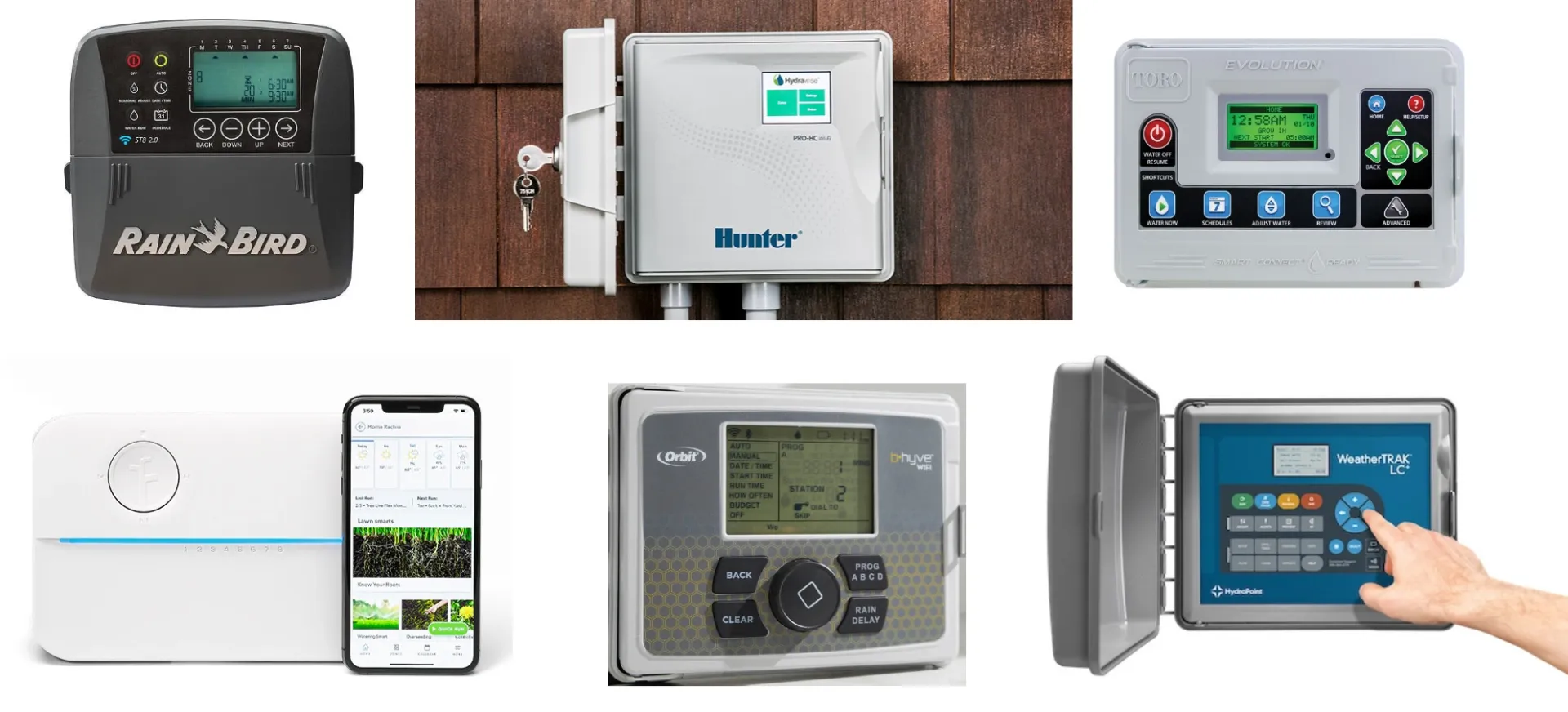
Here are the brands in the residential category.
- ET Water
- Hunter
- HydroPoint
- Hydro-Rain
- Irritrol
- K-Rain
- Moen
- Netro
- Orbit B-Hyve
- Rachio
- Rain Bird
- Smart Rain
- Toro
- Weathermatic
Fourteen controllers are still a huge playing field to choose from. And it could be daunting to figure out which one would best suit your needs. Fortunately, WaterSense has a web page where you can use filters to narrow your search. Here’s the link to the page and a screenshot of it:
https://lookforwatersense.epa.gov/Product-Search-Results-IrrigationController.html
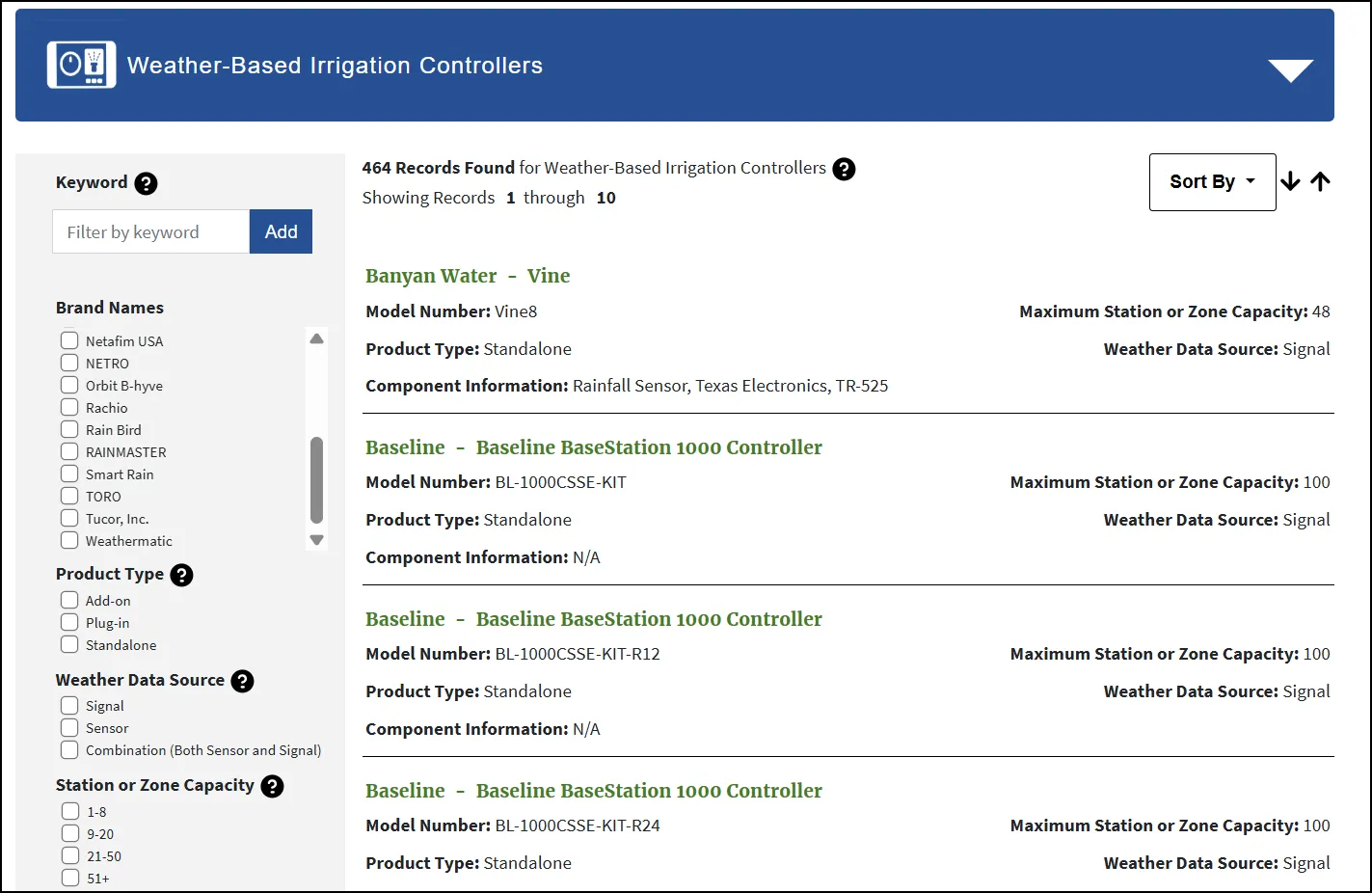
Using the EPA WaterSense product search web page is one way to narrow down your choices. Here are some recommendations for filters to use to make the search more relevant to your situation.
- Brand Names: Check only the 14 brand names listed above
- Product Type: Check “Standalone”
- Weather Data Source: Check “Signal.” This signifies either WiFi or cellular weather data access.
- Station or Zone Capacity: Count the number of zones (stations) on your existing controller, and add 5. That way, if you choose to expand the system later, you’ll have room to add new zones without having to purchase a new controller.
Even if after applying the filters suggested above, you’ll still be presented with more than 100 models.
Valuable tips to cut down on your search time
Here are a few tips that could not only save you time but also help ensure that you end up with a product that will best suit your needs.
- If you already employ a landscape professional to maintain your landscape, or you know a professional, ask them if they have a favorite smart controller. It’s best if this person has direct experience using and programming their favorite controller, as they may be a valuable resource for you in not only choosing your controller, but giving you guidance in its usage once it’s in place.
- Visit your local professional irrigation store and ask which controllers are most popular, easiest to use, and have the lowest return rate. Ask them to show you the controllers they offer, and explain to you which they think would best suit your needs. Once you’ve settled on your choice, ask them to refer you to a professional who can install and program it for you iin case you feel this would be beyond your DIY capabilities. Smart controllers can save great quantities of water. But they can also waste water in equal measure if not programmed correctly. If you don’t know about your local professional irrigation store, just perform an online search for “professional irrigation store near me.”
- Look for YouTube and other online videos dedicated to the controllers you’re considering. It’s best if these videos are produced by the manufacturers themselves. This way, you can be assured the information they convey is correct. There are lots of well-meaning and helpful people making video tutorials but keep in mind that they actually may be using the product incorrectly. The manufacturer will provide the highest quality guidance.
Smart controllers have been in mainstream use for over 25 years. The manufacturers have had plenty of time to work out the kinks. The interfaces have improved over time, making them easier for the general public to use. And the support offered by the manufacturers in the form of YouTube videos and written documentation has given us the key to unlocking this valuable tool and bringing the benefits within our reach. Go ahead. Take the plunge. You’ll surely be glad you did.
Note: All graphics courtesy of Lori Palmquist