

What is Fire?
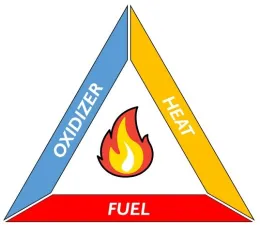
Fire (combustion) is both a physical and ecological process. Physical processes include the heat produced, rate of spread, and direct impacts on other ecosystem components.
Fire requires three elements: fuel, an oxidizer, and heat. If you remove any of these components, the fire will extinguish. The relation between these three elements is often described as the “fire triangle”.
Plants, trees, artificial materials, and even buildings can be considered combustible fuels, and are often classified based on their fire hazard and flammability. A fuel burns by reacting chemically with an oxidizer (usually oxygen in the air). Because these reactions occur at high temperatures, the heat source is the third essential component of a fire.
While the initial energy needed to start a fire can come from ignition sources, once flammable materials begin to burn, they generate enough heat to sustain the process until all fuel has been consumed.
This can be seen as a feedback loop in which the heating source is both an input and an output. In addition to heat, fires emit smoke, which is made up of particulate matter (PM), as well as gaseous emissions such as carbon dioxide (CO2) and water vapor.
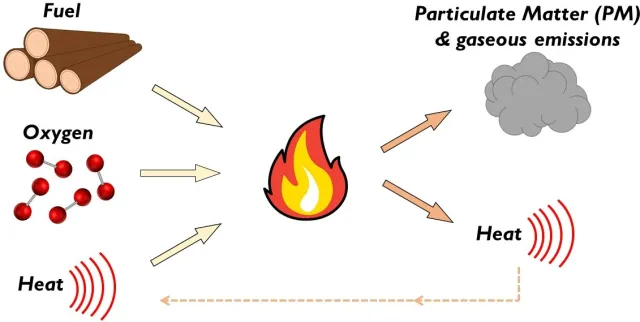
Particulate matter (PM) is a mixture of solid and liquid particles suspended in the air. PM can vary widely in size, shape, and chemical composition, and are classified by their diameter. Particulate matter (PM) is a primary pollutant of public health concern from short- and long-term smoke exposure. Particulate matter is grouped into two size classes: PM10 (inhalable particles <10 microns) and PM2.5 (fine particles < 2.5 microns). While smoke particles range in size, studies show that 90% of smoke particles from wildland fires fall into the PM10 category and about 90% of those particles are within the PM2.5 size range.
As fuels burn, heat from the fire spreads through radiation, conduction, and convection to adjacent unburned fuels, resulting in fire spread. Oftentimes these three energy transfers can occur simultaneously.
What Influences Fire Behavior?
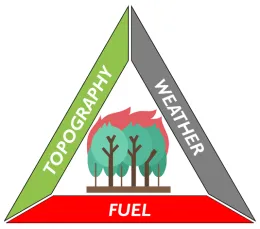
Whether near the home or in the wildlands, there are three factors that significantly influence fire behavior: fuel availability, or the readiness for fuel to ignite and combust entirely, past and current weather conditions, and terrain and topography.
The relation between these three elements is often described as the “fire behavior triangle”. The three components of the fire behavior triangle all interact with each other to influence fire behavior and spread.
In both rural and urban landscapes, the one component of the fire behavior triangle that we can manipulate is fuel. This is typically done by implementing defensible space near homes to reduce near-home landscaping, or at larger scales like treating larger landscapes with prescribed fire, mechanical treatments, or grazing.
Fuel
The potential effect fuel can have on fire behavior depends on its physical properties (vegetation type, particle size and quantity, etc…) and its availability (fuel moisture).
Both live and dead vegetation can become sources of fuel in both near-home and wildland settings. Fires can behave differently based on fuel type.
- Ground fuels include things like combustible mulches in urban settings and duff, or partially decomposed organic matter in wildland settings. Ground fuels can lead to smoldering combustion and can produce flames under proper weather conditions.
- Surface fuels include things like low-growing herbaceous and woody plants in urban settings or downed woody fuels in wildland settings. Surface fuels often produce light foliage, which develops into fine fuels that can be easily ignited and burn rapidly. If there is a continuous patch of surface fuels, wildfire can carry across the landscape and lead to the ignition of larger fuels nearby, like ladder fuels.
- Ladder fuels include things like larger woody shrubs or vines in urban settings or undergrowth in wildlands. Ladder fuels carry fire vertically into the crowns of the dominant vegetation.
- Crown fuels include the upper canopy of dominant vegetation, in most landscapes, this is tree canopies. While most native trees have adaptations to resist low intensity fires, crown fires can damage the foliage and lead to mortality.
Weather
Weather conditions, such as wind speed, relative humidity, and temperature, can greatly influence fire behavior and spread either directly through winds or indirectly through the preheating and drying of fuels (i.e. making fuels more available to burn). Additionally, large wildfires can “create their own weather” due to the atmospheric instability created by the fire plume interacting with the external wind.
- Temperature: changes in air temperature influence fire behavior. High temperatures contribute to increased fire behavior by drying and preheating fuels.
- Relative humidity: is the amount of water vapor evaporated into the air compared with the maximum amount possible at a given temperature. High relative humidity generally reduces fire behavior while lower relative humidity values typically increase fire behavior.
- Wind speed and direction: wind direction is expressed as the direction it is coming from, while wind speed is how fast the wind is moving expressed in miles per hour. Winds directly influence fire spread by accelerating the warming and drying of fuels. High winds can further increase a fire’s rate of spread and flame length. Additionally, topographic features such as canyons, gorges, saddles, or ravines create avenues for wind to funnel through.
![slopeandfirebehav[1]](/sites/default/files/styles/medium_large_350x350_/public/2022-06/368834.jpg.webp?itok=pr48b8RJ)
Topography
Topographic features such as slope, aspect, ridges, and canyons, can directly influence fire spread. For example, a wildfire burning on steep slopes will preheat the fuel in its path, causing the fire to spread more rapidly. As mentioned previously, topographic features like ridges and canyons can create “chimney effect” updrafts, which can accelerate fire spread.
What are the Different Types of Fire?
Fire also behaves differently when different fuels are involved. A wildfire can be composed of three different types of fire: ground, surface, and crown. The proportion of each type of fire helps determine the overall severity of the fire and how much vegetation will be consumed.
- Ground Fires: Ground fires mostly consume the duff layer and can produce a few visible flames. Ground fires also can burn out stumps and follow and burn decaying roots and decayed logs in the soil. A fire burning in tree roots often goes undetected except when it follows a root near the soil surface. Then, it can emerge, ignite surface fuels, and become a surface fire. Ground fires can often smolder for days and weeks, producing little smoke.
- Surface Fires: Surface fires produce flaming fronts that consume needles, moss, lichen, herbaceous vegetation, shrubs, small trees, and saplings. Surface fires can ignite large woody debris and decomposing duff, which can then burn (glowing combustion) long after surface flames have moved past.
- Crown Fires: Crown fires are either passive or active. Passive crown fires involve the torching of individual trees or groups of trees. Torching is the precursor to an active crown fire. Active crown fires occur when enough heat is released from combined crown and surface fuels to preheat and combust fuels above the surface, followed by active crown fire spread from tree crown to tree crown though a canopy. Crown fires are usually intense and stand-replacing, and are strongly influenced by wind, topography, and tree (crown) density.
What Determines Fire Activity at the Landscape Level?
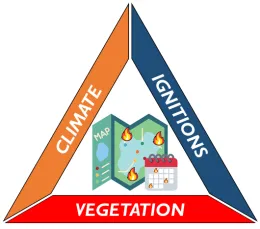
Climate, ignitions, and vegetation determine the fire regime, which describes the frequency and severity of fires across ecosystems over long periods of time. The relation between these three elements is often described as the “fire regime triangle”.
Climate and vegetation are linked; plants have adapted to regional characteristics (water, temperature, soil content, etc.), including fire, over millennia. As the third determinant of fire regimes, ignitions are defined by their distribution and their nature over time.
What is a Fire Regime?
The fire regime describes the typical or expected variation in an ecosystem’s historic relationship to fire, a region over long periods of time and prior to modern fire suppression. These include: 1) frequency, 2) intensity, 3) severity, 4) size, and 5) seasonality.
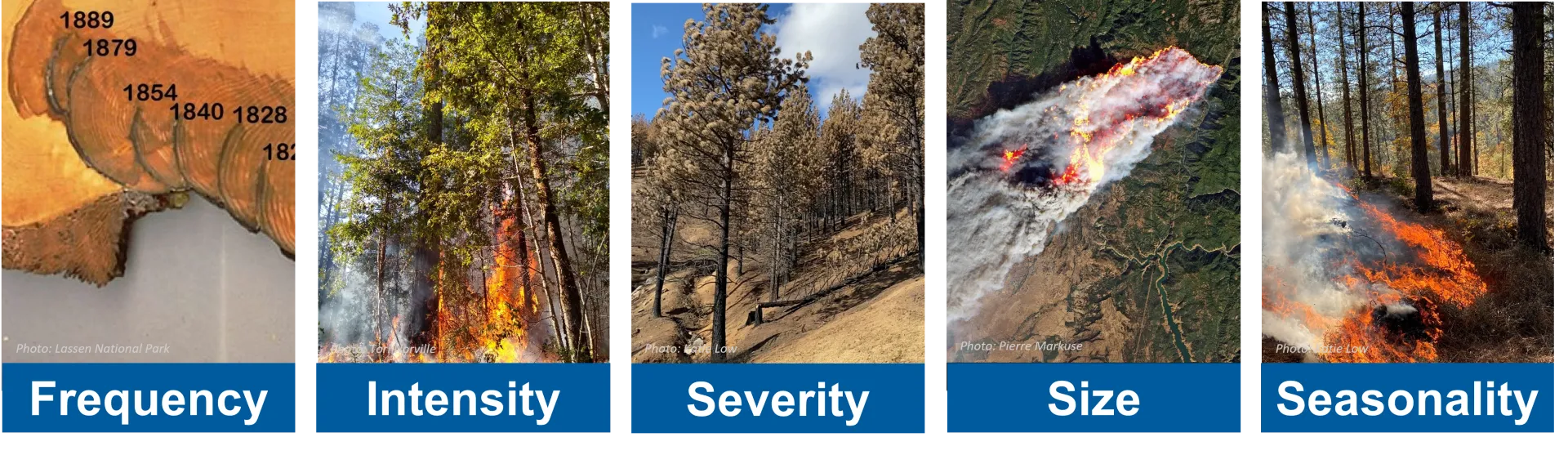
- Frequency: How often fires occur in a particular area. This can be measured by fire return interval (the average time between fires). For example, coastal mountains in southern California have a fire return interval of approximately 35 years whereas some regions in the Sierra Nevada have a return interval of less than 5 years.
- Intensity: The energy released by a fire. Intensity is often measured by fireline intensity, which is the rate of heat transfer per unit length of fire line (the amount of radiant energy released in the flaming front).
- Severity: The impact of a fire on the ecosystem, including the extent of plant mortality, litter consumption, and changes to soil. Fire severity measurements will vary depending on ecosystem type. In forests, fire severity is measured in terms of tree mortality, canopy loss, or tree scorch, however, severity measures used in forests are not generally relevant to shrublands where all vegetation is killed in fires. In shrublands an indicator of fire severity may be resprouting success or seed bank survival.
- Size: The spatial extent of individual wildfires. Fire size varies from a lightning-ignited fire that burns around the tree it strikes to large wildfires that burn entire watersheds.
- Seasonality: The time of year when fires are most likely to occur. This can be influenced by factors such as fuel moisture and climate. For example, in California, the majority of wildfires occurs in the late summer and early fall after extended periods without rainfall/snow.