
Kings County celebrates National 4-H Week

On Sept. 30, the Kings County Board of Supervisors presented local 4-H youth with a proclamation recognizing Oct. 5–11, 2025, as National 4-H Week.
Plant California Alliance honors Del Castillo for her research
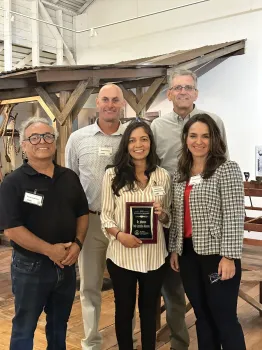
Johanna Del Castillo Múnera, UC Cooperative Extension plant pathology specialist at UC Davis, received the 2025 Research Award from the Plant California Alliance, a coalition of nursery growers, at the California Nursery Conference in Santa Paula on Sept. 10.
This award recognizes scientists who contribute to the advancement of California’s nursery industry.
The Research Committee, chaired by Fred Ceballos, chose Del Castillo Múnera for her current work on two grant projects for the California nursery industry, in addition to her efforts as an instructor and presenter providing educational workshops in Spanish. The two projects are “Adapting to Reduce Water Availability in California Nurseries: Identifying Pathogen Risk of Reusing Irrigation Water” and “Efficacy and Crop Safety of Miravis Prime for the Control of Fusarium Wilt in Greenhouse-grown Cucumber.”
In addition, she has collaborated on many peer-reviewed publications, most recently a publication titled, “Evaluating Oomycete Pathogen and Community Responses to Chemical – and Slow Sand Filtration-based Water Treatment Strategies to Enable Water Recycling in Nursery Production Systems.” Her interests include developing and improving sustainable solutions for disease control through studies of fungal and oomycete biology, population genetics and community ecology.
Elkus Ranch celebrates 50th anniversary
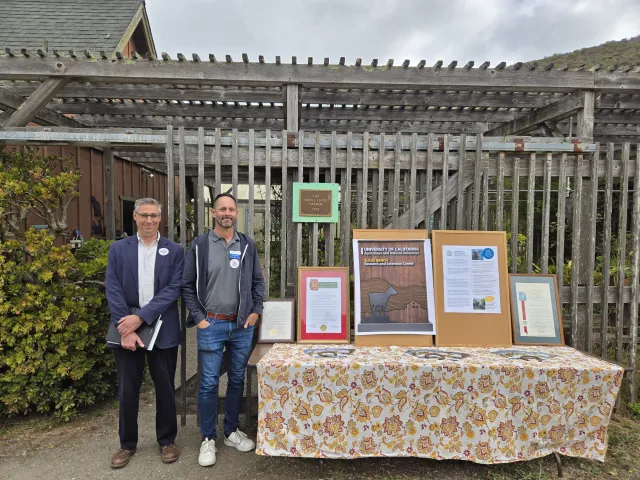
The Elkus Ranch Environmental Education Center has provided experiential learning opportunities for Bay Area youth and their chaperones since 1975, touching thousands of lives with educational school field trips, small group tours, day camps, lunchtime events, community service days and more.
“For many of these students, a visit to Elkus is the first time they pulled a carrot out of the ground, looked a goat in the eye, or even entered a barn,” said Igor Lacan, UC Cooperative Extension county director in San Mateo and Elkus Ranch director. “Teachers, who return year after year, recognize that our setting and our educational programs play a critical role in enhancing school-based learning and offer a unique experience for students in the urban Bay Area.”
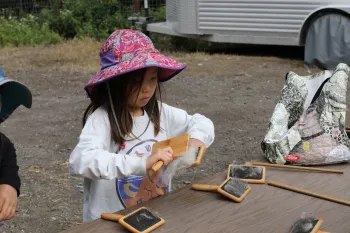
To celebrate five decades of service to the community, Elkus Ranch staff held a fun-filled event with local residents on Sept. 6. UCCE San Mateo County staff and volunteers headquartered at the Ranch provided information about gardening, food preservation and youth development.
Linda Forbes, Strategic Communications director, attended the event and wrote about it at https://ucanr.edu/blog/anr-news-releases/article/elkus50years.
See the video we produced for social media https://www.youtube.com/shorts/DNytgsPoRCY.
ANR gathers to grill, chill and ketchup
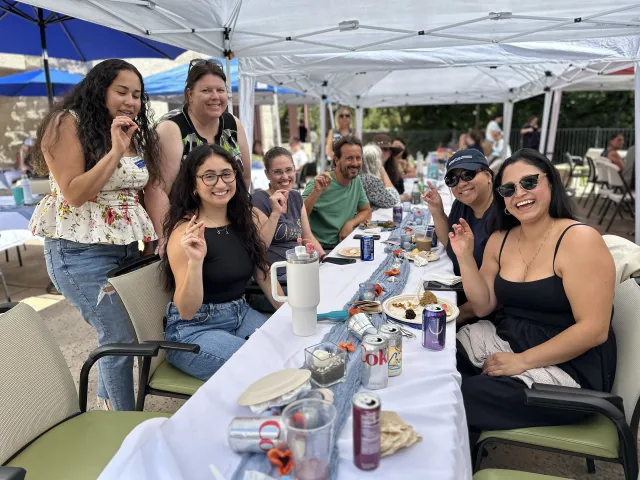
Employees in the ANR Building in Davis gathered Sept. 10 for a backyard BBQ with food, fun and fellowship. The Bad Wolf Band performed live music.
Our thanks to the 2025 BBQ Committee: David Alamillo, Andrea Rayray, Annastasia Hermle, Tracy Roman, Janelle Wood, Jasmin Ramirez-Strain, Kim Pador and Lora L. Schroeder.
Relive favorite moments and see photos at the ANR Facebook Group Page: https://www.facebook.com/groups/634449560883829 or at the Box link https://ucdavis.box.com/s/95rg12w37wvqunkbaasuwaif5e8lx4xh.
The next Second Street BBQ will be on Wednesday, Sept. 16, 2026.
Panel discusses communicating land-grant mission
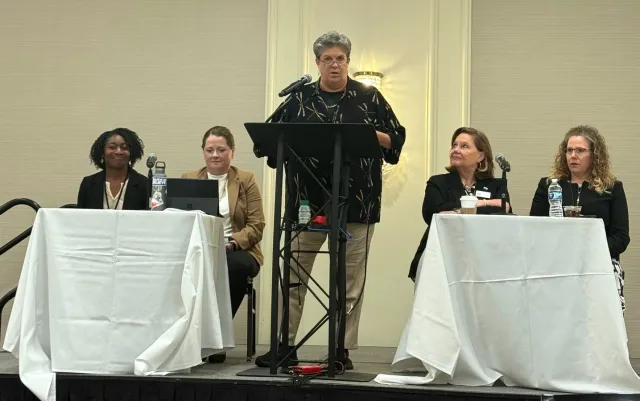
Land-grant universities are encountering challenges and opportunities arising from changes in political forces and funding environments. At the 2025 Joint AgInnovation and Extension Directors Conference in St. Louis, Vice President Glenda Humiston moderated a panel discussion on “Communicating our Land-Grant Mission: Responding to Evolving National Priorities.”
The panel discussed approaches to communicate the land-grant mission when facing a critical crossroads. Humiston opened the discussion by telling the group how communicating the public value of UC ANR’s research and extension convinced the California Legislature to provide additional funding to hire for a significant number of staff and academic positions.
Panelists included Hannah Carter, associate provost for online and continuing education and dean of University of Maine Cooperative Extension; Leslie Edgar, dean of the College of Agricultural and Life Sciences at University of Idaho; Latasha Ford, research communications manager of Agricultural Communications at Fort Valley State University; and Faith Peppers, USDA National Institute of Food and Agriculture communications director.
Swain honored by TIME, Grist
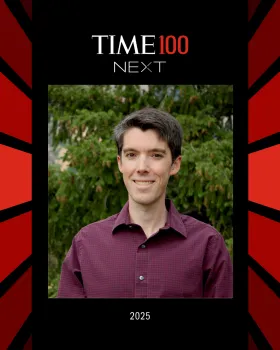
Daniel Swain, a climate scientist in the California Institute for Water Resources, is on the 2025 TIME100 Next list recognizing 100 emerging leaders from around the world who are shaping the future and defining the next generation of leadership.
“What makes Daniel special is that he doesn’t just do the fundamental science, he somehow finds the time to explain it to the public,” wrote Michael Mann, professor of earth and environmental science at the University of Pennsylvania and co-author of the book “Science Under Siege.”.
“When disasters happen, he appears regularly on cable news programs; is quoted in seemingly every related news article; and engages directly with people through social media, his blog, and his virtual ‘office hours,’ all in an effort to inform the public and policymakers.”
On Sept. 15, Swain was also selected for the 2025 Grist 50 list, which highlights the work of 50 innovative climate leaders who are applying their strengths, creativity and time to inspire climate action. “Swain is a research scientist studying how climate change is affecting extreme weather events, but he’s never pursued tenure, concerned about the demands it would impose on his time,” Grist wrote. “Instead, he’s placed a focus on being an effective and accessible communicator.”
“There is a critical need for institutions to support those who are trying to distill the complex societal and environmental issues that allow us to make more informed decisions about what comes next,” Swain said in a recorded message. “So, I am grateful for this recognition, which I see as an encouraging indicator that this kind of work really is valued.”
“I also want to acknowledge the University of California Agriculture and Natural Resources, which came through for me in a moment of academic precarity and, through their ongoing support, has allowed me to continue my climate communication efforts,” he added.
Read more at https://ucanr.edu/blog/green-blog/article/time100next.
Colusa County honors 100 years of Cooperative Extension service
In mid-September, the Colusa County agricultural commissioner briefed the local board of supervisors on this year’s crop and livestock report. That report recognizes a significant milestone for UC Cooperative Extension – for 100 years, from 1925 to 2025, UCCE has served Colusa County by connecting local issues with powerful UC research.
“UCCE Colusa is proud of its legacy and excited for the next 100 years of impact and innovation!” the report reads.
On March 25, 2025, UCCE Colusa County was honored with a proclamation by the Colusa County board of supervisors recognizing the Cooperative Extension’s history of service.
Vyas publishes GIS mapping book
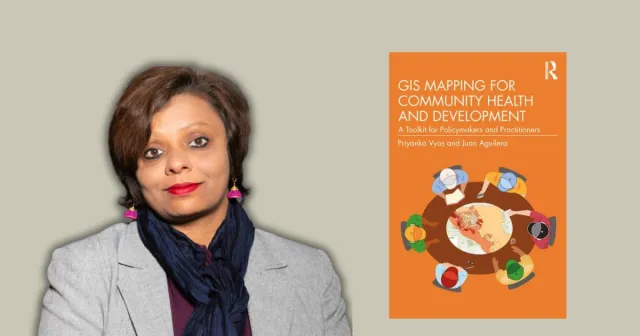
Priyanka Vyas of Informatics and Geographic Information Systems has published her first book, “GIS Mapping for Community Health and Development: A Toolkit for Policymakers and Practitioners,” co-written with Juan Aguilera, whom she met while at the Stanford School of Medicine. The book is a practical guide to using maps more thoughtfully in policy and public health decision-making.
In describing her book, Vyas said, “In today’s era web-maps and web-GIS based dashboards are commonly used for making policy decisions. An understanding of how to critique a map and ask the right questions is important for anyone using maps for evaluating policies or programs. The book is mainly for professionals who are not formally trained in GIS and use maps on a regular basis for decision-making. It is also relevant for students on how not to trust a map blindly and be paying attention to not only the story that a map is telling but what it is not revealing.”
The book introduces the “3Ps of GIS mapping: People, Place, and Policy” and demonstrates how different maps can highlight different disparities depending on how the same data is represented.
Featuring illustrated examples from government websites, nonprofit organizations, media, and her own work, the book provides readers with tools to better interpret web maps and dashboards in contexts such as health equity, environmental justice, and community planning.