Bug Squad

A daily (M-F) blog launched Aug. 6, 2008 and about the wonderful world of insects and those who study them. (Photo by Kathy Keatley Garvey)
Primary Image
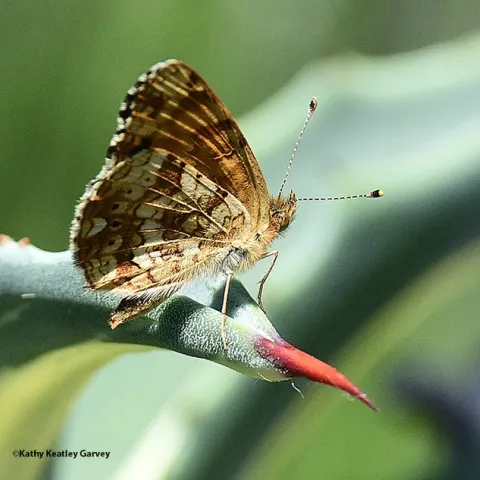
Phyciodes mylitta perches on a cactus. (Photo by Kathy Keatley Garvey)
Bug Squad: Article

Mylitta Crescent: Thistle Lover

June 27, 2023
Ever seen a Phyciodes mylitta, aka Mylitta Crescent? It's a butterfly that breeds on thistles, such as Cirsium, Carduus and Silybum. The one that visited our yard June 17 wasn't visiting a thistle, however. It landed on a cactus. It's an orange and black butterfly (orange wings with black markings).
View Article
Primary Image
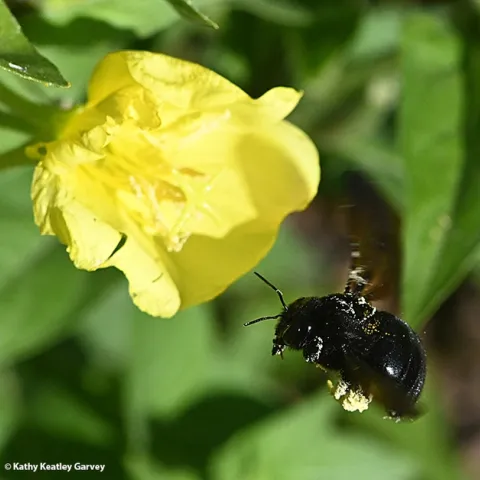
A female Valley carpenter bee, Xylocopa sonorina, heads for evening primrose in a Vacaville pollinator garden. (Photo by Kathy Keatley Garvey)
Bug Squad: Article

A 'Morning' Carpenter Bee and an Evening Primrose

June 26, 2023
As National Pollinator Month winds down, let's visit a "morning" carpenter bee and an evening primrose. The evening primrose, Oenothera biennis, native to the Americas, is unique in that it blooms as night (as its name implies) and dies back at noon.
View Article
Primary Image
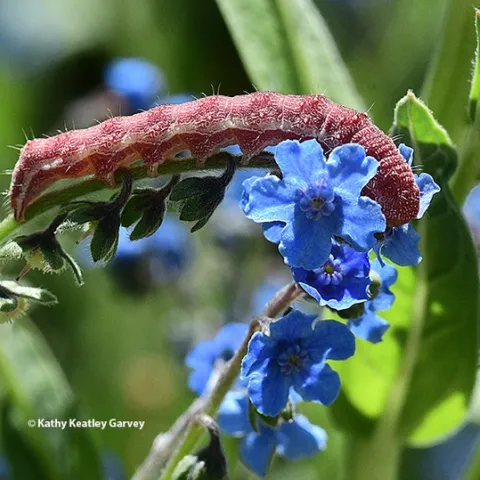
A tobacco budworm, Heliothis virescens,, munching on Chinese forget-me-nots in a Vacaville garden. (Photo by Kathy Keatley Garvey)
Bug Squad: Article

Tobacco Budworm Vs. Honey Bee

June 23, 2023
Please, please, forget to eat our forget-me-nots! But it's not going to happen. So here we are in our Vacaville pollinator garden, looking at the Chinese forget-me-nots. We see honey bees, leafcutter bees, syrphid flies, lady beetles, cabbage white butterflies, and other critters foraging.
View Article
Primary Image
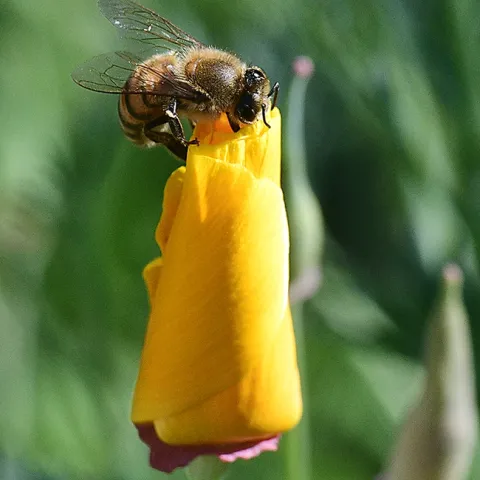
"Open up!" A honey bee attempts to enter a California golden poppy. (Photo by Kathy Keatley Garvey)
Bug Squad: Article

Sorry, Bee, I'm Closed for Bees-Ness

June 22, 2023
A honey bee heads for a patch of California golden poppies. She finds a blossom she likes. Bee: "Hey, Goldie Locks, I'm here to collect some nectar and pollen." Goldie Locks: "You're what?" Bee: "I want to collect some of your nectar and pollen.
View Article