Bug Squad

A daily (M-F) blog launched Aug. 6, 2008 and about the wonderful world of insects and those who study them. (Photo by Kathy Keatley Garvey)
Primary Image
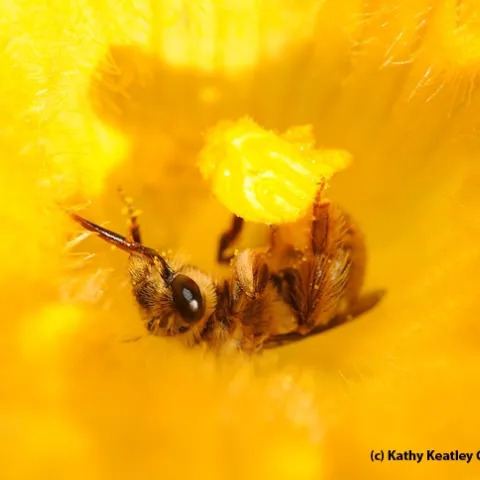
Male squash bee nestled inside a squash blossom. (Photo by Kathy Keatley Garvey)

Squash Blossom Special

June 30, 2011
Male squash bees know just where to sleep--inside a squash blossom. If you're growing squash and you head out to your garden just after sunrise, you'll probably see the males fast asleep, waiting for visiting females to arrive.
View Article
Primary Image
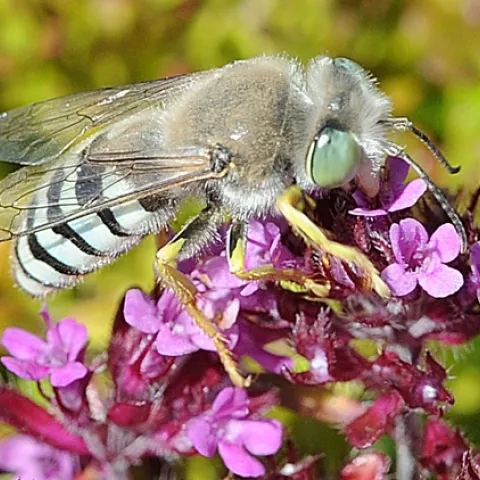
Sand wasp on red flowering thyme. (Photo by Kathy Keatley Garvey)

'The Little White Bees'

June 29, 2011
If it looks like a bee, sips nectar like a bee, and buzzes away like a bee, that doesn't mean it's a bee. Last weekend we visited a Fort Bragg nursery specializing in succulents, and these "little white bees" were all over the red flowering thyme (Thymus serphyllum). "Little white bees.
View Article
Primary Image
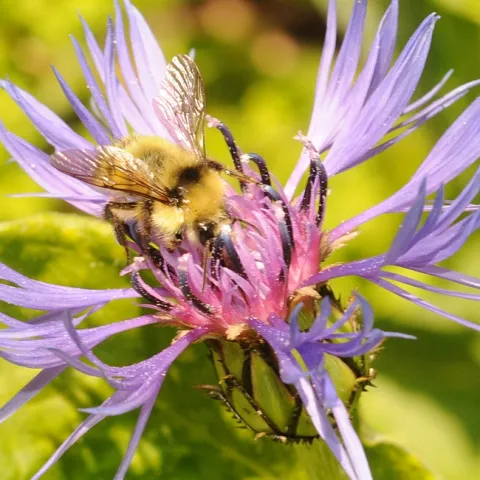
Male bumble bee (Bombus flavifrons) nectaring perennial cornflower (Centaurea montana). (Photo by Kathy Keatley Garvey)

A Bumble Bee to Remember

June 28, 2011
Not all bumble bees are primarily black. Take the Bombus flavifrons. We spotted a male Bombus flavifrons nectaring on Centaurea montana, aka perennial cornflower or mountain cornflower, recently in Mill Valley.
View Article
Primary Image
Tell-tale sign of an earwig. (Photo by Kathy Keatley Garvey)

Forceps, Please

June 27, 2011
Forceps, please! Have you ever stopped to admire a blossom and seen forceps protruding? Earwig! We were walking near Mrak Hall, UC Davis, on a hot summery afternoon and spotted a tell-tale sign: abdominal forceps, aka pinchers or pincers. Earwig! We unfolded the blossom and an earwig crawled out.
View Article
Primary Image
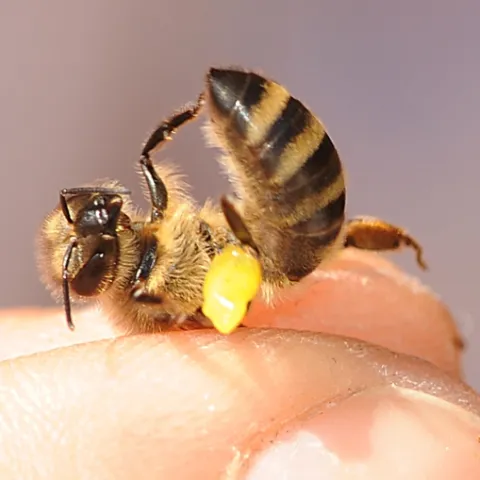
Honey bee with a load of propolis which her sisters later unloaded. (Photo by Kathy Keatley Garvey)

It's the Glue that Holds It Together

June 24, 2011
Honey bee foragers collect nectar, pollen, water and propolis. Propolis? What's propolis? It's that sticky plant resin or "goo" that the bees use to seal small spaces in the hive. It's also known as "bee glue.
View Article