Bug Squad

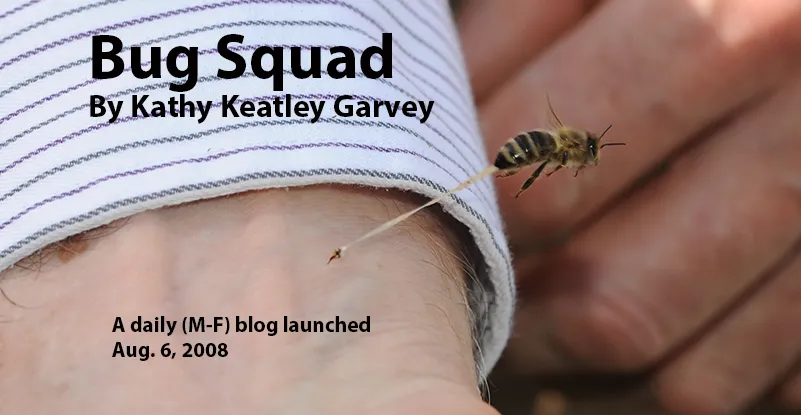
A daily (M-F) blog launched Aug. 6, 2008 and about the wonderful world of insects and those who study them. (Photo by Kathy Keatley Garvey)
Primary Image
ene Robinson of the University of Illinois, shown here following his Jan. 6 talk at UC Davis, is heavily involved in "The Manhattan Project of Entomology." (Photo by Kathy Keatley Garvey)

'The Manhattan Project of Entomology'

June 16, 2011
It's been dubbed "The Manhattan Project of Entomology." And it may have "the potential to revolutionize the way we think about insects," says Richard Levine, communications program manager of the Entomological Society of America (ESA). Call it "The Manhattan Project of Entomology.
View Article
Primary Image
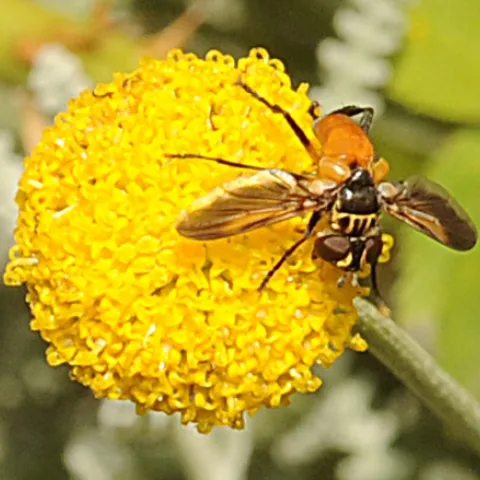
Distinctively colored tachinid fly, probably Trichopoda pennipes, on Santolina rosmarinifolia. (Photo by Kathy Keatley Garvey)

Not Your Average Lookin' Fly

June 15, 2011
The feather-legged fly looks as if it were formed by a committee. It's about the size of a house fly, but there the similarity ends. Black head and thorax, hind legs fringed with a "comb" of short black hairs, and an abdomen that's the color of honey--bright orange honey.
View Article
Primary Image
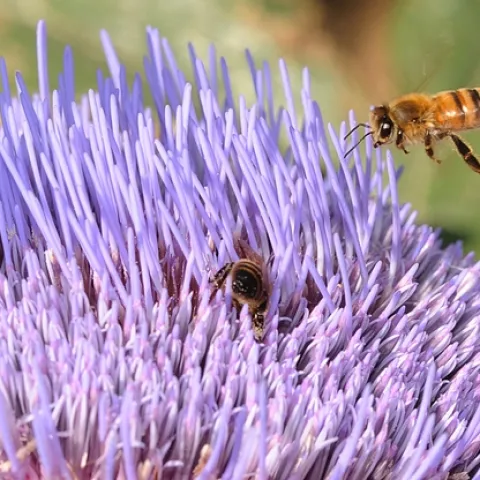
Honey bee heads for flowering artichoke in the Haagen-Dazs Honey Bee Haven at UC Davis. Photo by Kathy Keatley Garvey)

Let the Artichokes Flower

June 14, 2011
To attract honey bees to your garden, it's a good idea to let the artichokes flower. Sure, you could pick them for your dinner, but you'd be depriving honey bees of theirs. At the Hagen-Dazs Honey Bee Haven at UC Davis, the artichokes are beginning to flower.
View Article
Primary Image
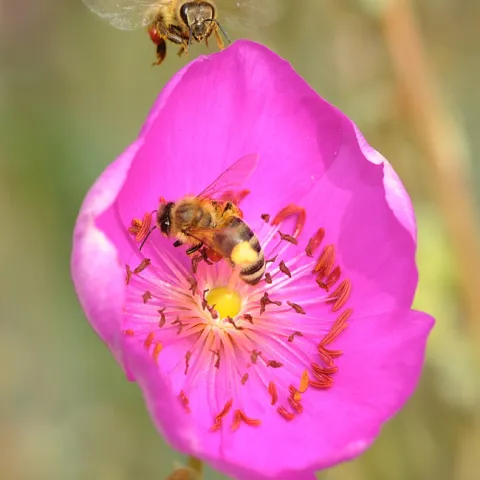
Pollen-packing honey bee heads toward a rock purslane blossom, already occupied by another worker. (Photo by Kathy Keatley Garvey)

In the Pink

June 13, 2011
Honey bees in the pink? Yes. If you plant rock purslane (Calandrinia grandiflora), a perennial succulent, be prepared for a posse of honey bees.
View Article
Primary Image
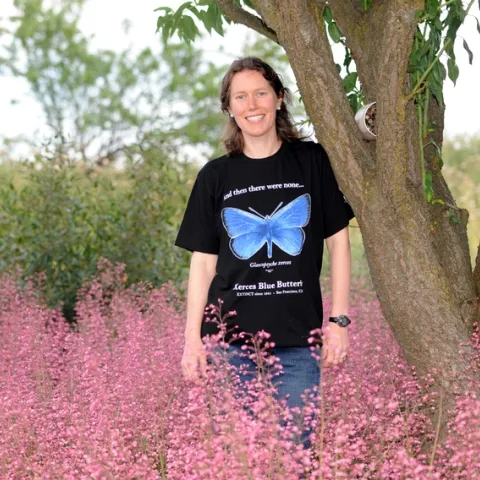
Tabatha Yang, outreach and education coordinator at the Bohart Museum, wearing a Xerces Blue Butterfly shirt. (Photo by Kathy Keatley Garvey)

And Then There Were None

June 10, 2011
The Bohart Museum of Entomology has five. Nature has none. Zip. Zero. Zilch. The Xerces Blue Butterfly, which once thrived on the San Francisco Peninsula before urbanization chased it away, is extinct. There are no more.
View Article