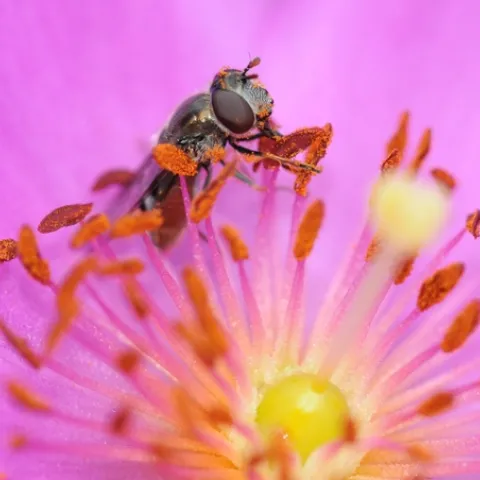
The warmth of the sun and the lure of nectar beckoned the hover flies or flower flies to our bee friendly garden. We saw this one nectaring the rock purslane (Calandrinia grandiflora) last weekend.
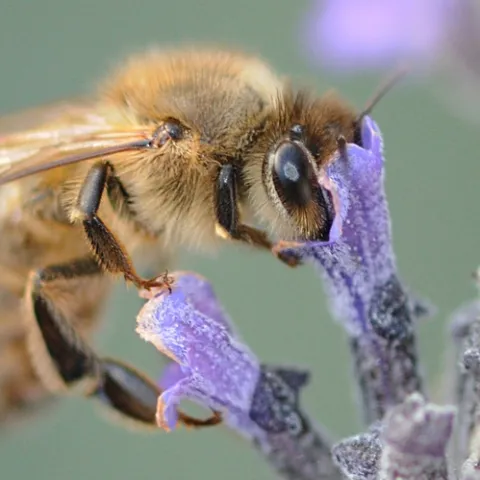
Ever wonder how a honey bee sees? Its compound eyes are comprised of hundreds of single eyes (ommatidia), each with its own lens. It can distinguish colors, but can't see red, which it interprets as black.
Hap-bee Thanksgiving! If you're having cranberries, squash, pumpkins, carrots, cucumbers (and pickles) onions, grapefruit, oranges, apples, pears, cherries, blueberries, sunflowers and almonds, you can thank the honey bee.
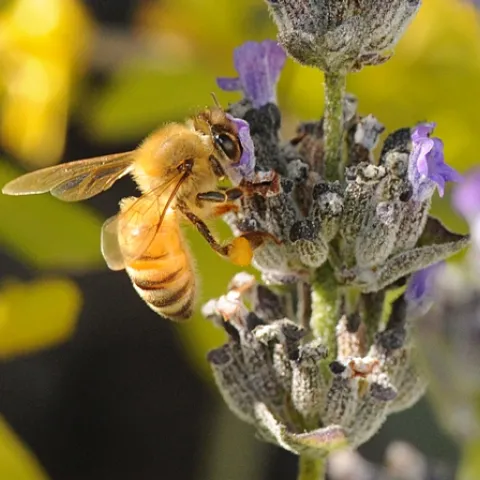
I slipped into the back yard today to see how many honey bees were nectaring the lavender, one of the few plants still blooming. A few here. A few there. That's when I saw her. A bee the color of pure gold. And she was carrying a load of pollen that was equally pure gold.
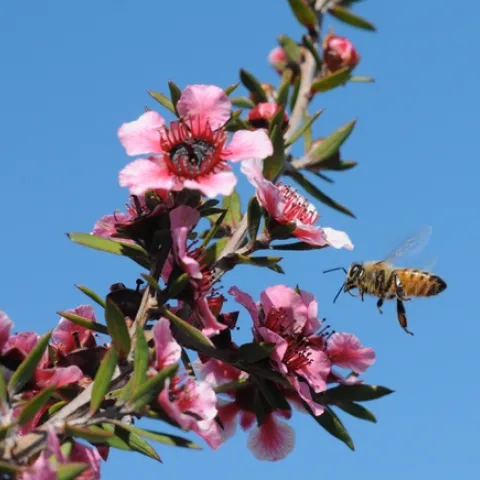
In a way, it's "tea for two." The New Zealand tea tree, Leptospermum scoparium, aka "manuka," "tea tree," and "Leptospermum," is a favorite of the light brown apple moth AND honey bees. We captured images of bees on Leptospermum scoparium keatleyi recently in Sausalito.