Bug Squad

A daily (M-F) blog launched Aug. 6, 2008 and about the wonderful world of insects and those who study them. (Photo by Kathy Keatley Garvey)
Primary Image
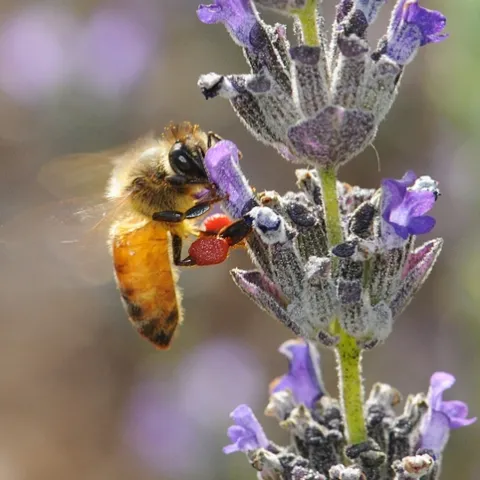
THIS HONEY BEE, on a lavender blossom, appears to "wave." She's actually ready for take-off. (Photo by Kathy Keatley Garvey)

"R" is for Research

November 9, 2009
"R" is for research at the Harry H. Laidlaw Jr. Honey Bee Research Faciity at the University of California, Davis. What's it all about? The Laidlaw facility is a nexus for diverse bee research and scientists from throughout the world.
View Article
Primary Image
HONEY BEE heads for catmint, a favorite of insect pollinators. The plant (genus Nepeta) is a member of the mint family or Lamiaceae. (Photo by Kathy Keatley Garvey)

The A's, Bees and C's....

November 6, 2009
In an aging queen bee, does age affect the quality of her offspring? Why do some bees leave the hive and never return?
View Article
Primary Image
A HONEY BEE and a sweat bee share the same flower, a rock purslane. The sweat bee is probably Halictus tripartitus, according to native pollinator specialist Robbin Thorp, emeritus professor at UC Davis. (Photo by Kathy Keatley Garvey)

Two Bees, Two Sizes

November 5, 2009
When a sweat bee and a honey bee share the same flower, the size difference is quite distinct. We took this photo of a honey bee on a rock purslane (Calandrinia grandiflora) blossom.
View Article
Primary Image
GOLDEN ONE--A honey bee, a social insect, nectars lavender. From Nov. 5-11, Häagen-Dazs will donate $1 per Tweet (up to $500 a day) Nov. 5-11 for honey bee research at UC Davis through social networking on www.twitcause.com. (Photo by Kathy Keatley Garvey)

Helping Honey Bee Research

November 4, 2009
Bees buzz. People "Tweet." Well, many people do. It's generous of the Hagen-Dazs brand to donate $1 per Tweet (up to $500 per day) from Nov. 5 through Nov. 11 to support honey bee research at the University of California, Davis.
View Article
Primary Image
HOVER FLY lands on red buckwheat (Eriogonum grande rubescens) and sips nectar. (Photo by Kathy Keatley Garvey)

Seeing Red--On Buckwheat

November 3, 2009
Butterflies, honey bees and hover flies can't get enough of red buckwheat. Tight clusters of pink blossoms, coupled with gray-green foliage, grace red buckwheat (Eriogonum grande rubescens), a California native. It's good for the insects and good for the gardener. It's drought-tolerant.
View Article