Bug Squad

A daily (M-F) blog launched Aug. 6, 2008 and about the wonderful world of insects and those who study them. (Photo by Kathy Keatley Garvey)
Primary Image
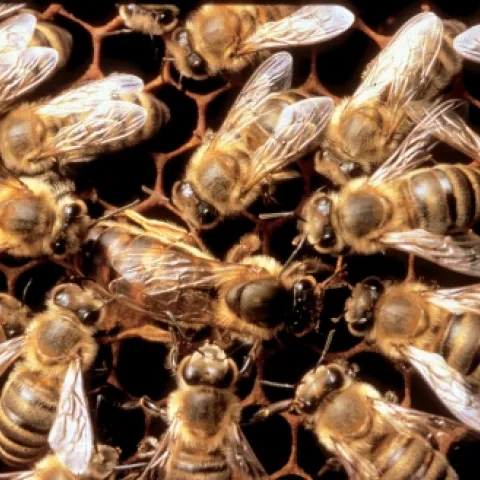
The queen bee (the largest bee, center) is surrounded by her court, the worker bees, who take care of her every need. They feed her, groom her and protect her "and then they have the additional tasks of rearing and feeding her young," said bee breeder-geneticist Susan Cobey of the UC Davis Department of Entomology. (Photo courtesy of Susan Cobey, UC Davis Department of Entomology)
Bug Squad: Article

The Queen Bee

September 11, 2008
If you were a queen bee, you'd be laying about 1500 to 2000 eggs today. It's your busy season. "She's an egg-laying machine," said bee breeder-geneticist Susan Cobey of the Harry H. Laidlaw Jr. Honey Bee Research Facility at UC Davis. "And she's the mother of all the bees in the hive.
View Article
Primary Image
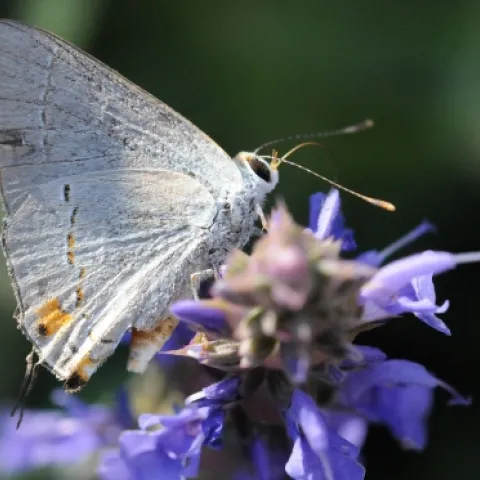
A male gray hairstreak butterfly (Strymon melinus) nectars on sage. (Photo by Kathy Keatley Garvey)
Bug Squad: Article

Gray Hairstreak

September 10, 2008
"Omigosh, what's that? A gray hairstreak?" If it's in your hair, you consult a mirror, your favorite salon, or just ignore it. If you're an entomologist or a lepidopterist, a gray hairstreak is delightful.
View Article
Primary Image
This is a bee nesting block built to attract native pollinators. (Photo by Kathy Keatley Garvey)
Bug Squad: Article

Build It And They Will Come

September 9, 2008
Build it and they will come. Baseball's Field of Dreams? No, a bee nesting block. Think "bee condo." It's an artificial nesting site made of wood and drilled with different-sized holes and depths to accommodate the diversity of native pollinators. Often the bee block is nailed to a fence post.
View Article
Primary Image
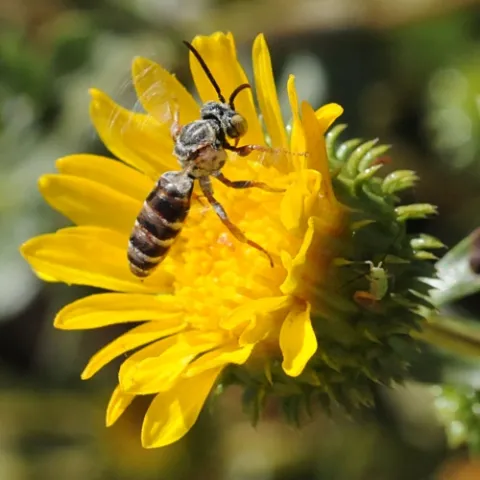
This floral visitor is a cuckoo bee, "probably the genus Triepeolus (maybe Epeolus) and probably a male," said UC Davis emeritus professor Robbin Thorp. (Photo by Kathy Keatley Garvey)
Bug Squad: Article

Cuckoo! Cuckoo! Cuckoo!

September 8, 2008
We've all heard of the cuckoo clock. And most of us have heard of the cuckoo bird (Cuculus canorus), which lays its eggs in the nest of birds of other species. But the cuckoo bee? Yes, there is a cuckoo bee. The female lays her eggs in the nests of other solitary nesting bees. They resemble wasps.
View Article
Primary Image
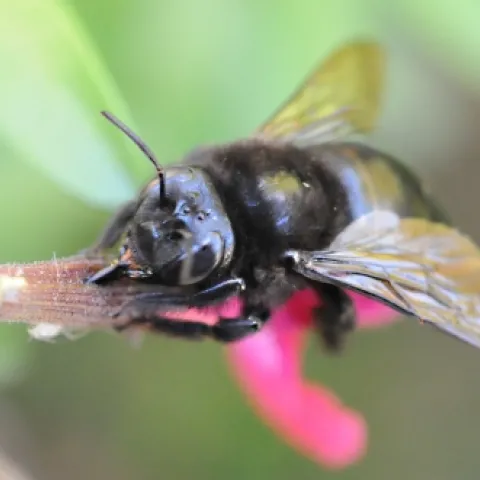
A female carpenter bee (Xylocopa tabaniformis orpifex) pierces the corolla of salvia to rob the nectar. (Identified by Robbin Thorp, UC Davis emeritus professor of entomology.) (Photo by Kathy Keatley Garvey)
Bug Squad: Article

I've Been Robbed!

September 5, 2008
Robber at work. No, this isn't a bank heist or a gas station hold-up or a home invasion. A carpenter bee is slitting the sides of salvia (sage) to steal the nectar. Floral larceny! Book 'em, Danno! Carpenter bees are nectar robbers.
View Article