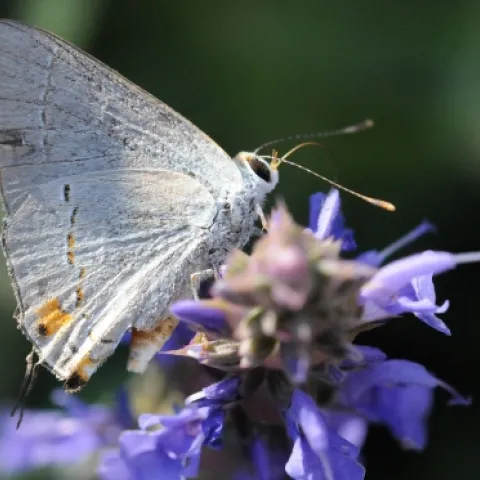
"Omigosh, what's that? A gray hairstreak?" If it's in your hair, you consult a mirror, your favorite salon, or just ignore it. If you're an entomologist or a lepidopterist, a gray hairstreak is delightful.
Build it and they will come. Baseball's Field of Dreams? No, a bee nesting block. Think "bee condo." It's an artificial nesting site made of wood and drilled with different-sized holes and depths to accommodate the diversity of native pollinators. Often the bee block is nailed to a fence post.
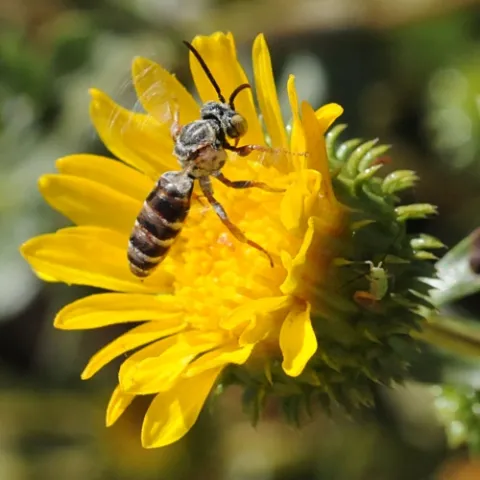
We've all heard of the cuckoo clock. And most of us have heard of the cuckoo bird (Cuculus canorus), which lays its eggs in the nest of birds of other species. But the cuckoo bee? Yes, there is a cuckoo bee. The female lays her eggs in the nests of other solitary nesting bees. They resemble wasps.
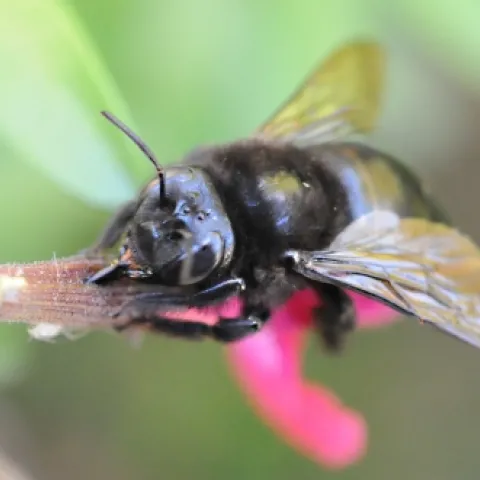
Robber at work. No, this isn't a bank heist or a gas station hold-up or a home invasion. A carpenter bee is slitting the sides of salvia (sage) to steal the nectar. Floral larceny! Book 'em, Danno! Carpenter bees are nectar robbers.
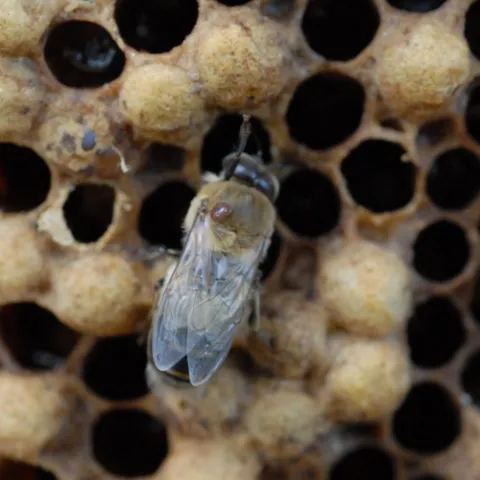
It's a mighty mite and it's causing beekeepers fits. The varroa mite (see photo below) is an external parasite that attacks honey bees. It sucks blood from the adults (apparently preferring drones, the male bees) and from the brood (immature bees).