Entomology & Nematology News

Primary Image
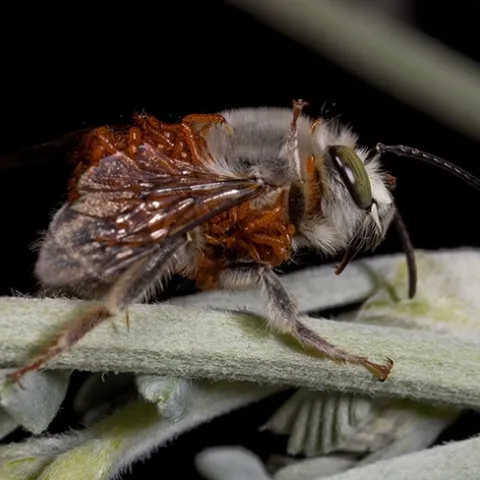
A male Habropoda pallida bee from the Mojave Desert covered with Meloe franciscanus triungulins (first install larvae). These triungulins will transfer from the male bee to female bees during mating and then deplane from the female bee when she enters her nest. The blister beetle larvae feed on the pollen and nectar provisions inside the bee nest and then emerge as an adult beetle the next winter (one beetle per each bee cell). (Copyrighted photo by Leslie Saul-Gershenz)
Entomology & Nematology News: Article

Groundbreaking Case of Exploitation, Deception: What UC Davis-UC Riverside Scientists Learned About Parasitic Blister Beetles and Digger Bees

September 10, 2018
DAVIS--A parasitic blister beetle thrives in digger bee nests through intricate exploitation and deception, adapting to different hosts in multiple geographic locations, according to groundbreaking research headed by evolutionary ecologist Leslie Saul-Gershenz of the University of California, Davis.
View Article
Primary Image
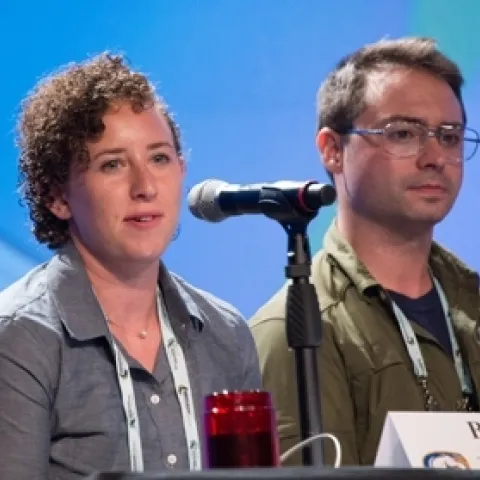
Doctoral candidates Emily Bick and Brendon Boudinot were part of the 2016 UC Davis Linnaean Games Team that won the national championship.
Entomology & Nematology News: Article

Emily Bick: ESA Student Certification Award

August 24, 2018
Doctoral candidate Emily Bick of the Christian Nansen lab, UC Davis Department of Entomology and Nematology, is the recipient of the Entomological Society of America's 2018 student certification award, which recognizes outstanding entomology students interested in the mission of the ESA certificatio...
View Article