


Exploration, trade and tourism have led to the interconnected world of today, with many economic and societal benefits. However, it has also provided a way for exotic pests to travel widely, including to California.
The introduction of nonnative species into areas where they don’t occur naturally causes significant harm to the environment, public health and the economy. The global economic impact is reported to be $1.3 trillion over the last 50 years, according to the UC Integrated Pest Management Program.
Several invasive species have become established in California, including the Argentine ant, citrus leafminer, beet leafhopper, tree-of-heaven and spotted wing drosophila, to name a few. The UC IPM program offers information on managing these pests in gardens, landscapes and in the home.
Efforts are continually underway keep out other potential invaders, and Fresno gardeners can play a role. If you find any of the following pests in your gardens, trees or landscapes, prevent their establishment here by reporting them to the Fresno County Department of Agriculture or CDFA:

Asian citrus psyllid and Huanglongbing disease of citrus
Most California citrus-growing areas are actively controlling Asian citrus psyllid, but the devasting disease it spreads, huanglongbing, is limited to a few quarantine areas in Los Angeles, San Diego and Ventura counties. (See the distribution map here.) Symptoms of huanglongbing disease are blotchy, yellowing leaves with an asymmetrical pattern, small and lopsided fruit and bitter juice. Suspected infected trees in Fresno County should be reported.
To help prevent introduction of the disease, watch for and control Asian citrus psyllid, an aphid-sized brown insect that feeds with its hind quarters lifted up at a 45-degree angle to the twig or leaf.
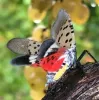
Spotted lanternfly
This pest made its way from China to Pennsylvania in 2014 and has been spreading to neighboring states ever since. It is not in California at this time, but farms and landscapes offer many potential hosts; economic damage to vineyards could be severe. The pest’s preferred host plant is tree-of-heaven, itself an invasive species from China.
Spotted lanternflies move around easily via egg masses that look like a smear of brown mud on tree trunks, cars, crates, trucks, etc. Mature lanternflies are an inch long with grey spotted wings. When the pest fans out its wings, it exposes bright red and yellow portions of its anatomy. Report spotted lanternflies to Fresno County Department of Agriculture or CDFA.
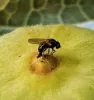
Black fig fly
Found in Southern California in 2021, this is a pest exclusively of figs. It prefers unripe or unpollinated fruit. The adult female lays eggs inside the fig and larvae feed on the flesh – leaving unsightly damage – then exits through a small hole. Report if found in Fresno County.
South American tomato leafminer
Small silvery-brown moths, the females lay yellow eggs on different plant parts. This pest damages tomato plants by mining the leaves and boring into flower buds and fruits. Monitor for the twisting trails the larvae leave beneath the leaf surface. Submit any samples of leaves or fruit with possible South American tomato leafminer damage to the Fresno County Department of Agriculture or CDFA.

Japanese beetle
A small beetle with shiny green head, brown wings and tufts of white hair around the body, the adults feed on foliage, flowers and fruits of more than 300 plants. Currently found mostly east of the Mississippi River, they can hitchhike on nursery stock, sod or soil. Report sightings of this pest in Fresno County.
___________________
Written by UC Master Gardener Jeannette Warnert