
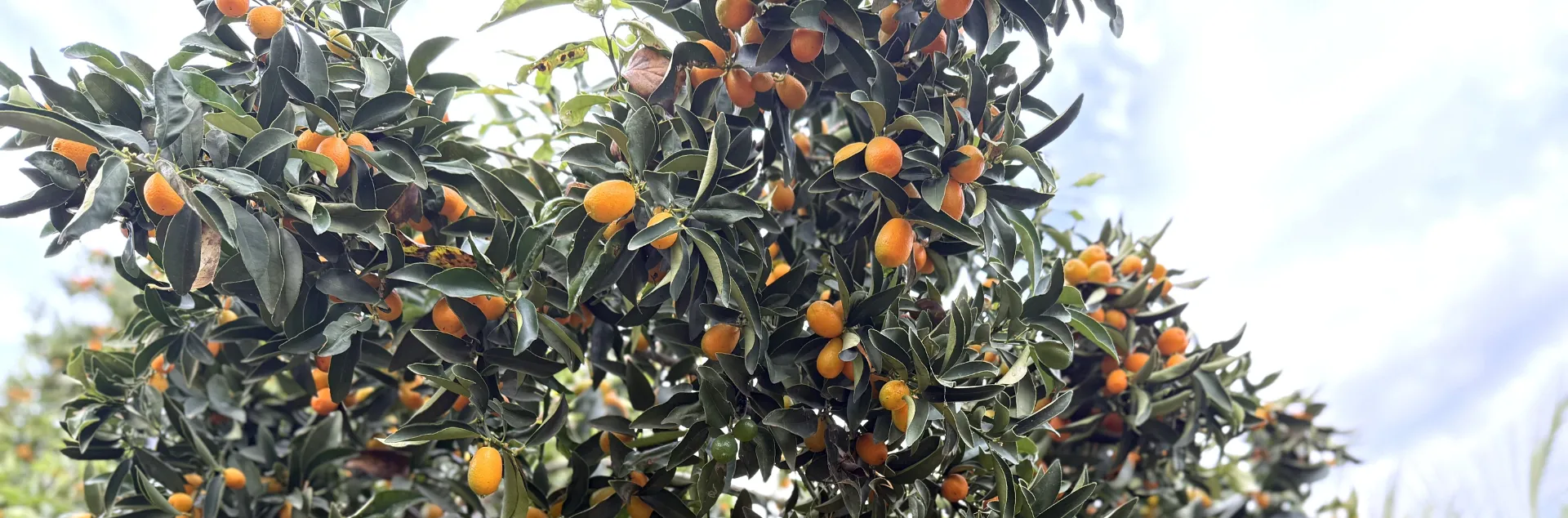

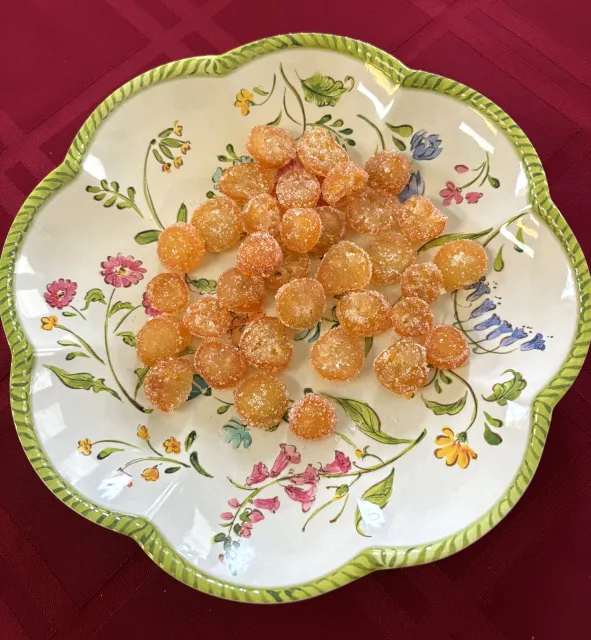
Do you love kumquats but don’t know what to do with them? How about candying your kumquats? Candied kumquats are a delicious and beautiful treat! Kumquats have a sweet skin and a tart center. In fact, the skin is the sweetest part of the fruit. Unlike other citrus fruit, kumquats have very little bitter pith, which makes their skin sweeter than other citrus fruits. A kumquat is the only citrus fruit that you eat whole. Heating kumquats breaks down acid in the skin and results in a sweeter fruit, making them excellent for candying.
Some fun kumquats facts:
- Kumquats are native to China. The name kumquats comes from the Cantonese word game gwat, which means golden orange.
- Kumquat trees can handle cold temperatures, colder than lemons or oranges.
- Kumquat leaves contain higher essential oils than many other citrus, which helps repel some pests.
- Kumquats have a natural shine because the skin produces natural oils.
- A kumquat tree can produce fruit 2 to 3 times a year.
A little about growing kumquats:
Kumquats grow on compact evergreen bushes. They are related to other citrus but are much smaller and bear small oval fruit. Because of their relatively compact size, kumquats are well-suited to growing in containers.
Kumquats like full sun for at least 6 hours a day. Keep the rootball moist but not waterlogged. Frequent watering may be needed, especially in hot weather or when grown in pots. Overwatering or poorly drained soil can cause root problems.
Kumquats are among the more cold-hardy citrus; some literature notes they can tolerate temperatures down to around 19 °F.
Kumquat fruit should be allowed to fully ripen on the tree — unlike some other fruit, they generally do not continue to ripen significantly after picking.
Candying kumquats
The procedure below comes from the UC Master Food Preserver Program’s “Citrus Creations” guide, with slight modifications.
Ingredients:
- 1 lb. fresh kumquats
- Water
- 2 cups sugar
- Optional spices: e.g., 1-inch piece of ginger, 1 cinnamon stick, 1 star anise, 2 cloves
Steps:
- Wash the kumquats and slice them in half. I cut off the ends and do not use them because I like all the pieces to be a uniform circle.
- Pop out seeds.
- Blanch the kumquats: fill a saucepan with water, bring to a boil, add kumquats and boil 1 minute - then drain. Repeat two more times (total 3 blanchings), each with fresh water. This removes the bitterness and is an important step.
- Make syrup. Refill pot with 2 cups water + 2 cups sugar (plus spices, if using). Bring to boil and stir until sugar dissolves.
- Add the blanched kumquats, reduce heat to low. Simmer, making sure fruit stays submerged (spoon syrup over or gently press kumquats under syrup). Continue until the peel becomes translucent, about 45 minutes.
- Remove pot from heat, cover with a cloth and let kumquats steep in syrup 8 hours or overnight.
- Remove each kumquat with a slotted spoon. Gently press to remove syrup and press out any remaining seeds, if visible. Set the kumquats on a tray. I use parchment paper to make clean up easier.
- Dry the candied kumquats in the oven at 200 °F.
- Remove the kumquat slices when they are still sticky, roll in sugar and leave out to dry for 24 hours. Check for dryness.
- Store in an airtight container in refrigerator. Best if eaten within a week.
Tips:
Seed removal: While seeds aren’t toxic, they tend to stay bitter and no one wants seeds in the candy. Removing them improves the final candy’s eating quality.
Don’t discard the leftover syrup — it’s useful as a flavoring in sparkling water, cocktails, over cakes or in marinades/dressings.
Fruit quality harvest timing: Because kumquats only ripen fully on the tree, avoid harvesting too early — taste first to make sure the sugars and acids are balanced.
Patience: Candying is not instant — it’s a multi-step, time consuming process (blanching, simmering, soaking, drying), but yields a distinctive preserved treat with unique flavor and peel chewiness.
___________________________
Written by UC Master Gardener/Master Food Preserver Sue Bohigian