


Gardening has many benefits as we grow older. Physical agility, mental sharpness, emotional health and a longer life have all been tied to gardening. It can also help to improve balance. However, as we get older, our bodies change, making gardening more difficult.
Master Gardener William Elliott will explain how gardeners with physical challenges can continue to enjoy and benefit from gardening at a free class offered from 10 to 11:30 a.m. Oct.18 at the Woodward Park Library, Fresno. Participants will learn about gardening with adaptive tools, techniques and accessible garden design. The presentation will offer practical strategies to reduce strain, conserve energy and adapt gardening tasks to individual abilities. It will also highlight how gardening supports mental well-being, reduces stress and promotes physical health.
The “Accessible Gardening: Practical Solutions for Physical Challenges” class is free, but advance registration is required. Register here.
There are several reasons aging makes gardening more challenging:
- We have thinner and more fragile skin. We get more bumps, bruises and sunburn. We need more sunburn protection, including hats as well as sunscreen, wearing long sleeves and pants to protect our arms and legs. Gardens may need to have more shade.
- Our body has less ability to regulate temperature, so we get more heat exhaustion and heat stroke. I find that I cannot tell as well when I am getting overheated and dehydrated. We need to schedule breaks out of the heat and drink more fluids before we feel thirsty. These breaks also rest our muscles and reduce pain and overuse injuries. Aim to garden before 10 a.m. and after 4 p.m. to reduce the chance of heat stress.
- Our eyesight changes and we cannot see things as clearly as before, such as seed packets and product labels. We need to protect our eyes more in sunlight.
- Our balance isn’t as good. We need to be able to grab something sturdy to make staying on our feet easier and avoid falls. Canes, wheelchairs and walkers have become important. Avoid ladders, chairs or stools. If they are absolutely needed, make sure that the feet are perfectly level. No rocking.
- Kneeling, reaching and moving are more challenging with weakened muscles, arthritis and stiffness. Bending over, reaching overhead, grabbing garden tools and carrying items can cause problems. We need to stretch before gardening to loosen the joints, reduce cramps and prevent pain. We need to get away from ground level gardening and get more friendly tools.
Below are a few ideas for making gardening easier for people with physical limitations.
- Wear gloves. Select tool handles that are cushioned and have larger diameters. There are special tools that can be adapted for people with hand issues. One such tool is a ratchet pruner. Its gears ratchet in place so you don’t have to constantly squeeze as tightly. With all pruners, keep your wrist straight to reduce strain on the wrist.
- Garden scooters can be used to get around the garden area. They increase mobility and can reduce falls caused by uneven surfaces. Even level surfaces and clear paths can be affected by the wind blowing debris on them.
- Back and knee pain and stiffness can be reduced with changes in the way we garden. One change is to use vertical gardening – trellises, poles or archways. These reduce how much we must reach and bring plants closer to eye level. Tomatoes, cucumbers, beans, squash, peas, berries and other vines are options. Fruit trees can be espaliered – spread across a trellis.
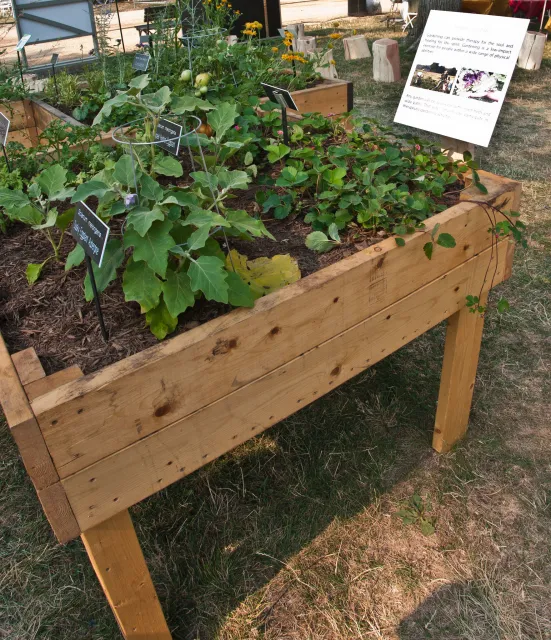
- Raised beds can be used to bring gardens up to waist level. Stooping, bending and kneeling can be nearly eliminated. Falls are reduced and you can grab the sides for stability. Since they are raised, the garden benefits from improved drainage. They are easy to build, or you can buy lower ones.
- Wheelbarrows are not balanced and should be replaced with garden cart. They are balanced and easier for moving loads.
- Plant fewer annual plants and plant more perennials to reduce clean up. Plants that will require a lot of pruning may need to be replaced. The less work the better.
- Replace watering cans with drip irrigation. The less you carry and reduce water in garden paths, the fewer falls that can happen.
- Make sure all equipment is stored safely afterwards. This reduces tripping hazards and the inevitable “senior moments” of “where did I put this!”
- Always have a cell phone or panic button at the ready in case of falls or other medical emergencies.
________________________
Written by UC Master Gardener Jim Miser