
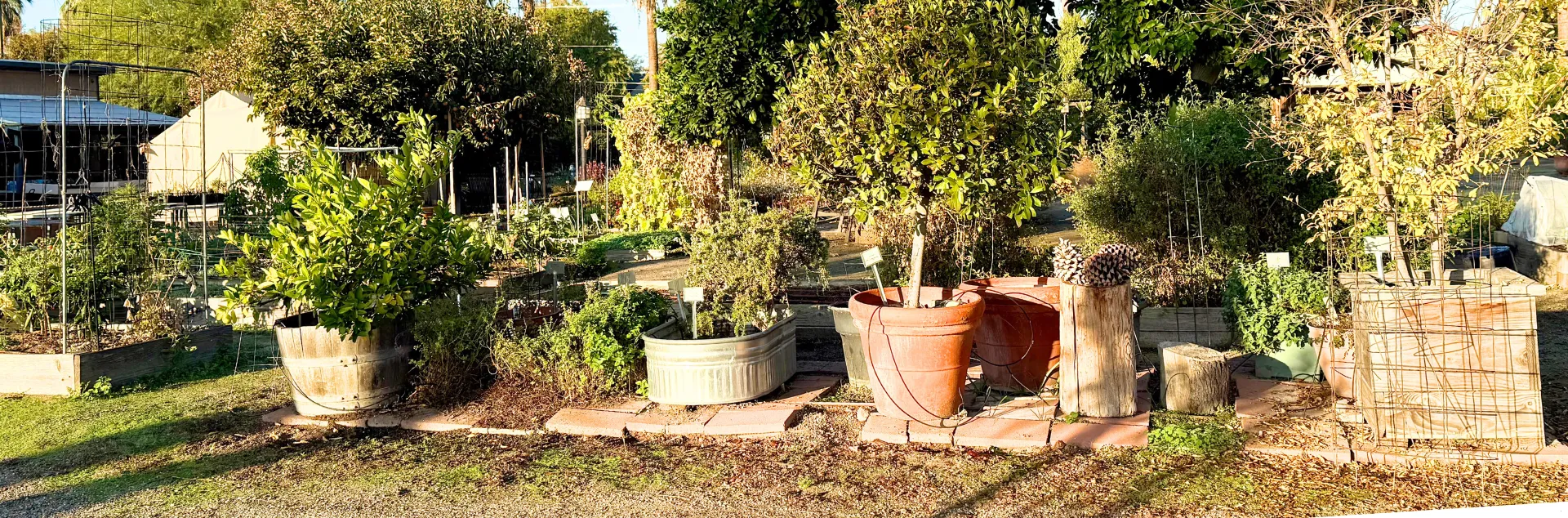

Trees in containers are becoming increasingly popular additions to small patios, terraces and garden spaces. They add a focal point with color and texture, create privacy and designate boundaries as well as disguise your neighbor’s ugly fence. Trees in containers can live for years in sequentially larger pots or even in the same pot if given the right care from the beginning.
Buy trees for planting in pots in 5-gallon cans for best results. Check labels for ‘size at maturity.’ Dwarf varieties will do best in containers but smaller-sized cultivars will also do well.
Buy wide mouth pots that will hold at least 1.5 cubic feet of potting soil. The larger the tree would be at maturity, the larger pot that will be needed. Heavy plastic pots tend to crack over time; wooden barrels will rot over time. Good quality clay pots, both glazed and unglazed, are the better choice, but will be heavy when filled. Buy plant saucers with casters to fit under your pot so that the pot and tree can be easily moved out of the summer sun or rotated to help balance leaf and branch production. Choose pots with good-sized drain holes or several drain holes. Cover drain holes with fine mesh or with fiberglass window screening material.
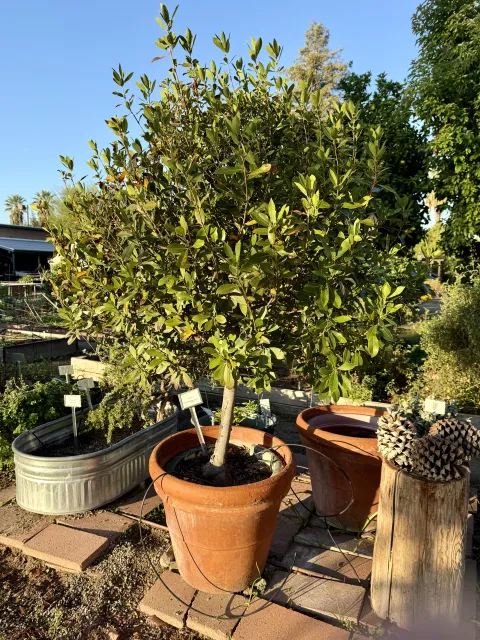
Drought-tolerant Mediterranean trees like olive and sweet bay will do best in succulent/cacti potting soil mixes. Japanese maples do best in acid or shade-type soil mixes that contain additional sulfur. Shade plant potting mixes aren’t always available, but adding a half cup of sulfur granules when planting and yearly thereafter will help lower soil pH levels.
Water needs vary with the tree species. Install drip irrigation if possible or make sure there is a nearby water source for daily deep watering in summer.
Many articles on growing trees in pots advise that little or no pruning will be needed. My experience with trees in pots has shown that healthy potted trees can grow vigorously. A deciduous tree in a pot will require annual shaping and pruning during the dormant season to remove any crossing branches and dead or diseased wood. That’s an easy chore. Japanese maples will need a dormant season pruning as well as probably three seasonal trims of long whip branches. Japanese black pines will need annual ‘candle cutting’ to remove growing tips.
Fertilize potted trees once and lightly in spring using organic formulations specific to the tree species and low in nitrogen. Olive and sweet bay trees and conifers seldom need fertilization.
It’s important to add more soil to the bottom of the pot as the soil level subsides, not on top of the soil surface. That means you’ll need to pull the tree out of the pot. If the root ball has filled the pot, use a root shaving bonsai tool or a serrated bread knife (the best!) to gently cut back the root ball an inch or two all around to provide space for new soil. Regular root pruning or shaving can allow the tree to stay in the same pot for decades.
Here are my recommendations for the six best tree species for container growing in our Central Valley Planting Zones, USDA Zones 8 and 9.
- Sweet bay (Laurus nobilis)
- Citrus, esp. Dwarf Meyer Lemon and Kumquat
- Japanese maples
- Olive
- Dwarf conifers, including pines (esp. Japanese black pine), dwarf spruce, dwarf cypress (esp. dwarf Hinoki cypress)
___________________
Written by UC Master Gardener Elinor Teague