
In the postfire environment of a coast redwood (Sequoia sempervirens) forest, it’s easy to get lost in the sprouts.
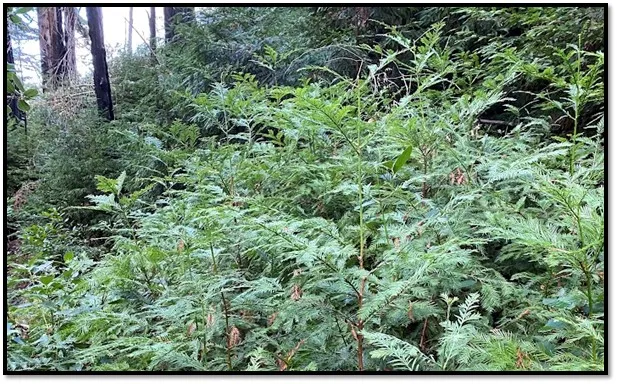
And it makes sense, coast redwood trees can sprout prolifically from their base after fire and other disturbances. This is called basal or clonal regeneration, and it is a nearly unique adaptation to coast redwood, existing in only a few conifers in the world. Sprouting is, by far, the primary way coast redwoods regenerate.
Sprouts originate at the base of a coast redwood tree and are a clone of the tree with which they regenerate. Sprouts utilize resources built up over time by their “parent” tree to rapidly grow in the face of disturbance. In fact, as a fire or disturbance gets more severe, like a fire increasing in intensity, individual coast redwood trees sprout even more voraciously. In some cases, sprouts can be over 10 feet high just a couple of years after a fire.
With that said, it’s a common misconception that coast redwood never reproduces by seed in natural environments.
Coast redwood produces asexually and sexually, meaning that in the right circumstances, coast redwood can and does establish by seed. Here we will discuss the relatively rare phenomenon of seedling regeneration, cone and seed production, and the factors that promote seedling establishment in coast redwood forests.
Coast redwood’s ability to sprout is one of the primary contributors to the species’ resilience in the face of disturbance. Still, seedling regeneration, even if only very occasional, remains an important trait. Seed dispersal is important for coast redwood’s ability to colonize new sites, like those that may currently be dominated by less fire-resistant species like coast Douglas-fir, and to migrate. The ability to “migrate”, while a very slow, multi-generational process in trees, is particularly important in the face of climate change. I have seen coast redwood seedlings at the northern margin of the species slowly establishing in new environments that have a mature overstory of Douglas fir. Seedling establishment into new areas with more favorable conditions may aid the species resilience to climate change and aid the species longevity over time. Seedling regeneration is also important to introducing genetic diversity over time, which may help coast redwood adapt to changing environmental conditions.
Cone and Seed Biology Offer Clues
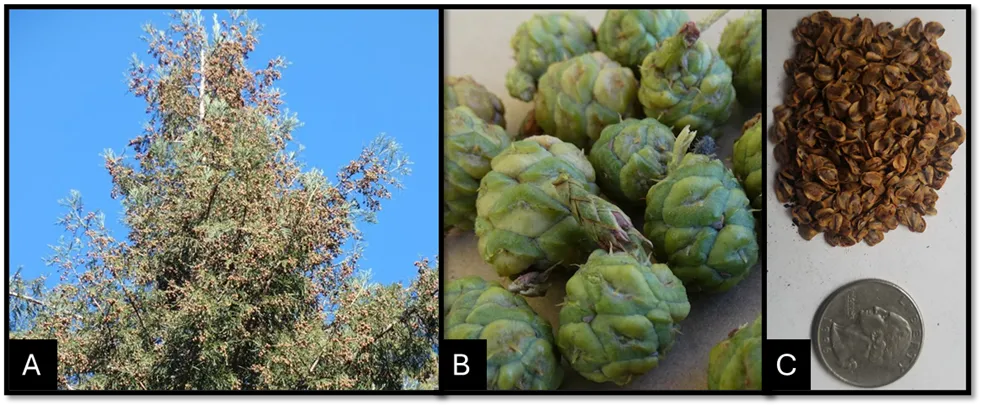
Coast redwood produces cones variably across its range – some regions have frequent large cone crops and others have periods where there is seemingly no cone production. Masting, or the production of more cones and seeds in some years and regions than others, is a highly complex ecological phenomenon that is not explained in coast redwood forests. In some years and regions, many thousands of seed cones are produced per tree. When cones are produced, they are about the size of a thimble and produce between 30 to 100 seeds per cone, with each seed smaller than a flake of oatmeal (Figure 2).
Coast redwood produces pollen (male) cones and seed (female) cones on the same tree. Seed cones begin development in the fall and begin to ripen in October. Cone scales open slowly and disperse seeds from the cone between October and February. While seeds slowly rain down through this period, empty cones remain attached to the tree following dispersal, falling to the forest floor over time. Most brown cones that you see on the forest floor of a coast redwood forest have already dispersed their seeds. If you move aside the duff in a coast redwood forest and look closely you will often notice that there are many seeds present that have fallen in previous years. So, with so many seeds, why don’t we see more seedlings?
Multiple Factors Result in Rare Seedling Establishment
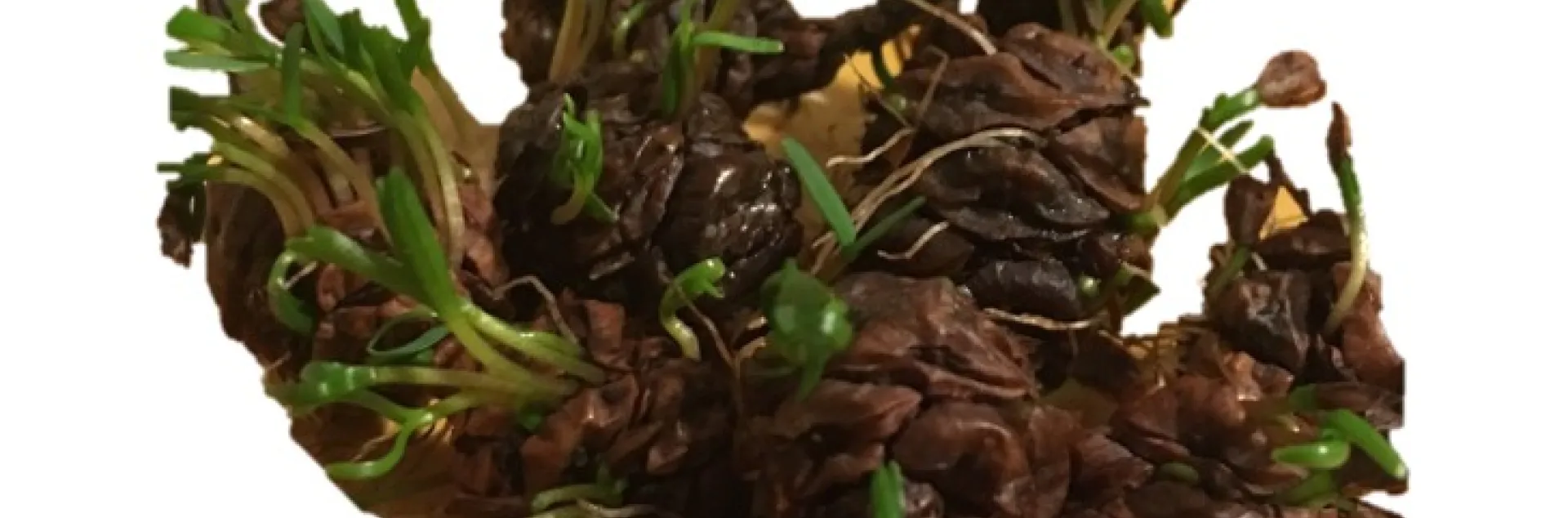
While cones and seeds are produced regularly in many coast redwood stands, seedlings almost never establish in the absence of disturbance. Like many conifers, coast redwood is highly reliant upon bare mineral soil or substrate to establish successfully. Given that duff layers in coast redwood are very thick in undisturbed environments, a seed’s radicle (or its “root”) are rarely successful in reaching bare soil. In addition, levels of light are low in undisturbed forests, further contributing to a lack of germination. Seedlings occasionally establish in the duff, substrate, or inside of fallen cones in undisturbed environments, but nearly always die as the result of damping off (where the base of the stem is infected by a pathogen and dies). Germinating seeds and small seedlings that have emerged are also occasionally consumed by animals on the forest floor.
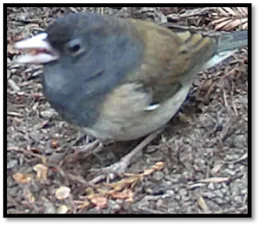
Coast redwood seeds also have very low proportional viability for a conifer. That means that the percentage of seeds that are produced that are capable of germinating is low. As a result, many of the seeds you see on the forest floor are actually not capable of germinating even in perfect conditions (as they do not have an embryo). You could think of this phenomenon as an egg with nothing but the shell – obviously, it will never hatch and grow into a chicken. Why coast redwood produces so many non-viable seeds is an open question, but some believe it may be a trait that evolved to make their seeds less enticing to small mammals and birds that feed on seeds in the forest floor. Searching through all those seeds to find those with caloric value is a lot of work.
Some plant species’ seeds remain viable in the soil after falling for many years, which makes up what we call the “seed bank”. These seeds sit in the soil waiting for appropriate conditions to germinate and establish. Coast redwood seeds, however, do not “bank”, meaning seeds are not viable on the forest floor for a very long time. Seeds are also not resistant to fire and coast redwood cones are not serotinous (cones that only open to release their seeds in response to heat) like some Giant Sequoia cones. That means that in the case of coast redwood, a new seed crop needs to fall to the forest floor following a fire event for seedling establishment to occur.
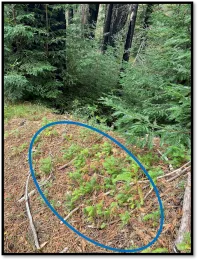
Still, even when the conditions are perfect, we don’t always see coast redwood regeneration in postfire environments. To effectively regenerate from seed, viable seeds need to be available. These factors likely explain why researchers have reported mixed results with regard to the presence of coast redwood seedlings in postfire environments.
Postfire Environments Are Prime For Seedling Regeneration, But The Stars Still Have to Align
Recent fires in coast redwood forests have resulted in a variety of seedling regeneration success, from nearly absent to explosions of seedlings. Cone crops are highly variable in the redwood range from year-to year and across the range, so sometimes it takes some time for seeds to be available to establish, and sometimes it never happens at all. There can be a misalignment between the availability of a cone crop and the period of suitable postfire conditions to see considerable seedling establishment. In addition, while coast redwood do generally live through high severity fire, it may take many years for individual trees to produce cones again if much of their canopy was consumed by a fire. By that time, understory conditions may not be prime for establishment.
Recently, abundant seedling regeneration has been observed in the north and south portions of the coast redwood range in fire affected areas, including the Chetco Bar Fire of 2017 (Oregon), the Soberanes Fire of 2016 (Monterey County) and in some areas of the CZU Lightning Complex of 2020 (Santa Cruz Mountains).
The same conditions that promote seedling regeneration of coast redwood also promote the establishment of coast Douglas fir seedlings. In the CZU footprint, I have found it to be quite common to observe groups of seedlings on the forest floor that are a mix-up of redwood and Douglas-fir (see photo at the end of this article). I like to think of these as little mini-forests encountering many of the same competitive interactions as the dominant trees above them at a much faster pace.
So next time you are out in the footprint of the CZU Complex Fire at Big Basin State Park or on your own property, keep your eyes open for coast redwood seedling regeneration. While only a fraction of the seedlings present in the footprint will make it to maturity, seedlings are a small but important way for coast redwoods to maintain genetic diversity and to expand into new space on the forest floor that was unfilled in pre-fire conditions.
Do you have observations you want to share about coast redwood seedling regeneration or cone production?
Reach out to the Santa Cruz Mountains Forests Program staff.
