
This column is written by the Master Gardeners of Yolo County each month. It provides answers to selected questions recently asked by Yolo County gardeners..
Question: What fungal diseases are commonly seen in fruit trees in the Sacramento Valley? What treatments do you recommend?
Answer: Fruit trees in the Sacramento Valley face a variety of fungal diseases due to our Mediterranean climate with cool, wet winters. Many fungal pathogens thrive during rainy periods, then infect new growth in the spring. Below is an overview of the most common fungal diseases you might see and the typical treatments and management strategies.
Peach Leaf Curl (Taphrina deformans) infects peaches and nectarines. It causes distorted, thickened, and reddened leaves in early spring, premature leaf drop and reduced fruit set. A dormant-season fungicide is essential. Apply copper-based fungicides between leaf drop in fall and before bud swell in late winter. Avoid applying once buds begin to swell, treatments after that point are ineffective. There are resistant varieties of peach available (e.g., ‘Frost’) that might be worth considering for a new planting. There are no resistant varieties of nectarine.
Brown Rot (Monilinia fructicola) affects stone fruit such as peach, plum, nectarine, apricot, and cherry. It will kill blossoms in the spring. Later, fruit will turn soft and brown, rotting while still on the tree. Still later, fruit that remains will become “mummified” and harbor spores that can spread the disease the following year. Pruning to improve airflow can reduce infections. Avoid overhead watering. Remove infected fruit including the “mummies” that fall or remain on the tree. Pick fruit promptly, even a little green, which may give you a harvest before the fruit is infected. Copper fungicides may be sprayed at just the point when the blossom buds begin to swell. You may need to spray again as the green fruit is ripening.
Powdery Mildew (Podosphaera spp.) can be found on apples, peaches, plums, and grapes as a white, powdery growth on leaves, shoots, or fruit. It can cause distorted foliage and russeting on fruit. Prune to improve air circulation. Apply sulfur or potassium bicarbonate as a preventative before you see symptoms. Horticultural oil or Neem or Jojoba oil may be applied to help control an infestation.
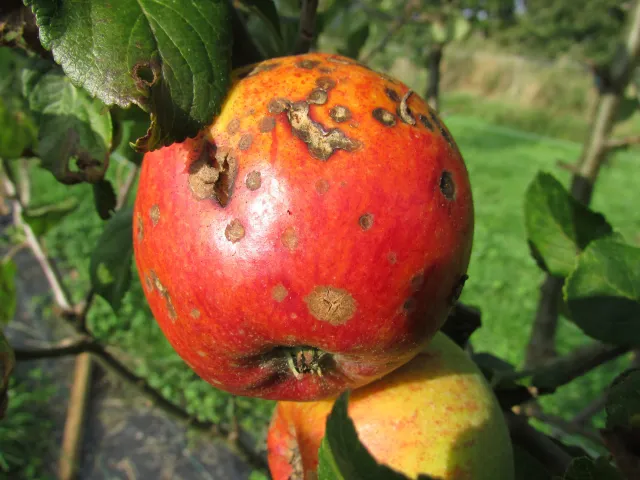
Apple Scab (Venturia inaequalis) infects apples and crabapples. It causes-green to black lesions on leaves and fruit and premature leaf drop. Remove fallen leaves in the winter to reduce overwintering spores. Copper-based sprays, or neem or mineral oils can be used in the spring up to the point of full bloom. Sulfur sprays can also be applied in the spring, especially just after a wet period. Some resistant varieties are available such as ‘Liberty’ and ‘Enterprise.’
Shot Hole Disease (Coryneum spp.) will infect stone fruit such as apricots, peaches, and plums. It causes small purple spots on leaves that drop out, leaving holes. It can also cause gumming lesions on twigs and gumming on the fruit. Remove infected twigs and avoid irrigation that splashes onto the leaves. Treatment consists of applying copper fungicide after fall leaf drop and again before spring rains.
In general prune in winter to increase airflow. Remove plant debris that may harbor fungi. Avoid wetting leaves and the trunk when irrigating. Maintain tree vigor with adequate irrigation and fertilization. When necessary, used approved anti-fungal treatments in accord with the manufacturer’s instructions.
Have a gardening question? Send it to jmbaumbach@ucanr.edu, with “Ask MGs” in the subject line. Include as much detail as possible and pictures if you have them.