

About the South Coast
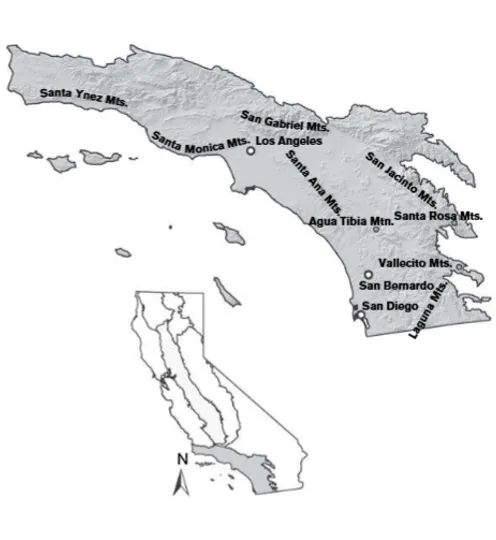
The South Coast is bordered on the north by the Transverse Ranges, the south by the US border with Mexico, the east by the Peninsular Ranges, and on the west by the Pacific Ocean. The South Coast is home to an extreme range of elevational change, from coastal plains near sea level to 11,000 ft (3500 m) peaks. The majority of the region is 1600 ft (<500 m) above sea level and supports a high diversity of vegetation types and fire regimes.
Despite comprising only 8% of the total land area of the State of California, the region contains about 60% (around 24 M residents in 2026) of the state’s total population and continues to grow rapidly; this has placed immense pressure on natural resources and has created difficult fire management challenges.
The climate of the South Coast is Mediterranean, with warm, wet winters and hot, dry summers. Most precipitation falls as rain from November through April. Snow occurs at higher elevations > 6000 ft. Increased humidity from coastal moisture in the air in the late spring to early summer delays the region’s fire season.
Lightning strikes are a natural ignition source with different seasonality due to coastal and interior climate patterns, but the amount and density of strikes are low compared to other regions in California. Lightning is more likely in the interior ranges, and with greater strike density, than the coast ranges, and peaks in August for the interior ranges and September for coastal ranges. Due to fuel moisture and the timing and density of lightning strikes, lightning strikes do not play a significant role in igniting fires in most of the region.
Fire History of the South Coast
Indigenous Burning
Historically, intentional ignitions from Indigenous people contributed to the frequent presence of fires in these landscapes. The South Coast region is the ancestral lands of many Indigenous tribes that still steward these lands today, including the Chumash, Cupeno, Kumeyaay, and Tongva tribes to name a few. Tribes burn for many reasons, including for the production of food and basketry materials, to aid in hunting efforts, and for cultural and ceremonial purposes. To learn more about other Indigenous tribes in the South Coast region, visit https://native-land.ca/.
Historic Fire Occurrence
The Mediterranean climate, common occurrence of strong winds, and widespread use of fire by Indigenous people historically promoted fires of mixed intensity, severity, and frequency. This fire regime encouraged and maintained plant species with fire-adaptive traits across ecosystems in the South Coast region.
After Euro-American settlement, Spanish Rancheros burned shrublands for more grassland for grazing, they also introduced numerous nonnative grasses and forbs, likely altering regional fire regimes and ecosystems. Historic, intensive grazing in the region continued to result in conversion of chaparral to grasslands by ranchers who would continue to burn rangelands to improve forage quality and transportation between pastures. On the other hand, some areas, especially in forested areas, saw a decline in fire activity due to the exclusion of Indigenous populations and fire suppression policies. These changes led to the creation of forest stands with high densities of young trees. In forested regions, changes in forest structure coupled with the removal of recurring fires have lead to increasing fuel loads.
Extensive shrublands are a unique component of the South Coast region, where unlike grasslands, oak woodlands or forests, fire patterns, driven constrained by live fuel moisture, are typically high-intensity and high-severity or no burn at all; low- or moderate-severity fire is not possible. Vegetation, in an ample arrangement and dryness, or alternatively if extreme Foehn winds are present, will burn in complete combustion as "crown fires," and can result in post-fire patterns of unburned green vegetation stands adjacent to entirely consumed stands with no gradient in between.
Fire Ecology of the South Coast by Ecoregion
Fire in Grasslands
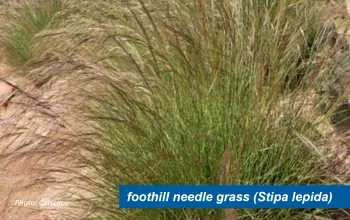
Fire return intervals in these ecosystems were likely heavily influenced by proximity to Indigenous communities, being more frequent in these sites, but in more remote areas, where lightning was the primary ignition source, fire return intervals were much longer. Historically, fires burned in late summer and fall, but human-caused burning led to fires burning in early winter and late spring as well.
Grasslands are resilient to a range of fire frequencies. Native grassland species are adapted to persisting through the dry season with dormant rhizomes, bulbs, or seeds. In the absence of fire for long periods of time, natural grassland patches persist because of their ability to out compete other types of plants in similar environmental conditions where most soil moisture is retained in the upper portions of the soil. Annual grasslands, dominated by non-native grasses, thrive on frequent fires due to prolific seed production and high seed survival under fires of low-intensity.
Fire in California Sage Scrub
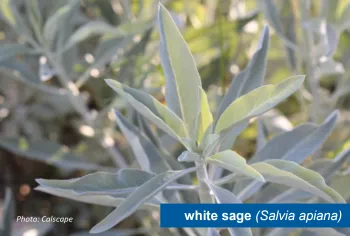
Historically, fires in the region burned in summer to winter, but now, the majority of the area burns in the fall. Human ignitions have increased both the frequency of fires and the length of fire season in the region. During periods of prolonged drought, fires can burn year round. Though size of fires is also highly variable, ranging from a few acres to thousands of acres, the average size of fires have decreased due to increasingly effective fire suppression and habitat fragmentation due to development, despite the increase in ignitions. Historically, lightning-ignited fires were rare, likely leading to longer fire return intervals. However, under Santa Ana conditions, fires would have rapidly burned these areas.
In the coast, many of the plants are capable of regeneration through resprouting or seed stored in dormant soil seedbanks. Many of these species respond well to fire – some even relying on smoke or heat from fires to open up their seeds. Typically many species see a massive flush of seedlings in the second year post-fire. In the interior regions, most species tend not to resprout and instead rely on seeds post-fire, as fire-caused mortality can be close to 100% in interior sites.
Fire in Chaparral
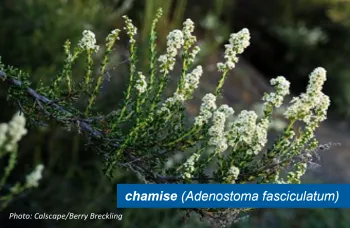
Historically, chaparral communities typically burn as active crown fires of high intensities and severities. Vegetation, in an ample arrangement and dryness, or alternatively if extreme Foehn winds are present, will burn in complete combustion as "crown fires," and can result in post-fire patterns of unburned green vegetation stands adjacent to entirely consumed stands with no gradient in between. Fire frequencies are highest in the summer, but the majority of the landscape burns in the fall during Santa Ana conditions. Today, an increase in human-caused ignitions have increased fire frequencies in this ecosystem type, but most ignitions under non-extreme weather conditions are quickly stopped by suppression activities.
Species in arid sites typically lack the ability to prolifically resprout post-fire, so species rely on dormant seedbanks as a source of regeneration. Most seedbanks are dispersed locally (close to the parent plant), but seeds can be stored at great depths and for long periods of time. Seedbanks are sensitive to fires of high frequency. Seed banks are triggered to germinated either by heat shock from fires or from chemicals from smoke or charred wood.
Species in mesic sites typically have the ability to resprout post-fire. Generally these sites have higher fuel moisture that can reduce fire intensity and severity under moderate weather conditions, however, because these sites are wetter (more productive), there is more vegetation, which creates conditions for more intense and severe fires under extreme weather conditions (i.e., Santa Ana conditions). When these productive sites burn at lower intensities, fires do not consume larger woody debris, thus putting the community on a trajectory for potentially more intense fires in the future.
Fire in Conifer Forests
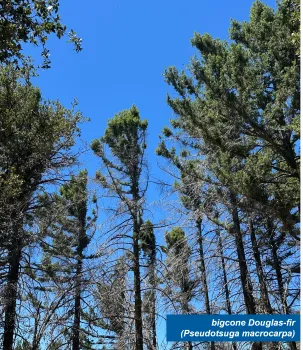
Historically, fire return intervals were short and intensity and severity were low to moderate in most forest types. Fires typically occurred in the late summer/early fall. The dominant conifer species in this zone all evolved with these fire regimes; which allowed them to develop various fire-adaptive traits such as developing thick bark when they mature, which allows them to survive frequent, low intensity fires. Closed-cone conifer forests and to some extent, lower-elevation stands of bigcone Douglas-fir typically experienced infrequent, moderate- to high-intensity fires that likely occurred in the late summer/early fall.
This regional also contains “sky island forests,” which are isolated high-elevation conifer stands surrounded by chaparral ecosystems in the San Gabriel, San Bernardino, and San Jacinto mountains. Sky island forests are experiencing a, shift from frequent, low-severity fire regimes to catastrophic, high-severity wildfires due to climate change and fire suppression. Due to their more isolated naturel, these forests are increasingly threatened by conversion to shrubland after severe, drought-driven fires, which hinder native pine and fir regeneration.
Generally, forests have changed since the onset of fire suppression, historic logging practices, and climate change. Forest density has increased along with a shift in species composition toward more shade tolerant species. Contemporary forest stands with increased stand densities and fuel accumulation are more susceptible to mortality from drought, disease, insects, and other fires. As a result, there is greater potential for high-severity fire due to large amounts of dead fuels. Historically, high severity fire was present in this system, just at smaller scales – likely a few acres to a few hundred acres. In recent years, we have seen high severity patches that are thousands of contiguous acres, which can affect postfire succession and the associated trajectory of the ecosystem. Succession in such fires usually begins with forests initially replaced with a combination of snags, herbaceous plants, and shrubs.
Generally, the larger the high-severity burn patch, the fewer the available seed trees, with increasingly less conifer regeneration except along edges of the patches. Most dominant conifer species in this zone rely on wind-driven seed dispersal for regeneration, with seeds generally travelling only ~200 feet from the parent tree. This means that in very large high severity patches, significant area is likely outside of the dispersal range of surviving mature trees. As a result, forest managers are increasingly working to actively reforest these areas. Where natural regeneration is lacking and no reforestation is undertaken, shrubs tend to come to dominate. In addition, all of the fire-killed trees in these areas will eventually fall and create heavy surface fuel loads. Taken together, these characteristics tend to result in high severity re-burns, which could result in a persistent type conversion to shrubland.
Fire in Oak Woodlands
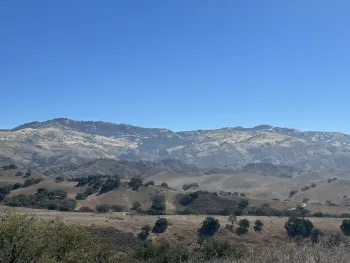
Fire regimes in lower elevation oak and walnut woodlands are variable depending on environmental conditions, woodland density, and topography. On more mesic sites, higher fuel moisture combined with a more closed canopy reduces the drying of fuels and therefore fire occurrence. When fire burns through these systems, it is typically patchier and of mixed intensities and severities. On drier sites, the main fuel is annual grasses, which increase fire frequency but reduce fire intensity and complexity (resulting in uniform burn conditions). Oaks provide a critical food resource for Indigenous populations; it was very common for fire frequencies to be greater in oak woodlands near community sites. Indigenous practitioners used fire to maintain herbaceous understories and reduce pests and pathogens in acorns. At higher elevations, black oak stands tended to burn at mixed intensities and severities.
Mature oaks in this region have thick bark and have relatively good resistance to frequent, low intensity fires. In areas with large accumulations of downed woody fuels and shrubs, surface fires can carry into the canopy, producing lethal crown fires. This is because older trees are less likely to resprout following fires of high severity/intensity. Seedlings and saplings often resprout from the base post-fire, but if fires are frequent enough, this can actually suppress their growth. Many of southern California’s young oaks require an extended fire-free period to grow to a size where they are capable of withstanding fires. There is little information on the fire adaptations or responses of California black walnut.
Additional Resources
Check out these resources below to learn more about fire ecology and history in the South Coast!
- Keeley, J.E., and A.D. Syphard. 2018. South Coast Bioregion. In van Wagtendonk, J. W., N. G. Sugihara, S. L. Stephens, A. E. Thode, K. E. Shaffer, J. A. Fites-Kaufman (Eds.), Fire in California’s Ecosystems. 363-397.
- van Wagtendonk, J. W., N. G. Sugihara, S. L. Stephens, A. E. Thode, K. E. Shaffer, J. A. Fites-Kaufman. 2018. Fire in California’s Ecosystems (2nd ed.). University of California Press. https://www.ucpress.edu/books/fire-in-californias-ecosystems/hardcover.