

About the North Coast and Klamath Mountains
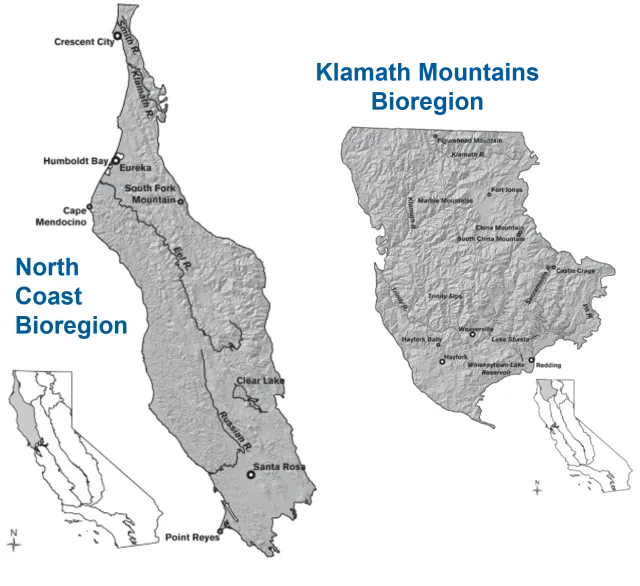
This region is known for its rugged topography, steep slopes, and remote mountain ranges, both along the coast and in the Klamath Mountains. Diverse topography, ranging from sea level to nearly 7,500 ft, supports complex and diverse vegetation mosaics. Topographic features like ridgetops, riparian areas, aspect changes affect fire behavior and spread, and microclimates. For example, the Klamath Mountains are known for steep mountains and deep river canyons—the perfect conditions for inversions that can create stable conditions, trap smoke, and dampen fire behavior.
The climate of the North Coast and Klamath Mountains is Mediterranean, with warm, wet winters and hot, dry summers. Generally, these three trends in climate can influence the development of plant communities: 1) summer climates going from moist and cool to warm and dry west to east, 2) a increase in summer temperatures and decrease in winter precipitation north-south, and 3) decreasing temperature and increasing precipitation as you increase in elevation. Low clouds or fog, is formed due to interactions between cool ocean currents and a warm atmosphere and travels a short distance inland, farther where river valleys allow. This fog, especially during the dry season, is important in terms of the vegetation types that occur. Generally, years that are drier and warmer than normal have larger and more widespread fires.
Fire History of the North Coast and Klamath Mountains
Indigenous burning
The North Coast and Klamath Mountains are home to a diversity of Tribes for whom fire is a central component of their stewardship. Indigenous tribes still steward these lands today, including the Central Pomo, Hoopa, Karuk, Northern Pomo, and Yurok tribes to name a few. Tribes burn for many reasons, including: general land stewardship, cultivation of food and medicine plants, cultivation of basket weaving materials, safety, and cultural and ceremonial purposes. To learn more about other Indigenous tribes in the North Coast and Klamath Mountain region, visit https://native-land.ca/.
Historic Fire Occurrence
Generally, fire frequency and effects were highly variable among ecosystems due to local topography, climate variation, vegetation types, and local populations. Following Euro-American settlement, fire regimes changed drastically due to the removal of Indigenous fire practitioners and changes in land use. After the removal of Indigenous peoples, some fire was reintroduced into the coast redwood range due to historical logging and grazing practices in the area. However, historical logging practices changed fire regimes by removing large trees, which led to the creation of forest stands with high densities of young trees. Changes in forest structure coupled with the removal of recurring fires have led to greater than historical fuel loads.
Fire suppression has altered the structure and function of ecosystems across the region, and moved many of the landscapes into less frequent, higher severity fire regimes. Modern fire suppression operations have successfully controlled most wildfires in the region, however, changes to climate and human ignition patterns have influenced fire occurrence in the region. Because of past management and climate change, in areas where low- to moderate-intensity surface fires were more frequent and extensive, fires are now either suppressed when they are very small or become large, mostly high intensity fires, outside of historic norms.
Fire Ecology of the North Coast and Klamath Mountains by Ecoregion
Fire in Coast Redwood/Douglas-fir Forests
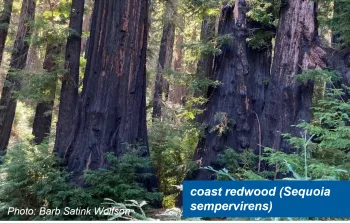
Redwood forests have a complex fire history, typically burning across a wide range of conditions over space and time. Generally, fire regimes were characterized by surface fires with mixed severities and intensities. Fires typically occurred in the late summer/early fall. The fire return interval was highly variable (1-500 years) depending on climate and fuel conditions and proximity to Indigenous villages, hunting areas, travel routes, etc.
Douglas-fir forests likely experienced more frequent fires due to their warmer, drier, inland locations. Fire sizes, intensities, and severities were highly variable, with areas near Indigenous sites experiencing more low to moderate intensity surface fires while other regions experienced more mixed-severity fires (with crown fires). Fire return intervals were likely every 10-16 years.
Since Euro American settlement, both coast redwood and Douglas-fir forests have been modified through the absence of fire. The most significant changes in old and secondary growth forests is the increase in density of understory shrubs and trees creating greater vertical fuel continuity, increasing the likelihood that fire can burn into the crown of dominant trees. The densification of these forests has significantly modified modern fire regimes.
Fire in Low Elevation and Coastal Conifer Forests
Historically, fire return intervals were short and intensity and severity were low to moderate. The dominant conifer species in this zone all evolved with these fire regimes; which allowed them to develop various fire-adaptive traits. California black oak stands were regularly burned by Indigenous people for food cultivation. California black oaks typically suffer the greatest fire damage during moderate- to high-intensity fires.
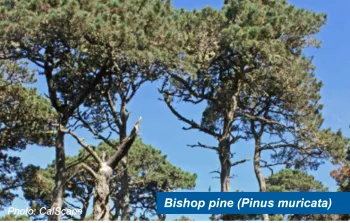
Additionally, in the North Coast, there are scattered Bishop (Pinus muricata), shore (P. contorta var contorta), and knobcone (P. attenuata) pine stands across coastal bluffs and marine terraces from the Oregon border to San Francisco. While shore pines have open cones, Bishop and knobcone pines are closed-cone species. The term “closed-cone” generally means the cones require heat to open and reproduce. These cones are considered serotinous and the extent of serotiny among species varies. For example, they require varying temperatures to open, and some may be opened by small animals seeking food in addition to being opened by heat. Seedling establishment after fire is typically high when ground fuels are consumed by fire and/or overstory trees have been killed, leaving mineral soil with significant light exposure.
Historic fire occurrence in closed-cone stands is highly variable among these species depending on location, site conditions, and likely the human populations that existed nearby. For many species, fire regimes were likely characterized by infrequent, moderate- to high-intensity fires that likely occurred in the late summer/early fall.
Fire in Mid- to Upper-Elevation Conifer Forests
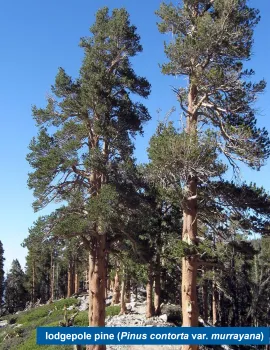
Fire regimes mid-elevation forests are characterized by low- to moderate-intensity fires that occur in the late summer or fall. Fire return intervals varied greatly by plant community. However, following fire suppression, the occurrence of fire in mid-elevation forests has decreased and the density of younger trees, which are more susceptible to mortality from drought, disease, insects, and other fires. Historically, in upper-elevation forests, fire regimes tended to be of mixed-severity, burning in the late summer and early fall. Fire return intervals varied due to topography, vegetation, and fuel availability, but generally, these high elevation sites had longer fire return intervals.
Lightning is frequent at higher elevations, but fire does not play a significant role in these ecosystems. Because of late melting snowpack and fuel scarcity, the few fires that do ignite do not spread beyond individual or small clusters of trees. Trees in this zone are sensitive to even low-intensity fires.
Fire in Oak Forests and Woodlands
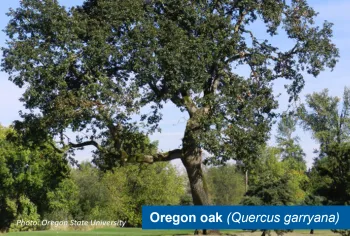
Historically, oak woodlands experienced frequent, low-intensity surface fires, many of which were ignited by Indigenous people. Average fire return intervals for these systems was 7-13 years for woodlands in Humboldt County. Indigenous fires likely occurred year-round for various reasons; ones in the winter likely were limited in their spread, whereas ones in the summer could have been extensive due to continuous dry herbaceous fuels.
Fire exclusion has resulted in the loss in the extent of oak woodlands throughout the region. Frequent surface fires once limited the seedling establishment and reduced the density of Douglas-fir and other competing conifers. In the absence of fire, conifers can out compete shade-intolerant oak species.
Additional Resources
Check out these resources below to learn more about fire ecology and history in the North Coast and Klamath Mountains!
- Skinner, C.N., A.H. Taylor, J.K. Agee, C.E. Briles, C.L. Whitlock. 2018. Klamath Mountains Bioregion. In van Wagtendonk, J. W., N. G. Sugihara, S. L. Stephens, A. E. Thode, K. E. Shaffer, J. A. Fites-Kaufman (Eds.), Fire in California’s Ecosystems. 171-193.
- Stephens, S.L., J.M. Kane, and J.D. Stuart. 2018. North Coast Bioregion. . In van Wagtendonk, J. W., N. G. Sugihara, S. L. Stephens, A. E. Thode, K. E. Shaffer, J. A. Fites-Kaufman (Eds.), Fire in California’s Ecosystems. 149 -170.
- van Wagtendonk, J. W., N. G. Sugihara, S. L. Stephens, A. E. Thode, K. E. Shaffer, J. A. Fites-Kaufman. 2018. Fire in California’s Ecosystems (2nd ed.). University of California Press. https://www.ucpress.edu/books/fire-in-californias-ecosystems/hardcover.