

In California, fuel reduction treatments are being implemented at increasingly greater scales to reduce wildfire risk. Some treatments, such as thinning, chipping, and mastication, produce wood waste, as the majority of what is being removed is either woody vegetation or trees that are too small to produce lumber. Generated wood waste can be left to decompose on site, piled and burned, or used as a by-product (i.e., biomass) for other purposes such as biofuels, energy production, or soil amendments.
Chip and haul treatments are common ways landowners can effectively reduce and remove fuels while also utilizing woody material from project sites as a secondary product. To learn more about other forms of woody biomass utilization, visit UCCE's Forestry Research and Outreach website.
Key Components of the Chipping and Hauling Process
Small-diameter trees and woody material removed during forest management activities can be turned into wood chips and used to produce renewable energy. The chipping process generally includes four key steps: 1) logging, 2) skidding to a landing and drying, 3) chipping and loading, and 4) hauling.
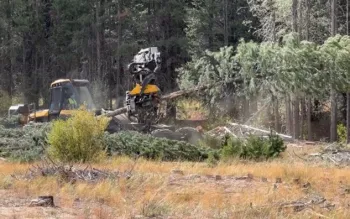
Logging
The first step involves cutting small-diameter trees (generally < 12 in. diameter) that are designated for removal. Depending on terrain, access, and project scale, cutting may be performed using either chainsaws or mechanical felling equipment. Often times, trees selected for biomass utilization are typically smaller-diameter, low-value trees that are not suitable for traditional lumber or sawlogs.
Skidding Trees to a Landing and Drying
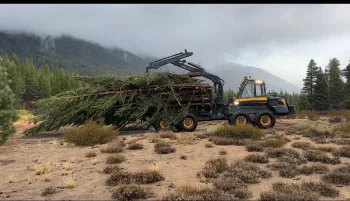
After trees are cut, they must be transported from where they were felled to a landing for further processing. Whole trees or bundles of trees are transported using heavy equipment like skidders or forwarders. Once at the landing, trees are left to dry before further processing. This drying period can range from 1-6 months, depending on weather conditions, species, and time of year. Landowners can chip freshly-cut trees, but their high moisture content can result in higher hauling costs. Generally, biomass facilities pay for biomass based on bone-dry tons (BDT), which represent the amount of dry wood fiber delivered, excluding water weight. Allowing trees to dry in the field reduces their moisture content, increasing the amount of usable wood fiber that can be transported in each load and improving the overall economics of the operation. Piling drying biomass near a road or a centralized landing can help improve operational efficiency.
Chipping and Loading Material
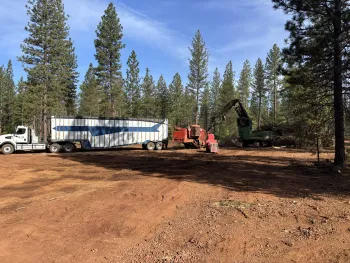
After material is sufficiently dried, it is fed into a wood chipper to be processed into biomass chips, which are typically 1-3 inches in size. The chipping process reduces the volume of the material, making it easier and more economical to transport. In some cases where material size or chip van access is an issue, whole logs may be loaded and hauled to a facility to be processed. However, this often results in material being obtained at lower prices than if they were processed on site. Chipping usually occurs directly at the landing so that chips can be immediately loaded into chip vans. In many operations, the chipper has a blower chute that directs chips into the trailer as they are produced. This allows the loading and chipping processes to occur simultaneously.
Hauling Chips to a Biomass Facility
Once a chip van is full, it transports material to a facility where the wood chips will be used to generate electricity. Transportation costs are often one of the largest expenses in biomass utilization, as chip vans carry relatively low-density material compared to traditional logs. Additionally, hauling distances can vary depending on the proximity of the project site to processing facilities. Generally, the longer the hauling distances, the greater the associated costs.
Upon arrival at the biomass facility, trucks are weighed twice at the truck scale. The difference between the incoming load weight and weight of trucks after chips are delivered is used to determine the net weight of biomass delivered. The chips are then stored until they are used to generate renewable energy.
Key Operational Factors
Several factors consistently influence the cost and feasibility of chip-and-haul operations:
Terrain can be the largest driver of cost. Flatter, less rocky ground allows for more efficient operations, reducing machine time and overall expenses.
Hauling distance is often the second largest driver of cost behind terrain. The distance between the treatment area and the biomass facility directly affects how many trips a chip van can complete in a day. Longer haul distances reduce the number of daily loads, increasing transportation costs per ton and reducing potential revenue from chip sales.
Biomass volume can also influence price. Stands with higher volumes of material require more time to process, increasing total operational costs.
Site accessibility is a critical prerequisite, especially if chips are to be hauled to a biomass facility. Roads must be wide enough, relatively flat, and capable of supporting the weight and turning radius of a fully loaded chip van.
Project area size can influence associated costs. Smaller projects, typically those under 100 acres, would incur slightly higher hourly equipment rates compared to larger projects.
Equipment costs vary based on equipment type, operator rates, and machine availability.
Additional Resources
Check out these chipping treatment-related resources from UC ANR Fire Network Members!