

What is Targeted Grazing?
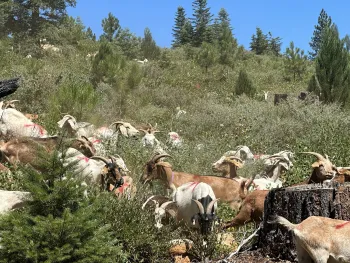
Targeted grazing is the application of livestock at a determined season, duration, and intensity to accomplish specific vegetation or landscape goals. The primary difference between good grazing management and targeted grazing is that targeted grazing refocuses outputs of grazing from livestock production to vegetation and landscape enhancement.
Targeted grazing contractors typically provide the livestock, fencing, staff, livestock watering equipment, predator protection, and other infrastructure necessary to safely and effectively manage livestock. By managing the type and number of animals, the duration of grazing, the season and frequency of grazing, and the spatial distribution of livestock, targeted grazing can help landowners and managers achieve a variety of land management goals.
Where is Targeted Grazing Effective?
Well-managed targeted grazing can be used to address site-specific landscape goals. Targeted grazing can impact specific invasive weeds (like yellow star-thistle, medusahead or Himalayan blackberries). By controlling competing vegetation at specific times, targeted grazing can enhance habitat restoration efforts. Targeted grazing can reduce, modify, and remove live fine fuels and ladder fuels to reduce wildfire danger in many environments. It is important to note that grazing does not reduce or remove dead woody fuels, which can significantly contribute to fire risk.
It is important to understand the benefits and costs of using grazing when removing hazardous wildland fuels. As a stand alone treatment, targeted grazing can be a cost-effective vegetation management alternative where other treatments are not feasible. Specifically, targeted grazing can be more cost effective on landscapes that are too steep, rocky, or remote for conventional vegetation management (like mowing or chemical treatment), or in the urban-wildland interface where burning is not an option.
The life history of targeted plant species will also influence treatment efficacy. In most circumstances, a single grazing treatment will not eliminate undesirable species and fuels in the same way that herbicides or mechanical removal will. Effective fuel reduction with grazing is best achieved when integrated into the ecosystem to manage surface fuels and vegetation composition. In complex vegetation environments with overgrown woody species, an integrated management approach can include targeted grazing to initially open the lower brush canopy which enables further treatment with other tools such as prescribed fire or mechanical removal which can later be maintained with more passive commercial grazing. It’s also important to understand that many brush species will resprout following grazing and must be treated in subsequent years with other tools or repeated grazing to achieve longer-term impacts by reducing the root stocks.
Managing Animal Impacts
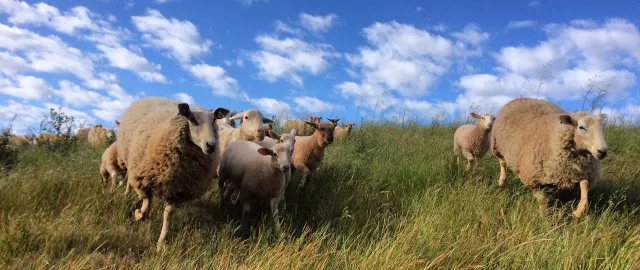
Grazing livestock have three basic impacts on the landscape. They consume vegetation through grazing, they trample vegetation (which can facilitate the breakdown of plant carbon in the soil), and they transfer nutrients through defecation and urination. Targeted grazing uses all three impacts to accomplish specific vegetation management goals.
Selecting the right animal for the grazing job is dependent on your management goals and types of vegetation that livestock are expected to consume. Sheep and cattle are most effective at consuming herbaceous vegetation on flat to moderately steep slopes while goats are effective at consuming brush and many weeds and are more effective on very steep slopes. And livestock with more experience and familiarity grazing the site and surrounding vegetation will be more effective than livestock that are naïve to the site.
Timing of grazing has been shown to impact plant species composition, as some plants tend to be more palatable and preferentially selected by livestock at different times of the year. Most plants have certain times of the year when they are more susceptible or resistant to grazing.
- Fall/winter grazing with cattle tends to reduce annual grasses and encourage forbs, including weed species.
- Spring grazing tends to be a good time for livestock weight gain as grasses and forbs are highly nutritious. During late spring livestock will graze some forbs and perennial grasses that stay green longer than the annual grasses.
- Summer grazing tends to be a period when forage values decrease and livestock may concentrate in riparian areas and utilize shrubs and oaks for forage.
- Since the nutritional quality of annual grasslands typically declines rapidly at this time of year, targeted grazers may need to provide supplemental nutrition to ensure both animal well-being and appropriate impact to targeted vegetation.
What to Look for in a Targeted Grazing Contractor?
Targeted grazing companies are essentially service providers. Consequently, experience, responsiveness and attention to detail are critical. Consumers should look for companies with experience in grazing projects in similar environments and situations. Ask potential contractors about their experience level – and ask for references.
How much does targeted grazing cost?
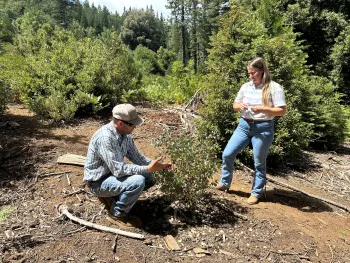
Targeted grazing may not be the least costly vegetation management option (especially compared to mowing or herbicide treatment). Most targeted grazing contractors will provide an estimate on a per acre basis, allowing consumers to compare targeted grazing to other vegetation management options. In addition, contractors will provide an estimate of the project start date and duration. These estimates can be somewhat uncertain depending on year-to-year changes in vegetation quantity.
There are a variety of factors that impact the cost of a particular targeted grazing project, including:
- Relative ease (or difficulty) of setting up infrastructure, including loading and unloading facilities. Projects in steep or difficult-to-access terrain require more labor (and, therefore, are typically more costly).
- Access to livestock water. Easily accessible water can make the project less costly; projects without access to water may require the contractor to haul water to the livestock.
- Other risks, like vandalism, toxic plants, or proximity to high-value landscaping may increase the cost.
- Multi-year contracts are typically cheaper on a per acre basis. Livestock and targeted grazing staff become more accustomed to a particular property (and therefore more efficient) if the contract is for multiple years.
Headache factors – like free-roaming pet dogs or neighbors who object to livestock or livestock guardian dogs – can increase the cost of a project.
Interested in taking a deeper dive into targeted grazing?
In 2026, UC Cooperative Extension piloted the California Targeted Grazing Short Course, a ten week virtual course for practitioners, resource managers, landowners, and students. Workshop participants learn about the fundamentals of small-ruminant targeted grazing, how to care for animals on targeted grazing jobs, critical business planning skills, and how to integrate new technologies into grazing operations. While the 2026 cohort has concluded, you can view all webinars on our YouTube channel!
Additional Resources
Much of the information above was borrowed from the Targeted Grazing: A Primer for Landowners and Land Managers factsheet by UCCE Livestock and Natural Resources Advisor, Dan Macon.
Below is a list of other resources about targeted grazing. Please note these materials are not maintained by UC ANR and may not meet current accessibility standards. If you need assistance accessing this content or require an accessible format, please contact the website owner or organization listed after the link provided below.
- Livestock grazing management resources from the California Board of Forestry and Fire Protection (California Board of Forestry and Fire Protection)
- Targeted Grazing: A Natural Approach to Vegetation Management and Landscape Enhancement handbook (2006; University of Idaho)
- The Art and Science of Targeted Grazing - A Producer's Perspective journal article (2014; Rangelands)