

The following information will answer some common questions about the local Inyo-Mono Master Food Preserver program.
What does the training program include?
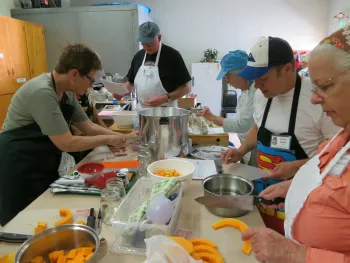
The University of California provides approximately 50 hours of training in food safety and preservation. Preservation methods addressed include canning, dehydrating, and freezing. Safe food handling and storage will be an important component of the class as well. We include food for the lessons, a manual, name tag, and apron.
Where do the classes take place?
On years that we participate with other counties to offer a statewide training, the lecture portions will be offered online so you will need to have access to the internet. Labs associated are in-person, usually in a local members' kitchen or at the fairgrounds in Bishop. (When we host our own trainings, most content is presented in-person, but it's usually more cost-effective for everyone involved to partner with the other counties.)
Is the class fun!
You bet! But we do cover some serious topics like food safety and food-borne illness.
Who can apply to our program?
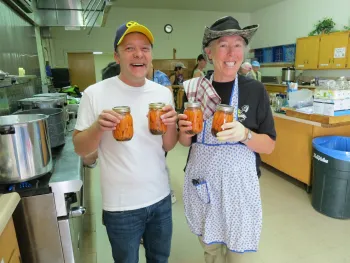
The program is open to residents of Inyo & Mono Counties. Prior experience in food preservation is helpful but not required. We seek people with a strong volunteer ethic and desire to make a long-term commitment to the program. A past history of volunteering in the community is one of the main qualifications we look for in applicants; past volunteer activities do not need to be related to food preservation. Applicants must have a desire to serve their community through leading workshops, answering questions from the public, and writing articles.
Since this year's class is being held in conjunction with other counties, residents outside our two counties should contact their local extension office.
UC Agriculture and Natural Resources (UC ANR) is an equal opportunity provider.
What are the responsibilities of MFP volunteers?
Upon completing all sessions and passing a written exam by 85%, volunteers will be certified as agents of the University of California to provide instruction in food safety and preservation. Volunteers will be responsible for leading public classes and demonstrations on food preservation throughout Inyo & Mono counties. To maintain Certified Instructor status, volunteers must complete both of the following annual requirements:
- Present public classes (as part of a team of instructors)
- Outreach: either in-person (i.e. tabling) or written (i.e. articles or blog posts)
- Answering home preservation questions from emails, Facebook, and other means
I am interested in taking the class but do not wish to become a Certified Instructor. Can I still take the class?
Currently, this is not an option.
I am unable to attend all sessions. Can I attend just a few days?
Sorry, no. We need our Instructors to be well-versed in all aspects of food safety and preservation, and therefore attendance at each session is essential. If you are unable to commit to all sessions, you may be interested instead in attending public workshops on food preservation. These classes will be shorter than those provided at the Instructor Training, but they will cover the basics of each preservation technique.
If you are interested in taking the entire Instructor Training, we recommend applying to the program when you are able to attend all sessions.
I am only interested in learning about canning. Can I just go to that session?
No. Please see previous answer. You may wish to attend a public workshop that focuses on canning.
Is there a cost to attend the basic training class?
Yes. The cost of the 2026 training is $275. This covers all supplies and books. We do our best to keep it as affordable as possible, but as you know, food and supplies are expensive in our area.
Where else can I learn about safe methods of home food preservation?
The National Center for Home Food Preservation offers a free, self-paced, online course for those wanting to learn more about home canning and preservation. You may sign up for this online class at http://nchfp.uga.edu/.
Our volunteers offer several workshops each year to the public on a variety of preservation topics. We usually announce these via email and in local media.
More questions?
If you have additional questions about the program, please contact us at (760) 873-7854. You'll likely find all the answers by attending one of the orientation sessions.