

Some folks wear their heart on their sleeves.
Others wear a dragonfly on their chest.
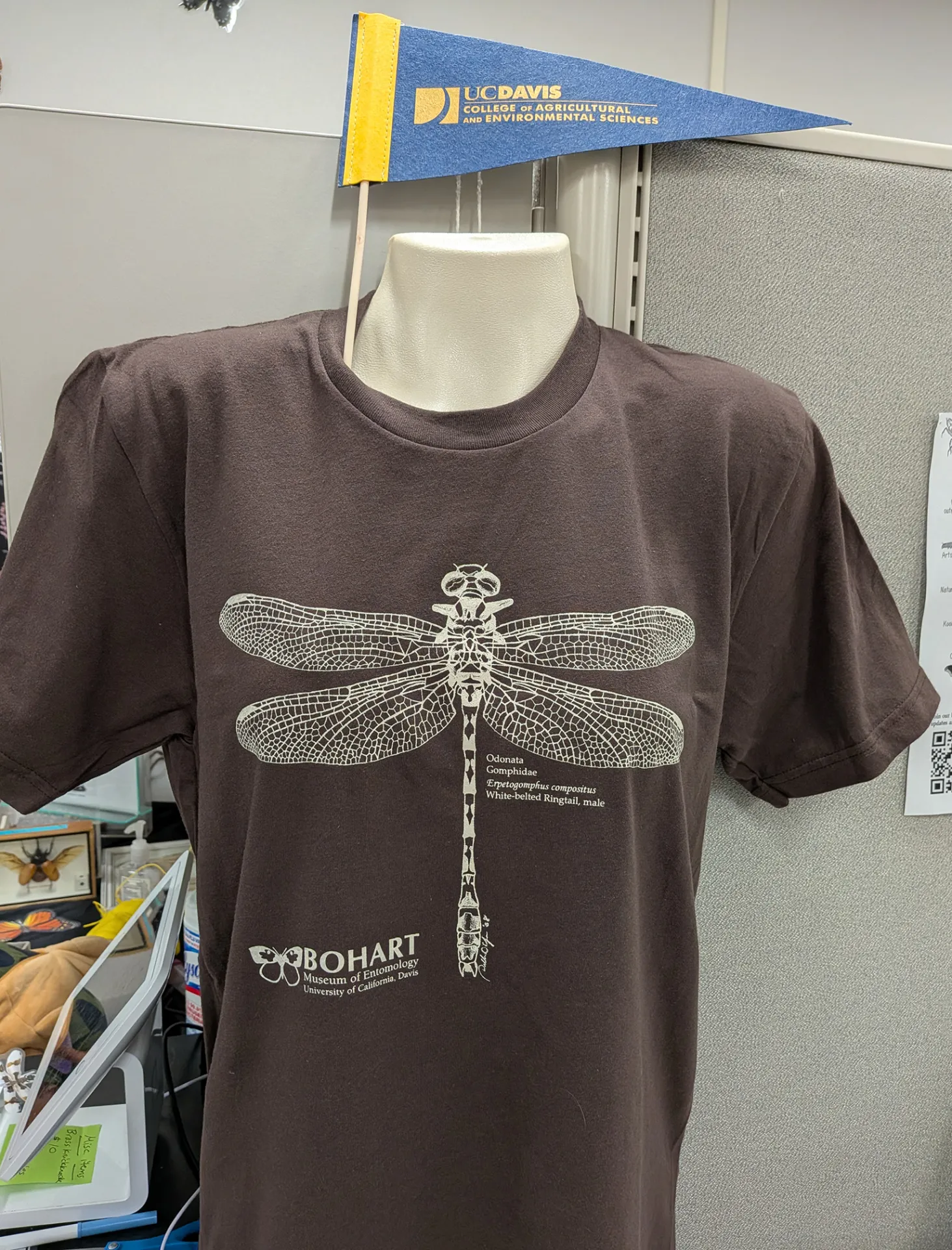
Newly arrived in the Bohart Museum of Entomology gift shop are dragonfly T-shirts.
"The dragonflies came in!" announced Tabatha Yang, education and outreach coordinator of the Bohart Museum. "They look great."
Colors include brown, sea blue and olive. The dragonfly itself is printed in off-white ink. "We have adult S, M, L and XL for these shirts," she related. "We have lots of shirt options for adults XXL and lots of kid shirts, too."
New items in the gift shop also include brass bugs and brass bug belt buckles (BBBB), all donated by retired faculty aquatic entomologist, Al Grigarick.
Remember Christofer Brothers, a UC Davis doctoral candidate who studies dragonflies and a frequent presenter at the Bohart Museum open houses?
Following one open house, he commented: "A lot of people were especially surprised to learn that dragonflies are aquatic, and many didn't expect there to be as many species as there are--more than 6400 species of dragonflies and damselflies combined!"
"One of the most common questions we got," he said, "was how long dragonflies live, and people were surprised to learn that the larvae can live for up to eight years, but the adults are always less than a year, and usually only for a few weeks to months. One young visitor asked us where the antennae were on them. They are present, but they're very reduced in dragonflies since they rely so much on their vision, so it's hard to locate them."
"Lastly someone asked about their eyes, and if their eyes are the biggest among insects--which they are, having up to 30,000 simple eyes within each of their compound eyes."
Dragonflies belong to the insect order Odonata. Like all insects, they have a head, thorax and abdomen. Dragonflies have nearly 360-degree vision. “Dragonflies are incredibly successful predators," Brothers said. "The adults catch prey up to 97 percent of the time."
As predators, dragonflies employ two broad strategies: active, and sit-and-wait (ambush), Brothers said. “When they're actively pursuing prey, they usually rely on speed or endurance. When they wait for prey, they usually rely on stealth, luring or surprise.”
Brothers also displayed a number of dragonfly books. One of the newest books available is "Dragonflies (Anisoptera) of California," the work of Kathy Biggs and Sandra von Arb, earlier participants in Bohart Museum open houses. Their book features the 73 species of dragonflies that occur in California, and includes photos and descriptions of both the males and females. The book also includes, for each species, the habitat, distribution maps, flight periods, behaviors and oviposition techniques.
The Bohart Museum, home of eight million specimens, is located in Room 1124 of the Academic Surge Building, 455 Crocker Lane, UC Davis. Besides the insect-themed gift shop stocked with T-shirts, hoodies, jewelry, books, posters, stuffed toy animals and insect collecting equipment, it includes a live petting zoo (Madagascar hissing cockroaches, stick insects, taranatulas and more)
Director of the museum is Professor Jason Bond, the Evert and Marion Schlinger Endowed Chair of Systematics in the UC Department of Entomology and Nematology, and executive associate dean, UC Davis College of Agricultural and Environmental Sciences.
During the winter break, the museum will be closed Monday, Dec. 22 through Friday, Jan. 2, 2026. For more information, access the website or email bmuseum@ucdavis.edu.
