
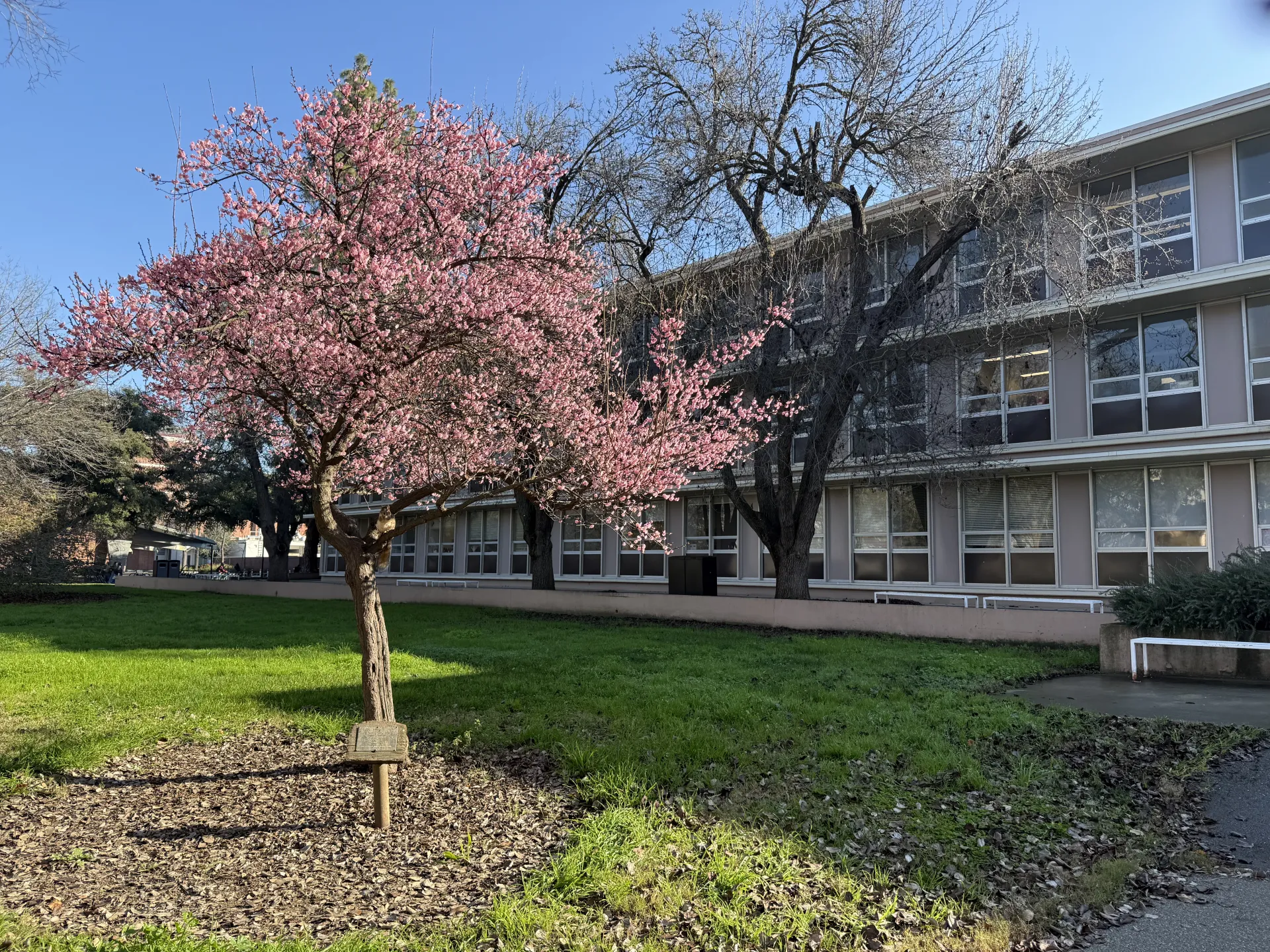
It's an early sign of spring on the University of California, Davis, when a solo Japanese apricot tree, located north central of Wickson Hall, bursts into full bloom.
A plaque reads "Japanese Apricot, Prune mume dawn, planted in honor of Dr. William Tufts, March 7, 1963 by the Landscape Horticulture Forum." The tree and inscription appear on the UC Davis Arboretum and Public Garden website. Tufts served as a UC Davis pomology professor, as did his son, William G. Tufts.
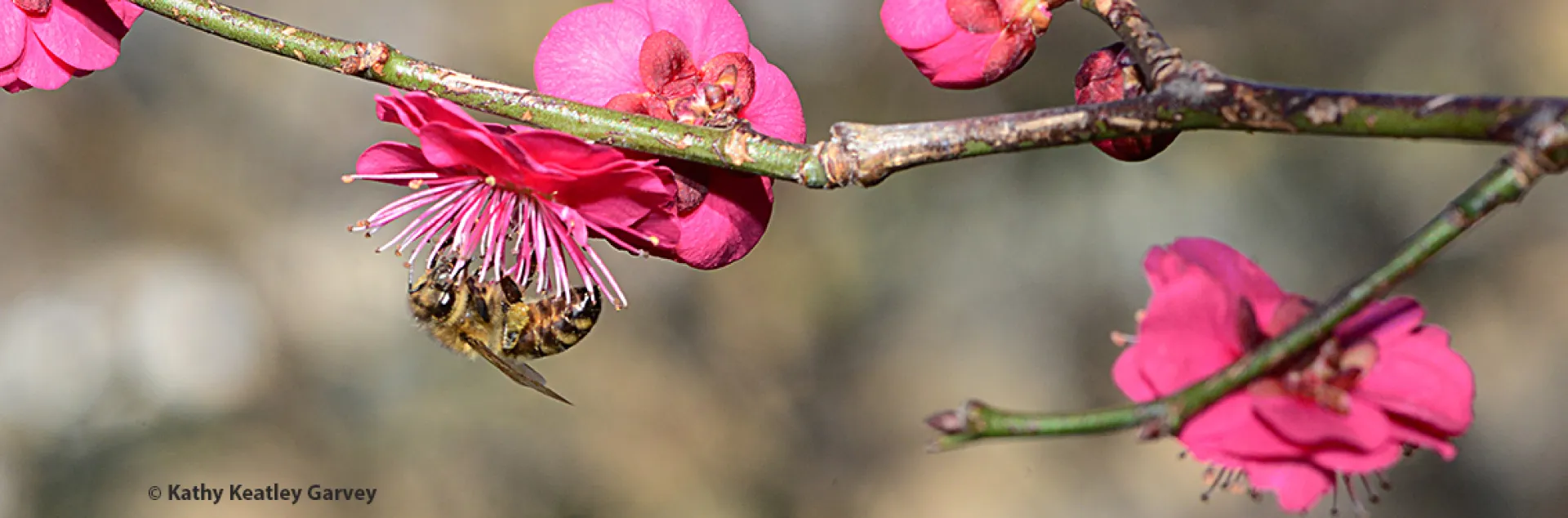
The tree, signaling that "Hey, winter is nearly over, let's celebrate," is a luminous pink spot on an otherwise gray day. Honey bees and syrphid flies sip nectar from the delicate blossoms, as UC Davis students with heavy backpacks trudge by, observed closely by the Aggie "lawn mascots"--the squirrels--looking for snacks.
The Japanese apricot tree is an ornamental deciduous tree, native to the woods and rocky hills of China South-Central and Laos.

"The Japanese flowering apricot is an important tree in Chinese culture and has been cultivated for over 1500 years," according to a North Carolina State University (NCSU) Extension website on Prunus mume (pronounced PRU-nus MU-may), "The five petals of the flower are said to represent five blessings that include wealth, health, love of virtue, old age, and natural death. Although it did not originate In Japan, it is grown extensively there and boasts up to 300 cultivars...The genus, Prunus, is derived from Latin and means plum or cherry. The epithet, mume, is the Japanese pronunciation of the Chinese name for this plant."
"This tree is resistant to most insects and diseases," the NCSU website points out. "Potential insect pests of the Japanese flowering apricot tree include aphids, scales, borers, spider mites, and tent caterpillars. The tree is susceptible to bacterial canker, honey fungus, silver leaf, and brown rot. In winter, cold temperatures may damage the flowers and fruits. The fruits can be messy if allowed to just fall to the ground. Trees that are grafted on peach rootstocks may be attacked by the peach tree borer. The leaves, stems, and seeds are toxic to dogs, cats, or horses if ingested."
Not toxic to honey bees and syrphid flies!
Cover image: A honey bee nectaring on the blossoms of a Japanese apricot tree on the UC Davis campus. (Photo by Kathy Keatley Garvey)