


The annual Yule blog...
Back in 2010, UC Cooperative Extension apiculturist Eric Mussen (1944-2022) of the UC Davis Department of Entomology and Nematology, and yours truly, department communications specialist, wondered why no insects appear in "The Twelve Days of Christmas
Zero. Zilch. Nada.
Just a partridge in a pear tree, 2 turtle doves, 3 French hens, 4 calling birds, 5 gold rings, 6 geese-a-laying, 7 swans-a-swimming, 8 maids a'milking, 9 ladies dancing, 10 lords-a-leaping, and 11 pipers piping.
Where, oh, where, are all the insects? Worldwide, some 10 quintillion insects inhabit the Earth, a billion times more than humans. Insects make up 75 percent of all the fauna on Earth.
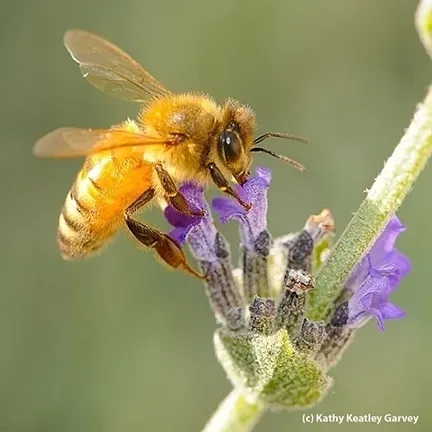
So we replaced "five gold rings" with "five golden bees." Other insects crawled, hopped, leaped and fluttered into the song. We sang the piece during our 2010 UC Davis Department of Entomology and Nematology holiday party. The lyrics went viral when U.S. News picked it up:
On the first day of Christmas, my true love gave to me, a psyllid in a pear tree.
On the second day of Christmas, my true love gave to me, 2 tortoises beetles and a psyllid in a pear tree
On the third day of Christmas, my true love gave to me, 3 French flies, 2 tortoise beetles and a psyllid in a pear tree
On the fourth day of Christmas, my true love gave to me, 4 calling cicadas, 3 French flies, 2 tortoise beetles and a psyllid in a pear tree
On the fifth day of Christmas, my true love gave to me 5 golden bees, 4 calling cicadas, 3 French flies, 2 tortoise beetles and a psyllid in a pear tree
On the sixth day of Christmas, my true love gave to me 6 lice a'laying, 5 golden bees, 4 calling cicadas, 3 French flies, 2 tortoise beetles and a psyllid in a pear tree
On the seventh day of Christmas, my true love gave to me 7 boatmen swimming, 6 lice a'laying, 5 golden bees, 4 calling cicadas, 3 French flies, 2 tortoise beetles and a psyllid in a pear tree
On the eighth day of Christmas, my true love gave to me 8 ants a'milking aphids, 7 boatmen swimming, 6 lice a'laying, 5 golden bees, 4 calling cicadas, 3 French flies, 2 tortoise beetles and a psyllid in a pear tree
On the ninth day of Christmas, my true love gave to me 9 mayflies dancing, 8 ants a'milking aphids, 7 boatmen swimming, 6 lice a'laying, 5 golden bees, 4 calling cicadas, 3 French flies, 2 tortoise beetles and a psyllid in a pear tree

On the tenth day of Christmas, my true love gave to me 10 locusts leaping, 9 mayflies dancing, 8 ants a'milking aphids, 7 boatmen swimming, 6 lice a'laying, 5 golden bees, 4 calling cicadas, 3 French flies, 2 tortoise beetles and a psyllid in a pear tree
On the 11th day of Christmas, my true love gave to me 11 queen bees piping, 10 locusts leaping, 9 mayflies dancing, 8 ants a'milking aphids, 7 boatmen swimming, 6 lice a'laying, 5 golden bees, 4 calling cicadas, 3 French flies, 2 tortoise beetles and a psyllid in a pear tree
On the 12th day of Christmas, my true love gave to me 12 deathwatch beetles drumming, 11 queen bees piping, 10 locusts leaping, 9 mayflies dancing, 8 ants a'milking aphids, 7 boatmen swimming, 6 lice a'laying, 5 golden bees, 4 calling cicadas, 3 French flies, 2 tortoise beetles and a psyllid in a pear tree
"On the 13th day of Christmas, Californians woke to see: 13 Kaphra beetles, ?12 Diaprepes weevils, ?11 citrus psyllids, ?10 Tropilaelaps clareae, ?9 melon fruit flies, 8 Aedes aegypti, 7 ash tree borers, 6 six spotted-wing Drosophila, 5 five gypsy moths, 4 Japanese beetles, 3 imported fire ants, 2 brown apple moths, and a medfly in a pear tree."
And, then, of course, there's that dratted pest, the Varroa destructor (varroa mite) from Asia, which arrived in the United States in 1987. Known as the No. 1 enemy of beekeepers, this external parasitic mite feeds on fat body tissue, and can transmit debilitating viruses. This is not what you want for the holiday season--or any other time.
Here's to a "bee-utiful holiday season, and may it "bee" as golden as a golen bee.