What exciting research--fitting overwintering monarch butterflies with the newly developed ULTRALIGHT solar-powered radio tags to monitor their movements.
Senior conservation biologist Emma Pelton of the Xerces Society for Invertebrate Conservation today announced in a news release that “Scientists are now tracking the movements of imperiled monarch butterflies in Santa Cruz with the help of new ultralight radio tags.”
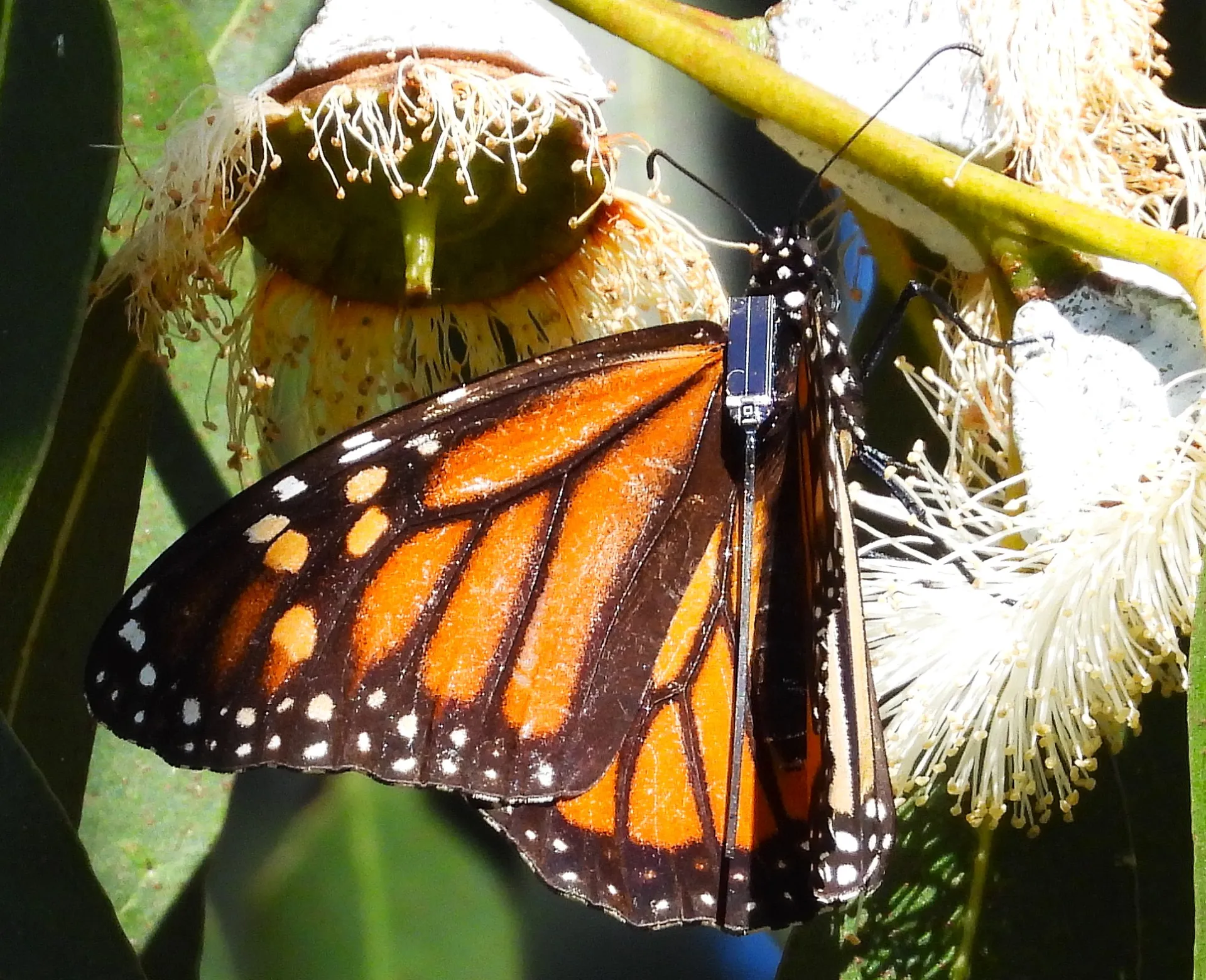
“The Xerces Society and Point Blue Conservation Science are partnering with California State Parks and Santa Cruz County Parks to study monarch butterfly movement during their overwintering season," accoring to the news release. "The conservationists gathered in mid November to attach small tags, weighing less than a tenth of a gram, to individual monarchs at Natural Bridges State Beach, Lighthouse Field State Beach, and Moran Lake County Park. Additional monarchs have been tagged by project partners further south on the Central Coast.”
Now we will know more about when and where they're heading!
As Pelton commented: “The tagged butterflies will help us understand when and where monarchs move among overwintering sites and the surrounding areas. These details will help us identify where to prioritize conservation of western monarch habitat, as well as provide the most accurate picture of their home range to date.”
Sadly, Western monarch populations have declined more than 99 percent since the 1980s. "Protecting and restoring overwintering habitat," Xerces shared, "is a crucial part of the species’ recovery plan.“
How much does the ultralight tag (comprised of a tiny solar panel and short antennae) that Cellular Tracking Technologies (CTT) developed weigh? Just 0.06-0.07 grams. A single grain of rice generally weighs slightly less, around 0.03 grams (30 milligrams), so two grains of rice would be close to this range
Migratory monarch specialist David James of the Washington State University, who has spearheaded a paper-tag tracking program for the last 12 years, recently posted on his Facebook page, Monarchs of the Pacific Northwest, that radio-tagging is a "game changer not only for monarch migration studies but also for insect movement research. For the first time, we can follow large insects like monarchs and bumblebees over long (or short) distances."
His results showed "conclusively that the majority of monarchs in Washington and all of the monarchs in Oregon, migrate to California for overwintering. The only mystery that remains is where do Idaho monarchs overwinter? Out of many thousands tagged over the years, only two were resighted in California. We suspect that the majority head due south from Idaho, perhaps ending up in Mexico. Radio-tagging offers us the opportunity to solve this mystery! We will bring more details of this exciting new project and how you can be involved early next year!"
As James noted: The radio tag "utilizes most smartphones with enabled Bluetooth and location services as passive receivers, allowing unprecedented spatial and temporal tracking in near-real time."
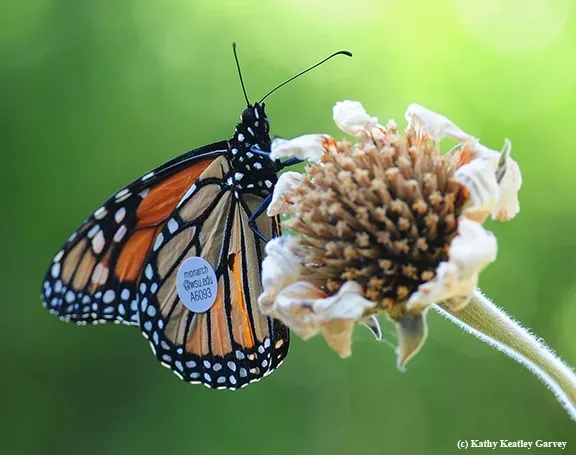
We remember when a male monarch, tagged and released in Ashland, Ore., by citizen scientist Steven Johnson of the James program, fluttered into our Vacaville pollinator garden on Labor Day, 2016. Records show that Johnson tagged and released it Aug. 28 and it found its way into our garden on Sept. 5. I managed to photograph it with its tag: “Monarch@wsu.edu A6093.” My alma mater!
James later told us: "So, assuming it didn't travel much on the day you saw it, it flew 285 miles in 7 days or about 40.7 miles per day. Pretty amazing."
Yes, totaly amazing. And if the radio tags had been developed then, we could have followed its movements. Where did it stop? How long? Where did it go after it left our garden? Did it escape predators and the elements or did it manage to survive and find an overwintering spot?
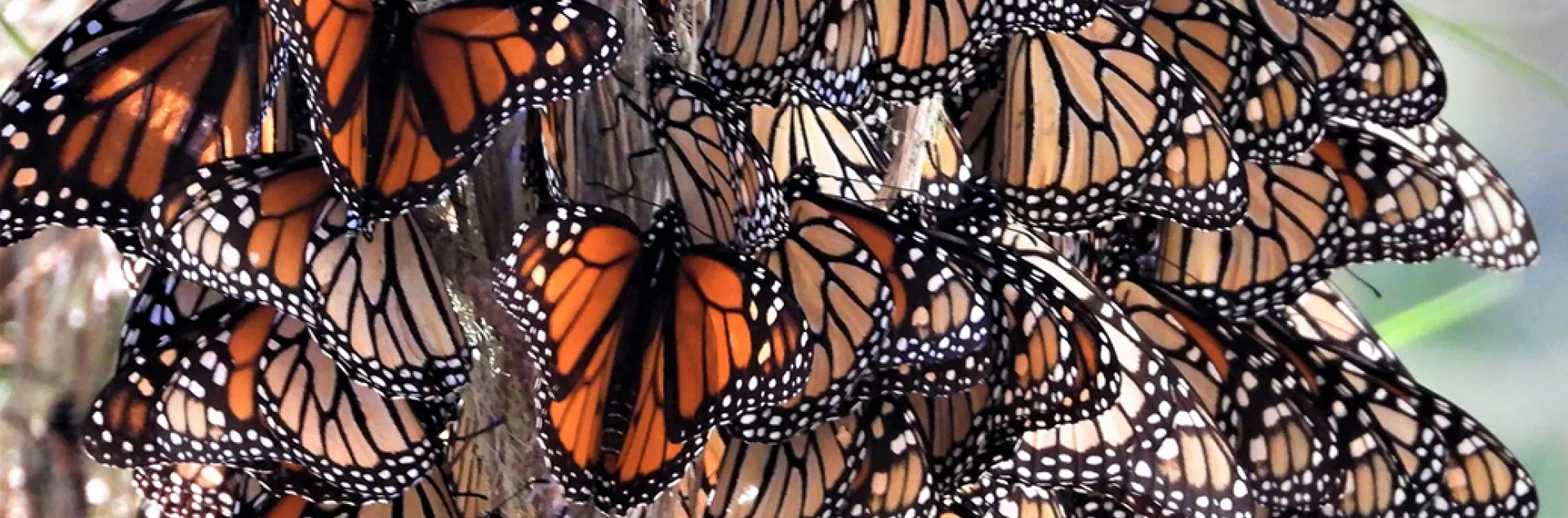
Cover image: A cluster of overwintering monarchs at a California State Park, Natural Bridges State Beach in 2016. (Photo by Kathy Keatley Garvey)