
Wait 'til you see the flora and the fauna on two ceramic-mosaic murals located behind the UC Davis Arboretum Plant Nursery on Garrod Drive.
An unveiling and celebration will take place at a public ceremony at 3 p.m., Saturday, Feb. 21 during the 15th annual UC Davis Biodiversity. Museum Day.
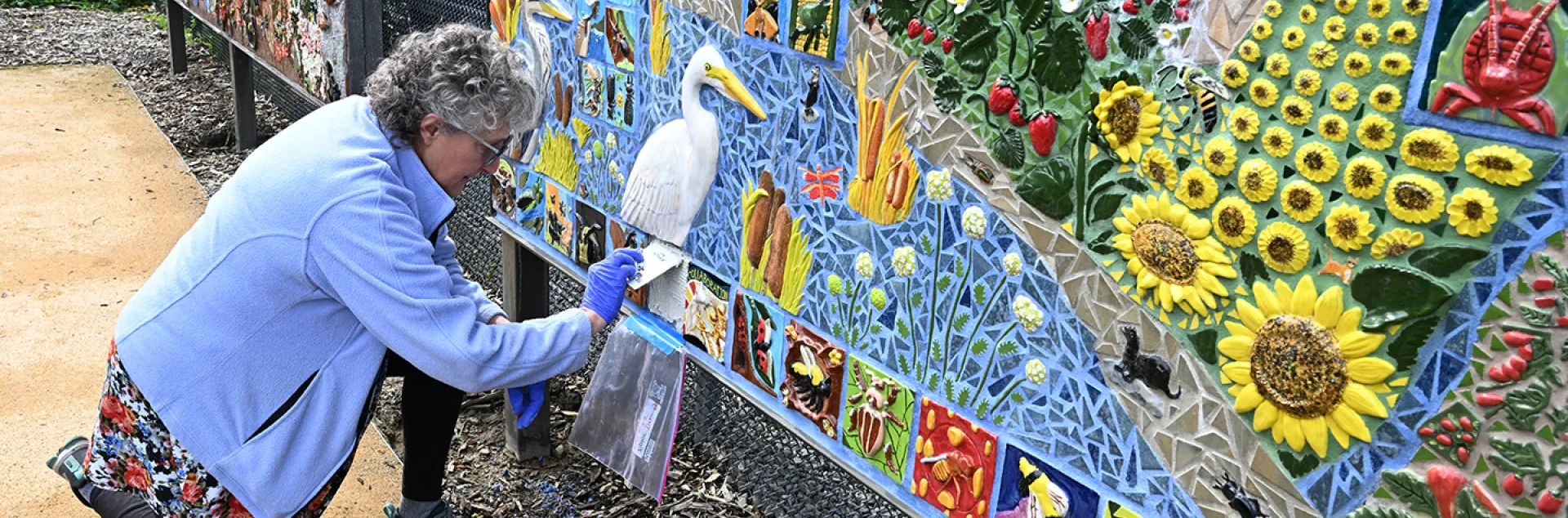
UC Davis Distinguished Professor Emerita Diane Ullman of the Department of Entomology and Nematology finished applying the finishing touches to the second of two murals today (Feb. 20).
Urban landscape entomologist Emily Meineke, associate professor, Department of Entomology and Nematology, headed the project. Meineke teaches ENT 001, "Art, Science and the World of Insects," a class that Ullman previously launched and taught. Ullman co-founded and co-directed the UC Davis Art/Science Fusion Program. Upon her retirement in June of 2024, she became the emerita director, and Meineke, the director.

"The two murals are the first half of a 4-mural project displaying a cross-section of California’s diversity, spanning from the coast to the Sierras," Meineke says. "The murals being unveiled are of the coast and the Central Valley. They are 15’ by 5’ large format, high-relief pieces, each made by one quarter of ENT 001 students."
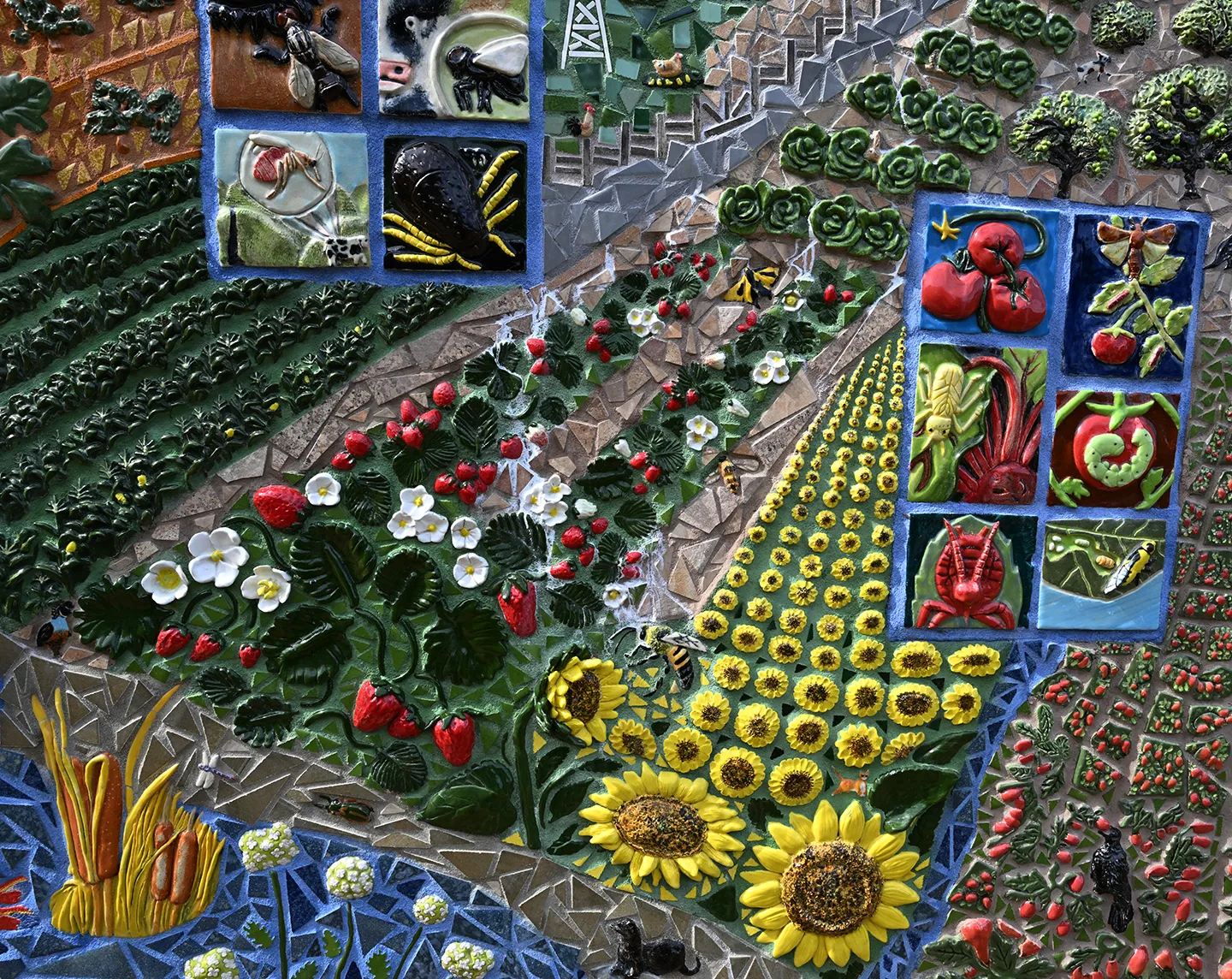
The second mural features such flora and fauna as strawberry, sunflower, pumpkin and watermelon fields; an egret and great blue heron; rabbits and squirrels; beetles, bees, dragonflies, aphids, and a Jerusalem cricket; and a family farm, complete with the iconic red barn, cows, chickens and a windmill. And much more!
The Biodiversity Museum Day, free and family friendly, features 12 museums or collections across campus. It's meant to be a "Super Science Day" filled with discoveries, explorations and connections where you can watch a carnivorous plant eat a fly, pet a stick insect, photograph a bald eagle, time-travel two billion years, stare down a T. rex, learn how to plant a pollinator garden, try your hand at flintnapping, laugh at yeast jokes, and take home seed cookies for the pollinators.
The event takes place within a time frame of 9 a.m. to 5 p.m. Some are scheduled in the morning; some in the afternoon; and some overlap.
The UC Davis Department of Entomology and Nematology (ENT) plays a major role in the production of BioDiv Day. The committee chair is Tabatha Yang, education and outreach coordinator of the Bohart Museum of Entomology. Participating museums and collections include the Bohart Museum; the Bee Haven; and the Nematode Collection.
- Bee Haven, 1 Bee Biology Road, off Hutchison, then Hopkins Road. Hours: 9 a.m. to 1 p.m.
- Bohart Museum of Entomology, Room 1124, Academic Surge Building, and hallway, 455 Crocker Lane. Hours: 12 noon to 4 p.m.
- Nematode Collection, 1026 Katherine Esau Science Hall. Hours: 10 a.m. to 2 p.m.
See the complete list at https://biodiversitymuseumday.ucdavis.edu/. Don't try to attend all of the events in one day. Pick and choose several and then return to see different ones next year, Yang advises.
Good advice!
Cover image: UC Davis Distinguished Professor Emerita Diane Ullman working on the second mural on Friday, Feb. 20. (Photo by Kathy Keatley Garvey)