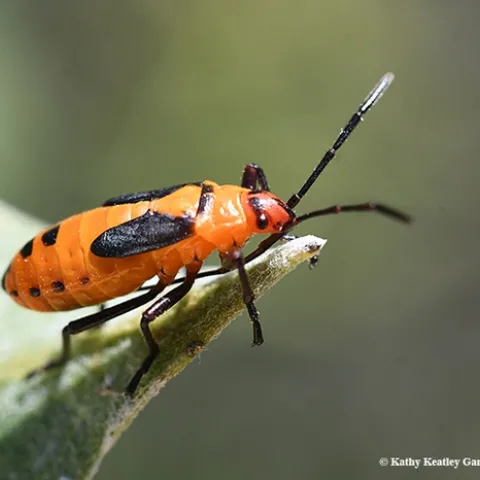
If you've been finding more milkweed bugs than monarchs on your milkweed, join the crowd. Monarchs are scarce--at least around Solano and Yolo counties--but milkweed bugs are quite plentiful.
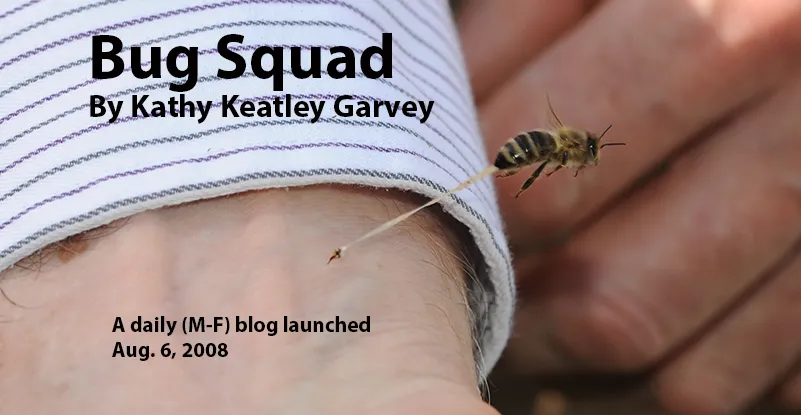
If you're a beekeeper or plan to be a beekeeper, you're aware of Public Enemy No. 1. That would be the varroa mite, Varroa destructor, an eight-legged external parasite that attacks and feeds on honey bees. Those mites can spread viruses and decimate a healthy colony.
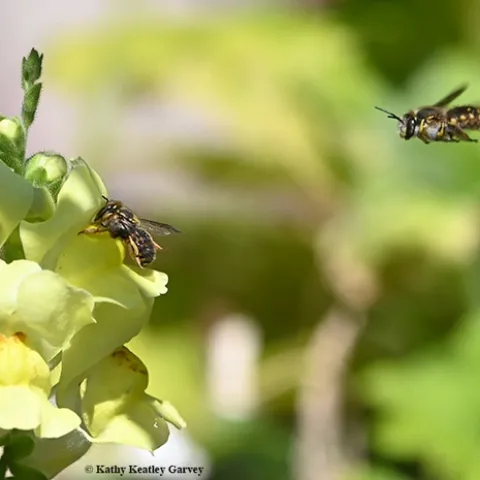
Love is in the air. Or, more specifically, in the snapdragons. If you maintain a pollinator garden, you've probably seen female European wool carder bees (Anthidium manicatum) nectaring on flowers or scraping or carding fuzz for their nests.
Let's hear it for biocontrol. You've seen lady beetles, aka ladybugs, preying on aphids. But have you seen an assassin bug attack a spotted cucumber beetle? No? How about a crab spider munching on a stink bug? All biocontrol, part of integrated pest management (IPM).
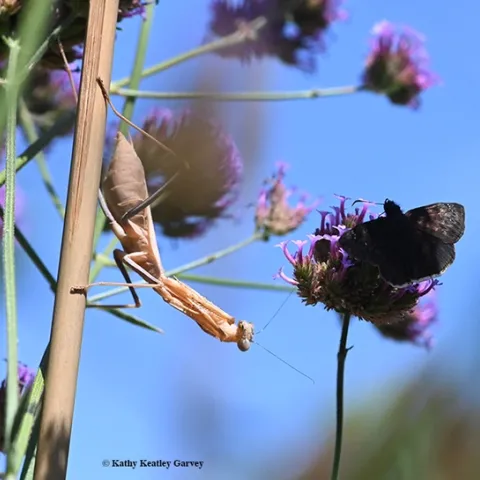
When we last left Ms. Mantis, a female Stagmomantis limbata residing in our verbena patch, she was munching on a honey bee. A successful ambush stalker, she was. But not always. Her plan to take down a duskywing butterfly, genus Erynnis, didn't go so well.