Bug Squad

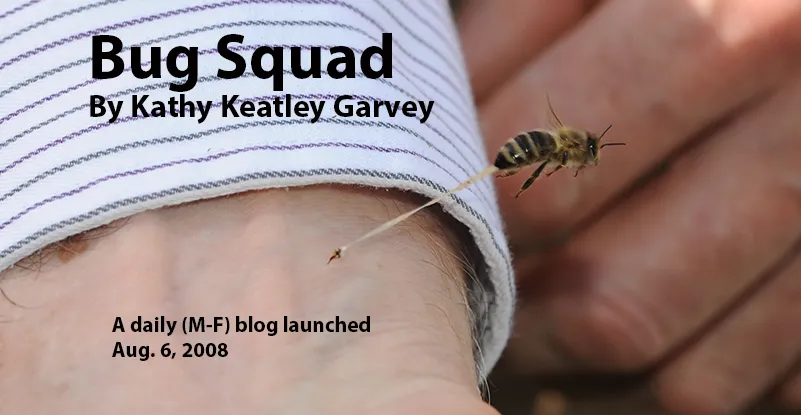
A daily (M-F) blog launched Aug. 6, 2008 and about the wonderful world of insects and those who study them. (Photo by Kathy Keatley Garvey)
Primary Image
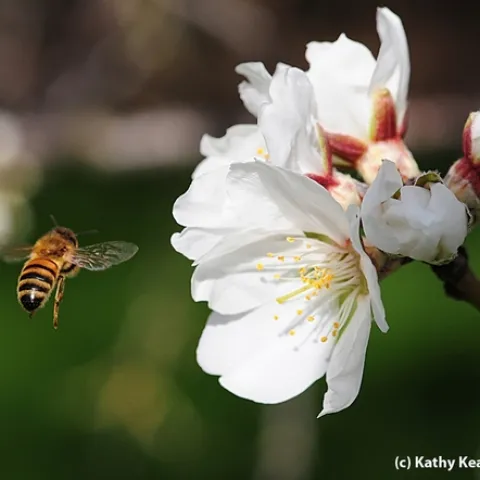
A honey bee heads for an almond blossom in Davis, Calif. (Photo by Kathy Keatley Garvey)

The Almond and the Bee

March 30, 2015
By Kathy Keatley Garvey
Remember Stephanie Hsia? She's the beekeeper/graduate student at Harvard's Graduate School of Design who traveled through almond orchards in California's Sacramento and San Joaquin valleys in May 2014 to illustrate and pen a book about the spatial relationship between honey bees and almonds.
View Article
Primary Image
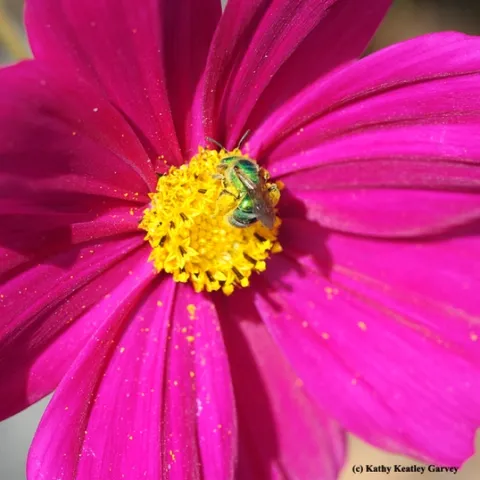
Long-distance view of a pink Cosmos with a "green" center. (Photo by Kathy Keatley Garvey)

How Green Is Your Cosmos?

March 26, 2015
By Kathy Keatley Garvey
The vibrant colors of Cosmos, an annual flower with the same common name as its genus, are spectacular. But we especially like the showstopping pink Cosmos with its bright yellow center. Well, sometimes, they have a green center--that's when an ultra green sweat bee is foraging.
View Article
Primary Image
James Carey teaching a UC Davis chemistry class “how to make one-minute videos on the properties of the elements in periodic tables.” The result: 540 one-minute videos, probably a world record. (Photo by Kathy Keatley Garvey)

It's Like Winning the Triple Crown

March 25, 2015
By Kathy Keatley Garvey
It's like winning the triple crown. The Pacific Branch of the Entomological Society of America (PBESA) has announced that two distinguished professors and a graduate student from the Department of Entomology and Nematology, University of California, Davis, have won major awards.
View Article
Primary Image
George Kennedy, the William Neal Reynolds Distinguished Professor of Agriculture at North Carolina State University, stopped to count thrips during a vacation to Mt. St. Helens. (Photo by Scott Kennedy)

Targeting Thrips

March 24, 2015
By Kathy Keatley Garvey
If you grow tomatoes, you ought to be concerned about thrips. They're pests of fruits, vegetable and horticultural crops, including tomatoes, grapes, strawberries and soybeans. They're barely visible to the naked eye, but oh, how disastrous they can be.
View Article