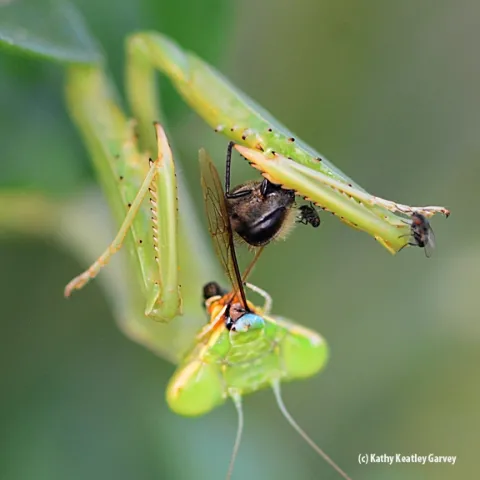
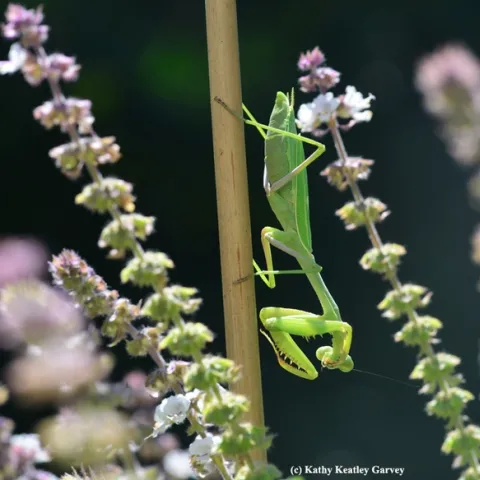
A freeloader. A moocher. A sponger. That's the freeloader fly. A praying mantis is polishing off the remains of a honey bee. Suddenly a black dot with wings edges closer and closer and grabs a bit of the prey. So tiny. So persistent. So relentless. That's the freeloader fly.
Last weekend a little critter made its first-ever appearance in our family bee garden. It was neither a grand entrance nor a grand insect. "A fly!" I thought, as I looked at its knoblike bristle or arista on the end of each antenna.
The bees. What about the bees? How are they doing? Better, says retired Extension apiculturist Eric Mussen of the UC Davis Department of Entomology and Nematology, who today published the last edition of his newsletter, from the UC Apiaries.
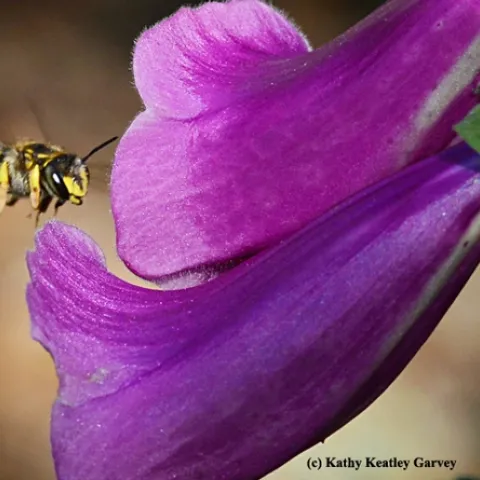
Foxgloves, meet the European wool carder bee. European wool carder bee, meet the foxgloves. It's like "old home week" when these two get together. The plant (Digitalis purpurea) and the bee (Anthidium manicatum) are both native to Europe.
We've trained puppies to "come," "sit" and "heel." We've trained an African grey parrot to say "Here, kitty, kitty, kitty! Meow!" We've trained the kitty to ignore the parrot. But how do you train a praying mantis? You don't.