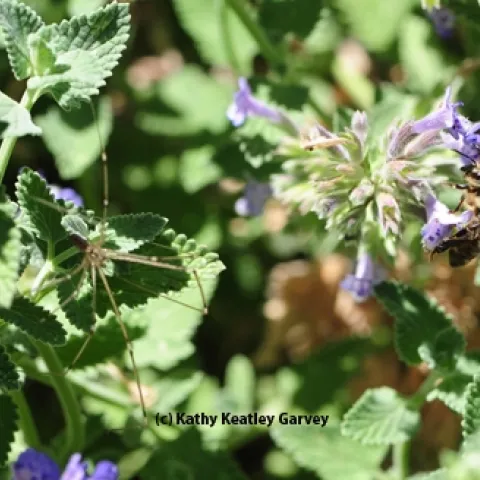
Just call it a missed opportunity. Catmint (genus Nepeta) draws scores of insects, from honey bees to leafcutter bees to European wool carder bees. It also draws spiders. We usually see a cellar spider (family Pholcidae) trapping prey in its web.
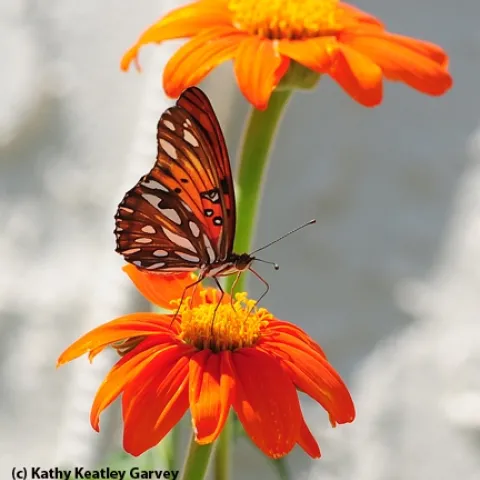
For months, I've been waiting ah, so patiently (well, not always s-o-o-o patiently) for the gulf fritillary butterfly to touch down on our Mexican sunflower, Tithonia. A perfect match, I figured.
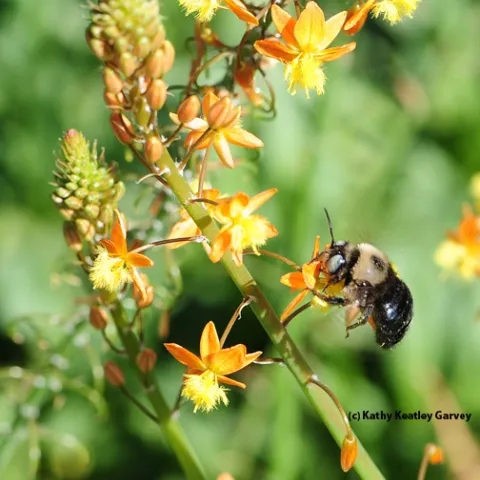
Look at the Xylocopa on the Xanthorrhoeaceae. If that sounds like a mouthful, think of the mountain or foothill carpenter bees, Xylocopa tabaniformis orpifex, on bulbine from the genus Bulbine in the family Xanthorrhoeaceae.
Take one nationally celebrated artist and one nationally renowned entomologist. Blend together. Add their deep concern for the declining honey bee population. Then just add bees. Ceramic bees.
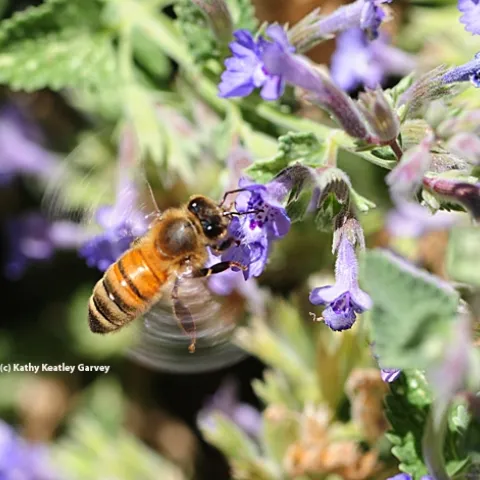
How fast can a honey bee fly? We captured these photos today of a honey bee nectaring on catmint (genus Nepeta). The bee was moving fast. To blur the wings, we set the shutter speed at 1/640 of a second with an f-stop of 13 and IS0 of 800.